

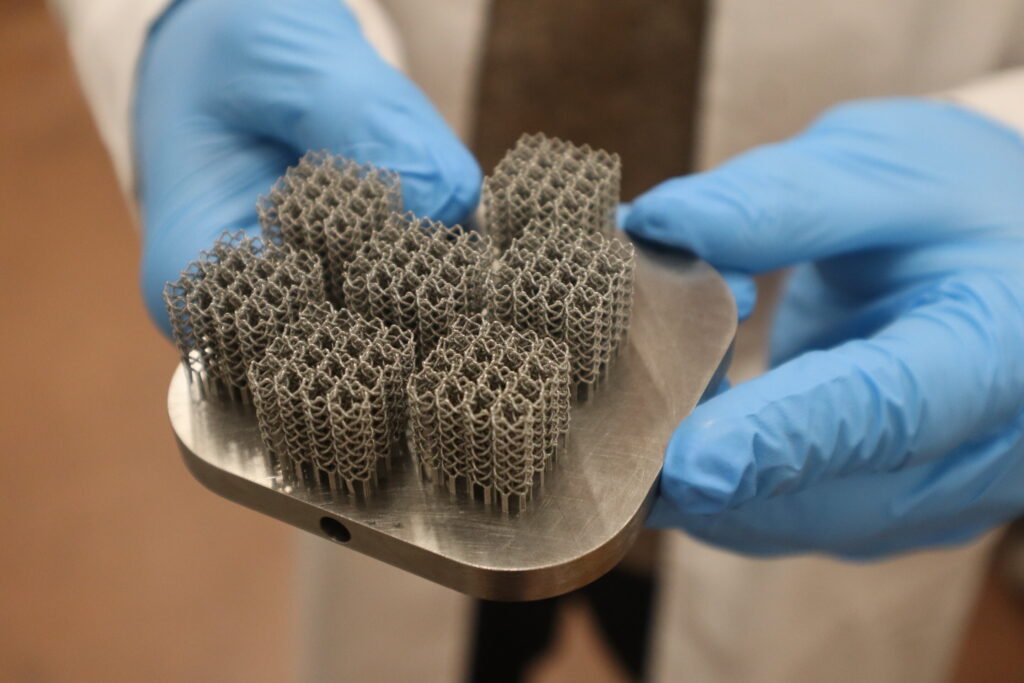
Engineers at the IMDEA Materials Institute and the Technical University of Madrid have developed a new class of woven nickel-titanium structures that unlock mechanical flexibility previously unseen in 3D-printed metal components, tells Tech Xplore. The team printed complex meshes, spheres, and ring shapes from nitinol, a nickel-titanium alloy known for superelasticity and shape-memory effects, and showed that this architected design approach significantly amplifies deformability compared with conventional additive manufacturing of the same alloy.
Nickel-titanium, often called nitinol, has long been valued for its ability to undergo large strains and then recover its original shape. That property makes it useful in medical devices and actuators. But standard 3D printing methods such as laser powder-bed fusion tend to produce parts with reduced elasticity and more brittleness than traditionally fabricated equivalents. In practice, this has limited the use of 3D printing for nitinol components that need high flexibility or shape-memory performance.
Instead of trying to change the alloy’s chemistry, the researchers focused on structural design. By weaving the material into fine, interlaced patterns reminiscent of textiles, they exploited geometry to give the printed parts exceptional mechanical behavior. According to the lead researchers, these woven architectures represent some of the most complex shapes ever achieved for nitinol via additive manufacturing, and they are self-supporting during the print process, a significant technical achievement.
The result is a set of superelastic metal structures that bend, stretch, and compress more readily than traditional printed forms. Such capabilities could benefit robotics, where compliant actuators are in demand, and aerospace or biomedical systems, where both strength and flexibility matter. Beyond nitinol, this design-centered strategy points to a broader trend of using engineered form to overcome material limitations in 3D printing, offering a new path for creating functional metallic metamaterials with tunable properties.
