

Researchers at Pohang University of Science and Technology (POSTECH) have developed a nickel-based high-entropy alloy that breaks the usual trade-off between strength and ductility, using only casting and heat treatment, says Tech Xplore. Traditionally, metals grow stronger at the expense of ductility, making them more brittle. In contrast, metals that stretch easily tend to be weaker. Achieving both traits in a single material has long been a significant challenge in materials science.
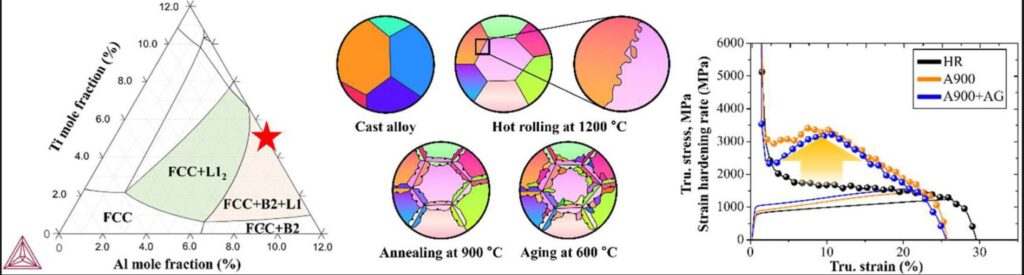
What sets this work apart is the generation of a “core-shell” grain structure using standard metallurgical processing. The researchers start with casting, then apply hot rolling and a controlled heat-treatment sequence. The core retains relatively large grains, while the shell is formed of finer grains. Nano-scale B₂ precipitates align at grain boundaries, stabilizing the fine shell structure and preventing grain growth. Under stress, the shell blocks dislocation motion (increasing strength), while the core absorbs deformation and reduces crack initiation (preserving ductility).
In tests, the alloy showed a yield strength of about 1,029 megapascals, ultimate tensile strength of 1,271 MPa, and an elongation exceeding 31%, remarkably high values given the simplicity of processing. The key insight is that you don’t need complex powder metallurgy or exotic fabrication techniques: careful control over heat flow and phase evolution is enough to engineer microstructures that deliver both toughness and resilience.
This advance opens a pathway for producing higher-performance structural metals at scale. Because the process relies on familiar casting and thermal steps, industrial adaptation may be more feasible than methods that require specialized equipment or materials. The work could shift how we approach alloy design for demanding applications.
