

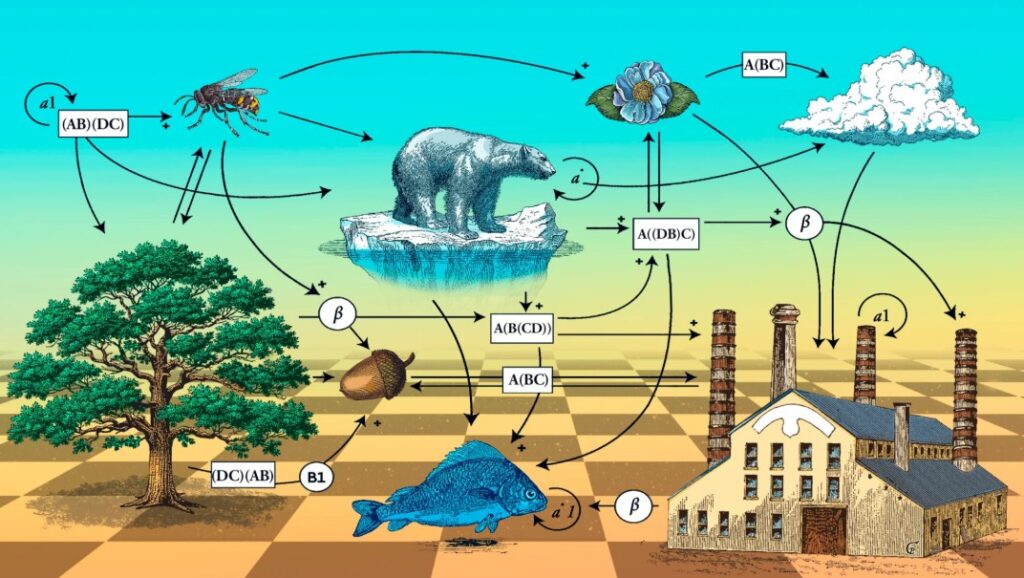
Mathematics is often divided into two categories: applied math, which directly addresses practical problems, and pure math, which explores abstract ideas without immediate real-world goals. Yet this distinction is increasingly blurred. Many concepts that once seemed completely theoretical are now proving useful in science, technology, and data analysis. A recent discussion in Quanta Magazine explores whether highly abstract mathematics might ultimately contribute to solving real-world challenges.
One area receiving growing attention is applied category theory, a branch of mathematics focused on relationships between structures rather than the structures themselves. Category theory originated in the mid-20th century as an extremely abstract field with little obvious connection to practical applications. For decades, it remained largely within theoretical mathematics. Today, however, researchers are discovering ways to apply its ideas to complex systems across many disciplines.
Category theory provides a framework for understanding how different systems interact and share underlying patterns. Because it focuses on connections rather than individual components, the approach can unify ideas from fields that previously seemed unrelated. Researchers have begun using it to analyze problems in computer science, network theory, and even environmental systems. By mapping relationships between processes, mathematicians hope to design better tools for studying climate models, energy networks, and biological systems.
Advocates of the field argue that this perspective could eventually help address large global challenges. Complex problems such as climate change, ecological resilience, or technological infrastructure involve many interconnected systems. Category theory offers a language for describing these interactions in a rigorous mathematical way, potentially revealing solutions that traditional models overlook.
Skeptics remain cautious, noting that translating abstract theory into practical tools is often slow and uncertain. Historically, however, mathematics has repeatedly demonstrated that ideas developed without practical intent can later become essential technologies. Number theory eventually enabled modern cryptography, and topology helped shape modern physics.
The emerging interest in category theory reflects this pattern. While its real-world impact remains uncertain, the history of mathematics suggests that even the most abstract ideas can eventually reshape our understanding of the world.
