

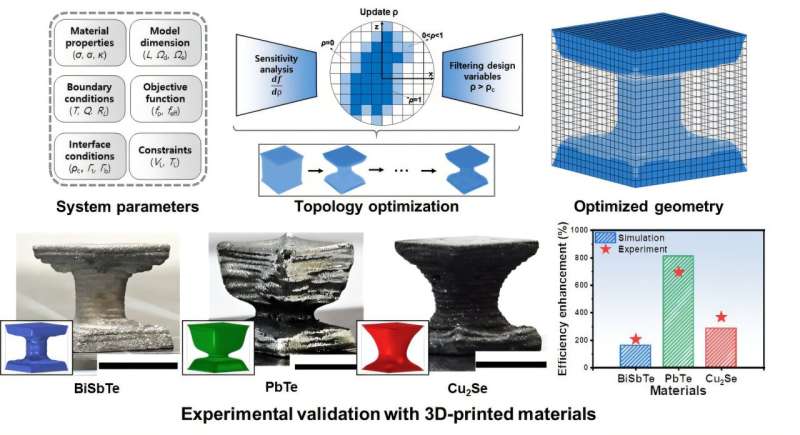
Thermoelectric generators (TEGs) have long promised a way to convert waste heat directly into electricity, but their limited efficiency and high cost have constrained widespread adoption. New research highlighted in this Tech Xplore article presents a computationally designed approach that significantly improves performance by refining how heat and electricity move through these systems.
At the core of the advance is a design strategy that tightly manages heat flow across the device. By increasing the temperature gradient between the hot and cold sides, the generator can produce more electrical output. At the same time, the design minimizes internal electrical resistance and reduces losses at material interfaces, both of which typically degrade efficiency. These combined improvements lead to a substantial boost in overall system performance.
Thermoelectric systems rely on the Seebeck effect, where a temperature difference across materials generates voltage. In practice, however, achieving high efficiency is difficult because heat and electrical transport are tightly coupled. Enhancing one often harms the other. The new work addresses this trade-off by optimizing geometry and material arrangement together rather than treating them separately.
The results point to more than an eightfold improvement in efficiency compared with earlier baseline designs, signaling a meaningful leap for a technology that traditionally operates in the low single-digit efficiency range. This is notable given that most existing thermoelectric devices typically achieve only about 5–8% efficiency under standard conditions.
Beyond performance gains, the approach also suggests a pathway toward more practical deployment. Improved efficiency directly enhances the viability of recovering energy from industrial waste heat, automotive exhaust, and even small-scale electronic systems. Since a large portion of global energy is lost as heat, more efficient TEGs could help reclaim part of that otherwise wasted resource.
The study underscores a broader shift toward computational and AI-assisted design in energy systems, where fine-grained control over physical processes can unlock performance levels that traditional trial-and-error methods struggle to achieve.
