

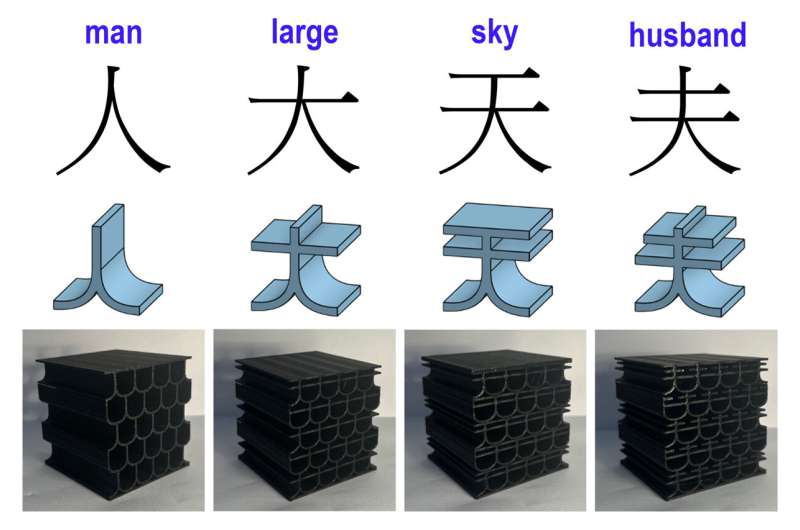
Researchers are finding unexpected inspiration for advanced material design in one of humanity’s oldest writing systems. By studying the geometry of Chinese characters, scientists have uncovered structural principles that could inform the creation of stronger, more resilient materials, tells Tech Xplore.
The study examines how different stroke patterns behave under mechanical stress, treating characters as miniature structural systems. Each stroke acts like a beam, and the arrangement of strokes determines how forces are distributed throughout the structure. When compressed, certain patterns demonstrate clear advantages in stability and load management.
Characters featuring horizontal strokes perform particularly well. These strokes act like crossbeams, redistributing stress across neighboring elements and delaying failure. This insight mirrors well-known engineering strategies, where cross-bracing improves structural integrity. In contrast, shapes with thin or diverging elements tend to deform earlier, revealing how curvature and geometry influence stiffness and flexibility.
The research highlights a broader principle: geometry alone can significantly affect material performance, even without changing the underlying material composition. By embedding these design patterns into metamaterials, engineers can create structures that are both lightweight and mechanically robust. This approach aligns with a growing trend in materials science, where structure, rather than substance, becomes the primary driver of performance.
Beyond technical implications, the work reflects a cross-disciplinary shift. Cultural artifacts such as writing systems and decorative patterns are increasingly being analyzed as sources of engineering insight. Similar approaches have drawn from origami and architectural motifs, but Chinese characters offer a uniquely rich set of geometries due to their combination of symmetry, repetition, and variation.
The findings suggest that future materials may be designed less like solid blocks and more like carefully arranged frameworks, where each element contributes to overall strength. By translating ancient visual logic into modern engineering, researchers are opening new pathways for innovation.
This fusion of culture and science underscores a key idea: solutions to modern engineering challenges may already exist in unexpected places, waiting to be reinterpreted through a technical lens.
