

Bell Labs, the research powerhouse once backed by AT&T’s monopoly, marked its centennial after a century of defining modern technology. The New York Times tells that beginning in the 1940s, the lab generated breakthroughs that underpin daily life, from the transistor and information theory to foundational software tools. As historian Jon Gertner has noted, nearly every hour of modern life carries traces of Bell Labs’ work.
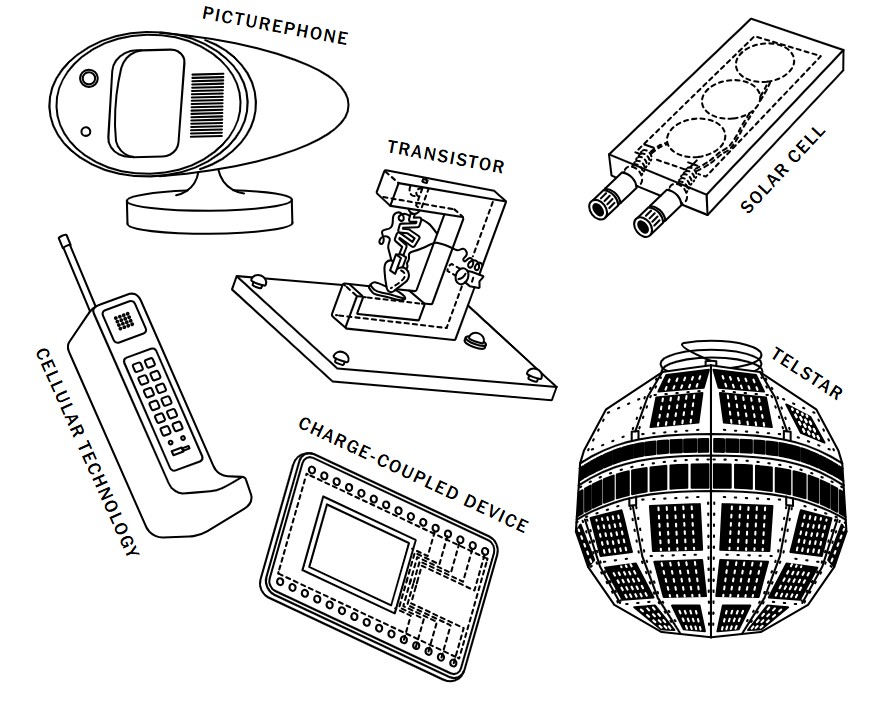
Its most profound intellectual contribution was Claude Shannon’s information theory, a mathematical framework for transmitting data accurately and efficiently. Often described as the foundation of the information age, it guides computing, telecommunications, and today’s artificial intelligence systems. The transistor, invented in 1947, became the essential building block of digital electronics. Licensed widely, it fueled the rise of the semiconductor industry and enabled ever smaller, faster chips. Modern processors, including AI accelerators containing hundreds of billions of transistors, descend directly from that invention.
Bell Labs also reshaped global communication. In 1962, Telstar became the first active communications satellite, amplifying signals to enable real-time transoceanic calls and television broadcasts. Earlier experiments such as Echo, a passive balloon satellite, paved the way. Today, thousands of satellites support internet access, navigation, surveillance, and autonomous systems.
The lab advanced mobile communications, proposing a cellular network in 1971 and laying the groundwork for the commercial systems that followed. Early video calling appeared in the 1964 Picturephone, a commercial failure but a technological precursor to modern smartphones and video conferencing. Digital imaging emerged from the invention of the charge-coupled device in 1969, which converted light into electronic signals and earned a Nobel Prize.
Even early solar cells, though initially expensive, foreshadowed the later boom in renewable energy. Across communications, computing, imaging, and energy, Bell Labs demonstrated the power of sustained research investment, leaving a legacy woven into contemporary technology and culture.
