

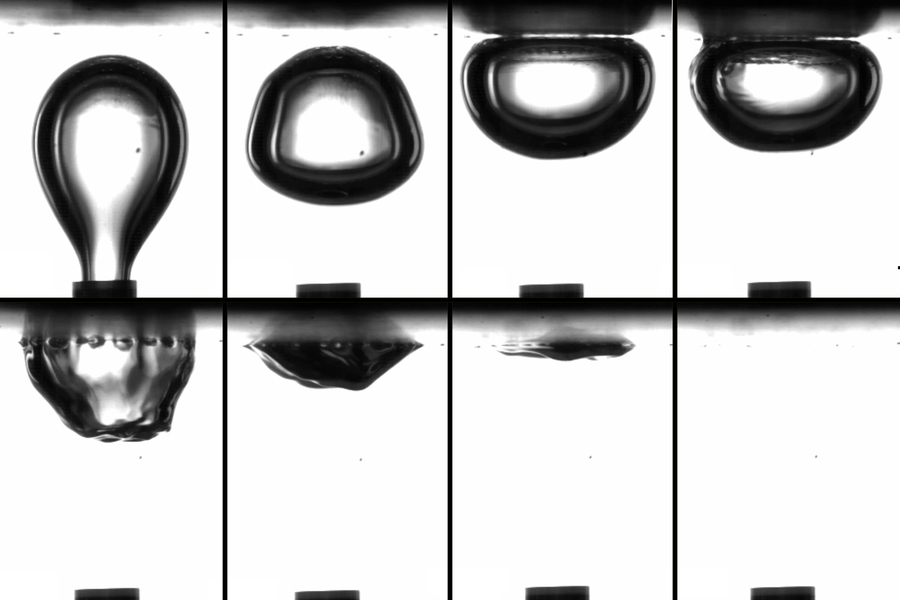
Tiny bubbles cause big headaches across industrial systems, from clogging filters to slowing chemical reactions, disrupting bioreactors, and even threatening cooling in electronics and nuclear plants. Researchers led by Kripa Varanasi at the Massachusetts Institute of Technology have taken a big step toward solving that problem by uncovering the physics behind “aerophilic” debubbling membranes and showing how to design them for optimal performance, tells MIT News.
Bubbles are a persistent bottleneck in high-throughput processes such as biomanufacturing, where foaming can’t be controlled with traditional defoamers because they may harm cells, or with mechanical shearing because it can damage delicate materials. The solution from the MIT group starts with membranes engineered at the microscale, that is, porous silicon sheets coated with water-repelling nanoparticles, that attract gas and let it escape rapidly from liquid surfaces. By adjusting pore size and material properties, the team demonstrated bubble removal that was 1,000 times faster in a bioreactor test.
Their work also identifies three distinct physical limits that govern how fast bubbles can be evacuated: gas viscosity through tiny pores, liquid resistance when pores are large, and inertial resistance from the surrounding fluid. By scaling bubble size, gas type, and liquid viscosity in high-speed imaging experiments, the researchers distilled these limits into a practical design map that engineers can use to select or design membranes for specific industrial scenarios.
The potential applications extend far beyond bioreactors. Industries from food and beverage to cosmetics and chemicals all grapple with unwanted bubbles, and the new membranes could be retrofitted into existing systems to improve throughput and quality. The researchers also see possibilities in environmental and energy applications, such as separating oil from water and enhancing gas extraction.
This work offers both a practical tool for industry and deeper insight into bubble dynamics, providing a physics-based framework for what has long been a costly engineering nuisance.
