

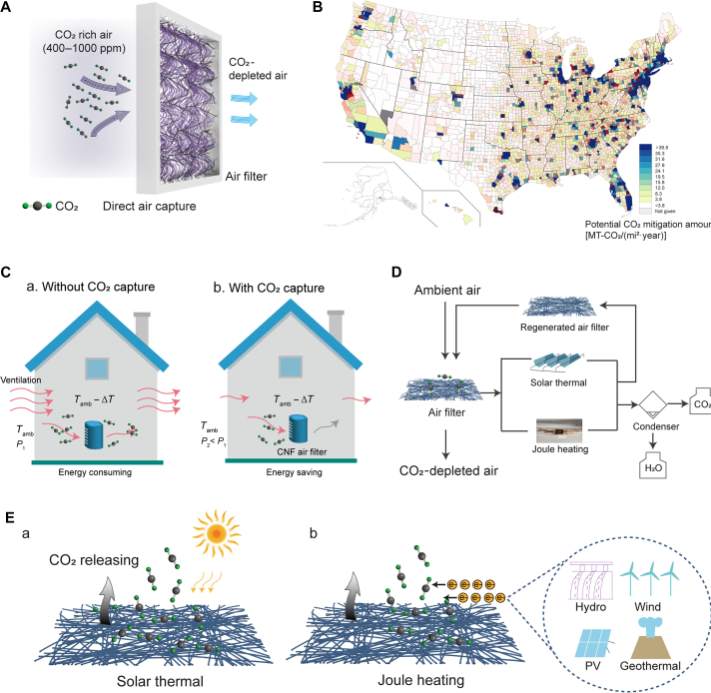
A team of scientists reports a filter made of carbon nanofibers coated with a polyethyleneimine polymer, capable of capturing CO₂ even at low concentrations. Instead of relying on large, dedicated direct-air-capture (DAC) plants, this technology is designed for retrofit into buildings’ ventilation systems, enabling widespread deployment of distributed capture, tells Tech Xplore.
In testing, the filter showed high selectivity (CO₂ molecules are adsorbed while other air constituents pass through) and rapid capture in a flow-system setup. Regeneration is achieved by either low-grade solar heating or by passing a low-voltage electric current through the conductive nanofibers. That frees the captured CO₂, which can then be collected for storage or reuse.
A life-cycle assessment found that the system achieved a net CO₂ removal efficiency of 92.1%. Economic modeling estimates capture costs between roughly US$209 and US$668 per ton of CO₂, which compares favorably to many centralized DAC technologies.
If deployed at scale, the researchers estimate that the filter technology could remove up to ~596 million tons of CO₂ per year globally, about 2% of annual global emissions, by taking advantage of the billions of existing building ventilation systems.
For engineers and sustainability professionals, this research signals a shift: instead of building massive standalone facilities, we may leverage existing building infrastructure to contribute to carbon removal. The technology still faces challenges, such as scaling, durability, integration with HVAC systems, and business models, but it opens fresh pathways for building-based decarbonization.
