

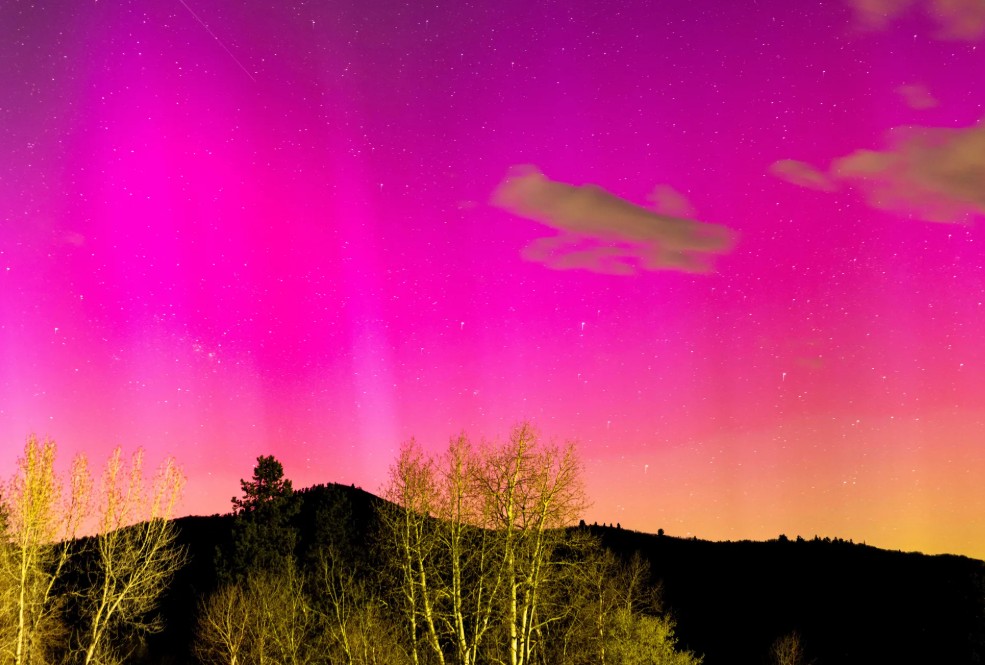
This article from Wired.com tells that the northern lights are brought to life through the interaction of solar winds and Earth’s magnetic shield. The Sun, powered by fusion at its core, constantly ejects charged particles, mainly electrons and protons, into space. When these particles reach Earth, they stream in at speeds of up to 1.5 million mph.
The timing of the spectacle aligns with the Sun’s approximately 11-year magnetic cycle. As the Sun’s magnetic field twists and reverses, solar storms and coronal mass ejections become more frequent and intense; such a burst in May 2024 triggered one of the strongest auroras seen in centuries.
Once the charged particles reach Earth, the planet’s magnetic field channels them toward the poles, where they spiral along magnetic-field lines and enter the upper atmosphere. There they collide with atoms such as oxygen and nitrogen, exciting those atoms until they release photons, producing the vivid greens, reds, blues, and purples of the aurora.
But the aurora is not just beautiful; it signals potent space weather. That solar wind onslaught can disrupt satellites, power grids, and communications systems. The same currents and magnetic shifts behind the dancing lights can induce harmful currents in ground electronics.
The aurora is a visible marker of complex plasma physics and geomagnetic coupling. It also reminds us that events occurring tens of millions of miles away can have real, tangible effects here on Earth.
In essence, the northern lights show is an elegant dance of cosmic energy, magnetic choreography, and atomic emission, a natural phenomenon linking astronomy, physics, and atmosphere in one breathtaking display.
