

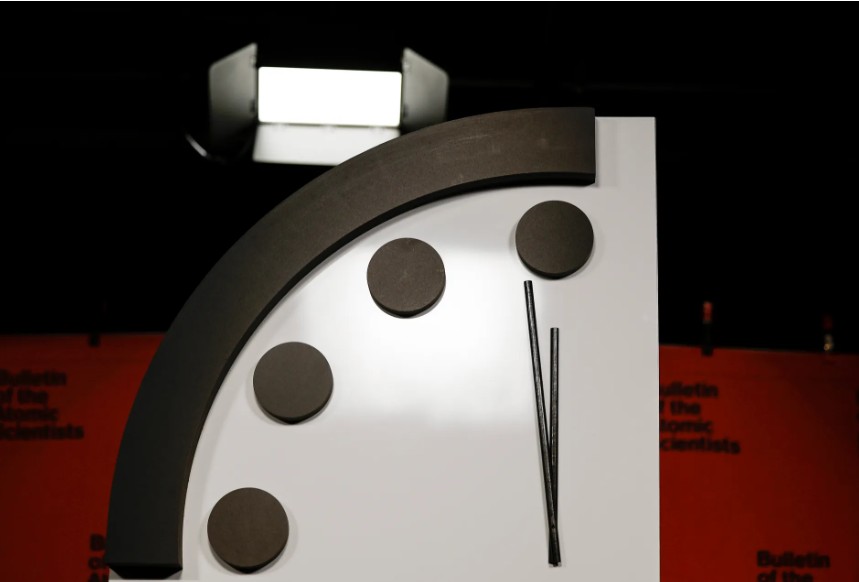
The Bulletin of the Atomic Scientists sets a symbolic time to show how close humanity is to global catastrophe. In the 2026 Doomsday Clock statement, the Science and Security Board moves the Clock to 85 seconds to midnight—its closest ever setting—because world leaders failed to slow down growing existential threats.
The statement says geopolitical tensions have worsened over the past year. Russia, China, the United States, and others have grown “increasingly aggressive, adversarial, and nationalistic.” International cooperation needed to reduce risks has weakened, leading to a more dangerous global environment.
Nuclear danger remains central. The document cites ongoing wars involving nuclear-armed states, rising arsenals in China and elsewhere, eroding arms control norms, and the looming expiration of New START, the last major treaty limiting U.S.–Russia nuclear weapons. These trends, it argues, increase the likelihood of miscalculation and undermine disarmament.
Climate change stands out as another core threat. Atmospheric carbon dioxide reached record levels, global average temperatures hit new highs, and extreme weather events caused widespread harm. Efforts at recent United Nations climate summits fell far short of what is needed, and some national policies rolled back renewable energy progress.
The statement also highlights emerging technological risks. Advances in the life sciences, including the synthesis of novel biological agents, have created possible pathways to catastrophic biological events. In addition, the rapid growth of artificial intelligence, especially its use in military systems and its ability to accelerate misinformation, adds new layers of danger.
To reverse these trends, the statement calls for renewed nuclear dialogue, multilateral agreements on biological and AI risks, stronger climate action, and better public engagement. It stresses that although the Clock’s setting signals urgent risk, coordinated political and scientific action could still move the hands backward.
