

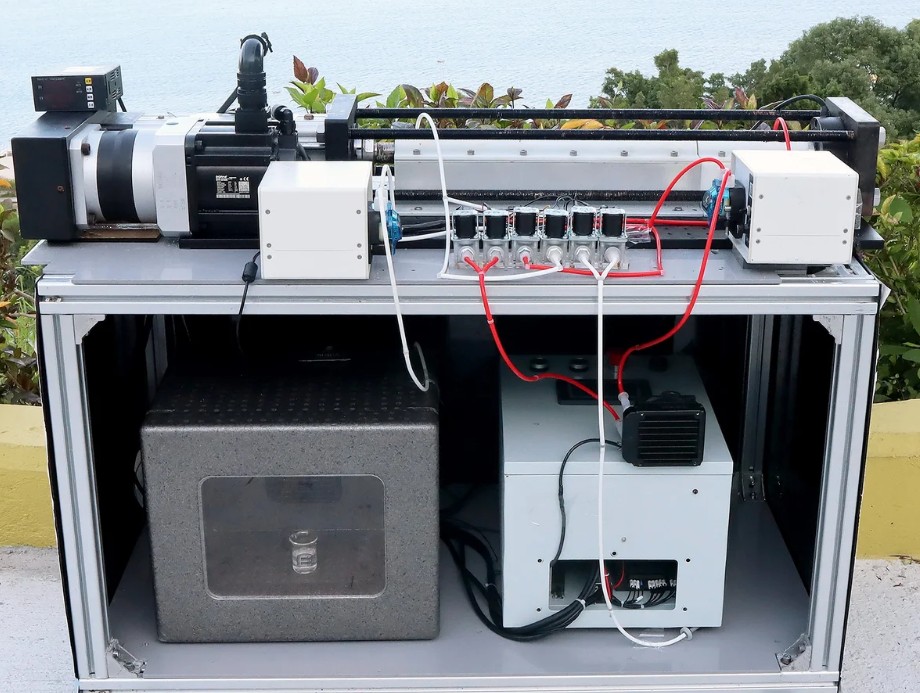
Researchers at the Hong Kong University of Science and Technology have demonstrated a prototype freezer that uses elastocaloric cooling to reach sub-zero temperatures without relying on conventional refrigerants, a milestone in solid-state refrigeration, tells IEEE Spectrum. Traditional refrigerators and freezers depend on vapor-compression systems and chemical refrigerants that can leak and contribute to greenhouse gas emissions; elastocaloric systems avoid those by exploiting temperature changes when certain metals are mechanically stressed and relaxed.
The new device, roughly desk-sized, achieved a cold-source temperature of about –12°C while the heat sink remained near 24°C, producing a 36°C temperature lift from room temperature. In laboratory tests, the prototype froze 20 milliliters of water into ice within two hours, a performance comparable with a small domestic freezer.
The core of this system is a regenerator made from nickel-titanium (Ni-Ti) shape-memory alloy. When compressed by a linear actuator, the alloy heats up; when the pressure is released, it cools. A circulating salt solution carries heat away during the hot phase and draws heat out of the freezer chamber during the cold phase. Each cooling cycle lasts about one second, and repeated cycles build up a significant cooling effect.
Despite the breakthrough, the team acknowledges that the system is not yet ready to compete with established refrigeration technology. Its energy efficiency trails conventional methods, largely because the actuator that compresses the alloy consumes significant power. Manufacturing the intricate Ni-Ti tubes is also expensive, prompting researchers to explore alternatives such as additive manufacturing to cut costs and material waste.
The researchers aim to improve performance further, including achieving much lower temperatures (down toward –100°C) and developing more efficient actuation mechanisms. Potential applications they foresee range from mobile frozen-food transport to thermal management in electric vehicles, areas where greener cooling could have a real environmental impact.
