

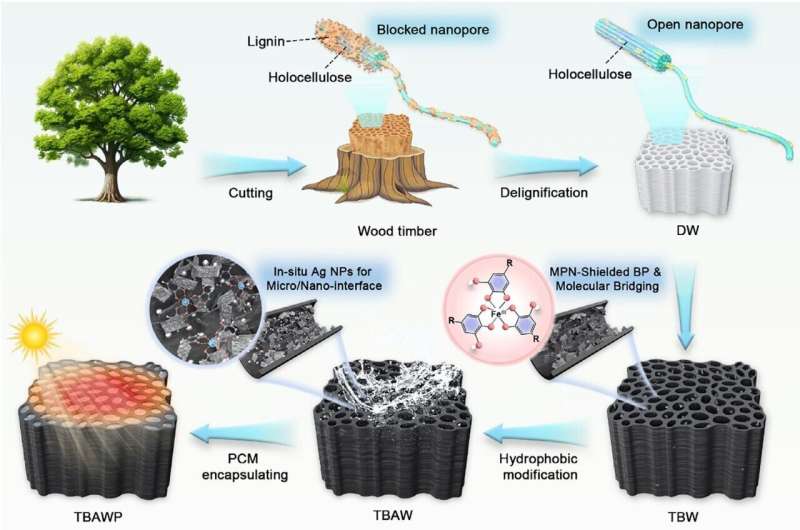
A team of researchers has developed a novel solar-energy material by transforming ordinary wood into a multifunctional system capable of capturing, storing, and converting solar energy even after the sun sets. The work addresses a key limitation of traditional solar technologies, which generate electricity only when sunlight is available, tells Tech Xplore.
The approach begins with balsa wood, chosen for its naturally aligned internal channels. Scientists removed lignin, the substance that gives wood its rigidity, leaving behind a highly porous structure. This network of microscopic channels was then engineered to absorb sunlight efficiently and store thermal energy for later use.
To enhance performance, the researchers coated the inner surfaces of the wood with ultrathin layers of black phosphorene, a material that captures a broad spectrum of light and converts it into heat. Because phosphorene is prone to degradation, it was stabilized with protective coatings made from tannic acid and iron ions. Silver nanoparticles were added to further improve light absorption, while a water-repellent layer ensures durability in outdoor conditions.
The modified wood was then infused with stearic acid, a phase-change material that melts when heated and solidifies as it cools. This allows the system to store thermal energy during the day and release it gradually at night. When paired with a thermoelectric generator, the material can convert that stored heat into electricity, extending power generation beyond daylight hours.
Performance tests showed that the system can convert over 91% of incoming sunlight into usable heat and store up to 175 kilojoules of energy per kilogram. It also demonstrated resilience, with improved resistance to fire, moisture, and microbial growth, making it suitable for real-world environments.
The research highlights a promising direction for sustainable energy systems. By combining natural materials with nanoscale engineering, the study offers a potential pathway toward low-cost, environmentally friendly energy storage and generation. While challenges remain in scaling the technology, the concept suggests that future solar systems may rely less on conventional batteries and more on integrated, material-based solutions that store and release energy as needed.
