

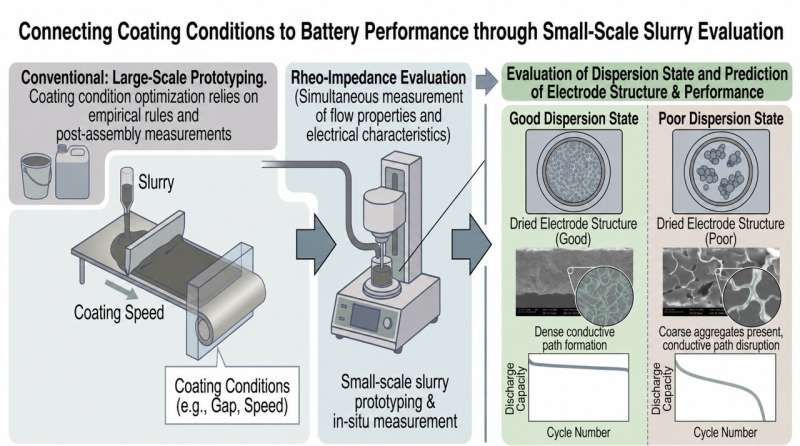
A new study highlighted by Tech Xplore explores a manufacturing challenge that quietly shapes the performance of nearly every lithium-ion battery: electrode slurry processing. Researchers from Tokyo University of Science have developed a method to observe how battery slurries behave during production, potentially giving manufacturers a faster and more precise way to improve battery quality before cells are assembled.
Battery electrodes are made from slurries containing active materials, conductive additives, binders, and solvents. During industrial coating, these mixtures experience mechanical stress that alters their internal conductive structure. Small changes in this process can significantly affect energy storage, charging performance, and long-term durability. Yet manufacturers have traditionally relied on repeated trial-and-error testing because slurry behavior is difficult to evaluate in real time.
The research team addressed this problem using rheo-impedance spectroscopy, a technique that combines controlled mechanical deformation with electrochemical impedance spectroscopy. The system allows scientists to monitor how conductive networks form and break apart while the slurry is being processed under conditions similar to industrial coating. The researchers applied the method to lithium iron phosphate cathode slurries, a chemistry widely used in electric vehicles and energy storage systems.
Their experiments revealed a strong relationship between processing conditions and battery performance. At lower shear rates, conductive additives remained clumped together, creating poor electrical pathways. At extremely high shear rates, the conductive network fragmented excessively, also reducing efficiency. Between those extremes, however, the slurry developed a more balanced conductive structure associated with stronger battery performance.
The significance of the work lies not only in battery chemistry but also in manufacturing optimization. By identifying ideal coating conditions earlier in development, manufacturers could reduce waste, shorten testing cycles, and improve production consistency. The technique also relies on equipment already familiar to many laboratories, potentially easing adoption across the battery industry.
The study reflects a broader shift in battery engineering toward process-aware design. As electric vehicles and grid storage systems scale globally, attention is increasingly moving beyond discovering new materials and toward refining the manufacturing steps that determine whether promising battery technologies can perform reliably at an industrial scale.
