

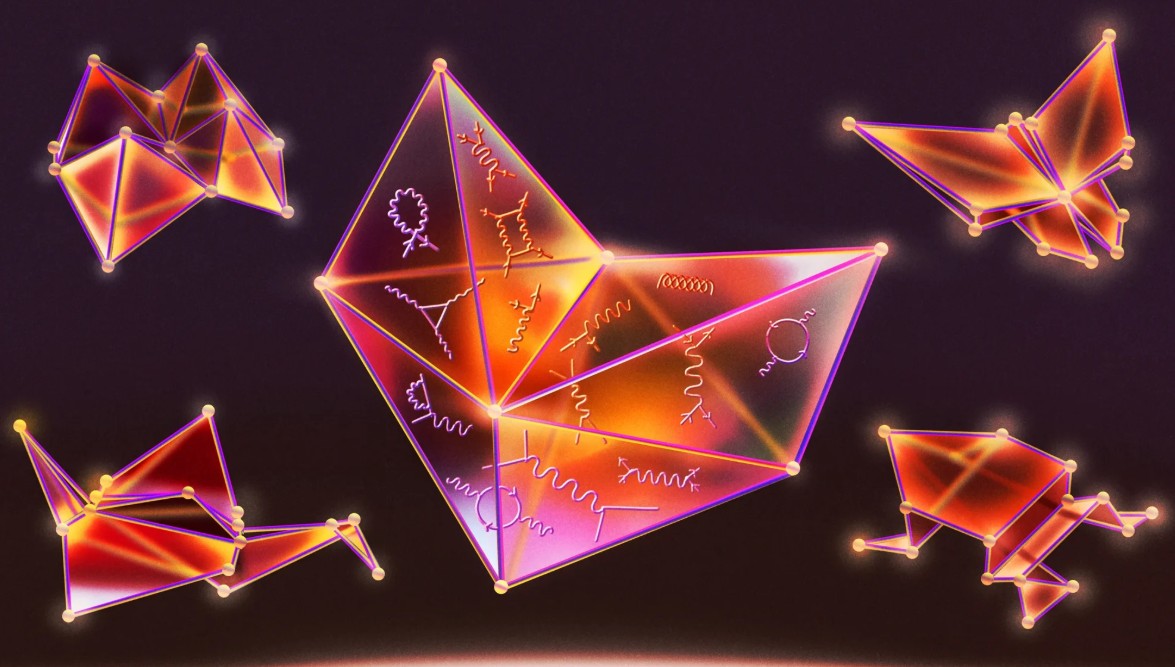
Quanta Magazine reports a striking discovery by mathematician Pavel Galashin: patterns from origami folding can be translated into points that lie in the amplituhedron, the geometric object central to particle physics. The amplituhedron encodes scattering amplitudes, probabilities for how particles interact, and physicists have long hypothesized it could be subdivided (triangulated) into simpler building blocks, though proof remained elusive.
Galashin’s insight emerged from linking an origami boundary-to-crease-pattern conjecture with the momentum version of the amplituhedron. He showed that any allowed boundary (a folded edge configuration) corresponds to a unique crease pattern, which in turn yields a plabic graph. That graph defines a specific region in the amplituhedron, placing the encoded point inside it. This construction implies there can be no overlaps or gaps in how these regions cover the amplituhedron, thus proving the triangulation conjecture for the momentum amplituhedron.
This result closes a gap in the connection between the amplituhedron’s geometry and scattering amplitude formulas derived from Britto-Cachazo-Feng-Witten (BCFW) recursion and positive Grassmannian theory. Beyond resolving a technical conjecture, it unites seemingly unrelated realms, such as paper folding and quantum interactions, and hints at deeper, unexplored correspondences in mathematics and physics. Mathematicians now hope this origami perspective will lead to more efficient amplitude computations, a clearer geometric understanding of particle collisions, and further cross-disciplinary breakthroughs.
