

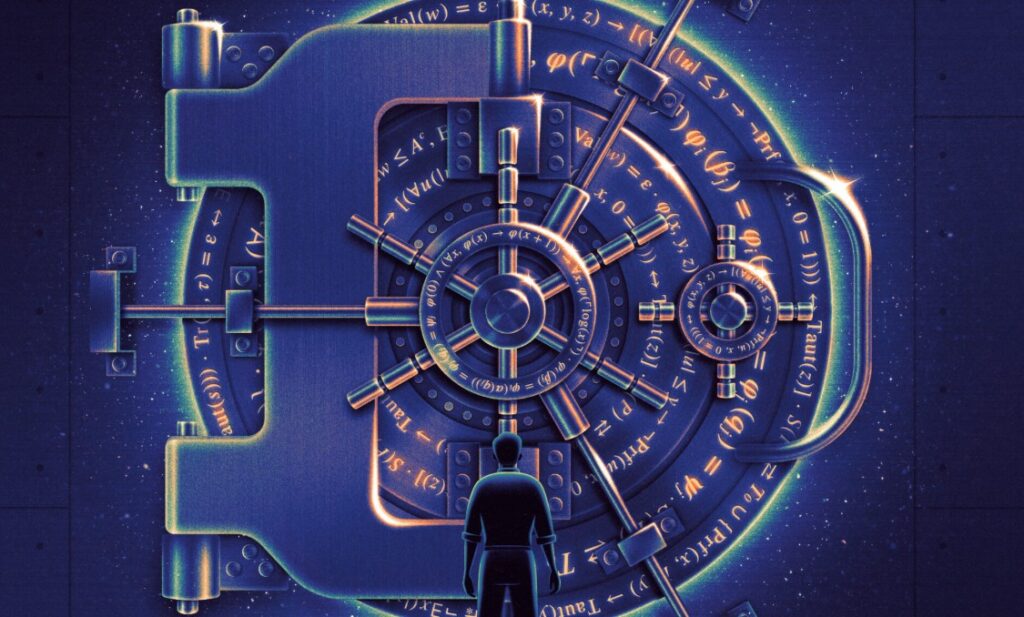
A recent breakthrough in cryptography is drawing together two ideas that once seemed unrelated: the unknowable limits of mathematics and the practical need to protect secrets online. In Quanta Magazine, writer Ben Brubaker explores how computer scientist Rahul Ilango developed a new type of zero-knowledge proof that relies on the fundamental boundaries of mathematical reasoning itself.
The story begins with the incompleteness theorems of Kurt Gödel, published in 1931. Gödel demonstrated that within any sufficiently powerful mathematical system, some truths can never be proven, and consistency itself cannot be fully guaranteed from inside the system. These ideas transformed modern logic by exposing permanent limits to mathematical certainty.
Decades later, cryptographers developed zero-knowledge proofs, a method that allows one party to prove a statement is true without revealing the underlying secret. These proofs became an important tool in modern cryptography because they enable secure authentication while preserving privacy. Traditionally, zero-knowledge systems depended on assumptions about computational difficulty, such as the impracticality of solving certain mathematical problems quickly.
Ilango’s contribution introduces a striking shift. Instead of relying only on computational hardness, his approach draws security from the inherent limitations of formal mathematical proof itself. By linking Gödel-style unknowability with cryptographic secrecy, he created a new framework for zero-knowledge proofs that bypasses constraints researchers once believed unavoidable. The work has surprised many specialists in computational complexity and cryptography, including researchers who initially doubted the connection could exist.
The breakthrough also signals a broader trend in mathematics and computer science. Researchers are increasingly exploring metamathematics, logic, and proof theory as practical tools for computing and security rather than purely philosophical subjects. What once appeared to be abstract questions about the limits of knowledge are now influencing the design of future cryptographic systems.
