

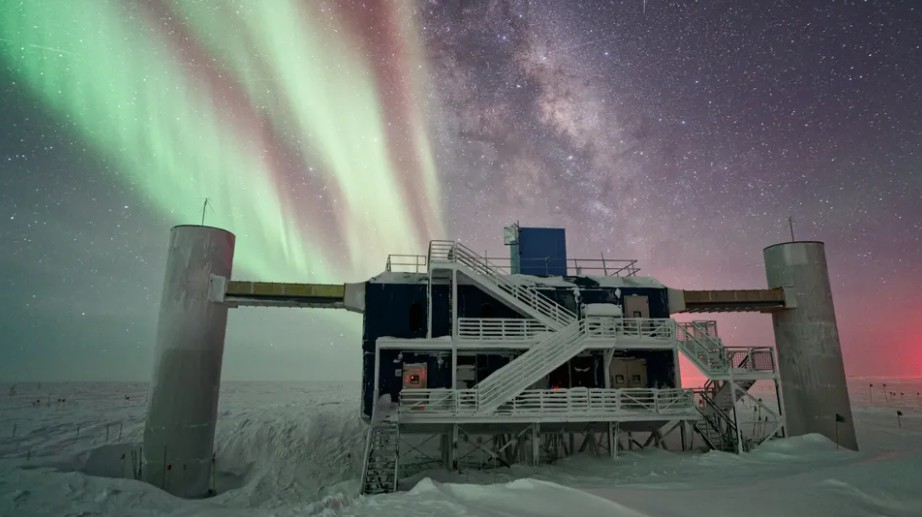
The IceCube Neutrino Observatory at the geographic South Pole recently received a substantial enhancement that expands its capacity to study elusive subatomic particles known as neutrinos, tells Live Science. The National Science Foundation, along with the IceCube collaboration, has installed more than 600 new optical sensors on six additional detector strings beneath the Antarctic ice, bringing the total to 92 strings embedded in a cubic kilometer of ice. These upgrades mark the first expansion of the facility in its 15-year history and represent a step forward in neutrino research.
Neutrinos, sometimes called “ghost particles,” are nearly massless and carry no electric charge. They stream through matter with minimal interaction, making them difficult to detect, yet they are fundamental to understanding astrophysical events such as supernovae and processes in the early universe. IceCube detects the tiny flashes of light produced when neutrinos occasionally interact with atoms in the ice; the new sensors improve the chances of capturing such rare events.
The upgraded array will enhance the observatory’s sensitivity to neutrino oscillations, that is, changes in neutrino types that occur as they travel, and to cosmic rays. With better calibration and measurement precision, scientists can refine data collected over the past decade and open new avenues for analyzing cosmic phenomena.
IceCube has already delivered several breakthroughs, including tracing a high-energy neutrino back to a distant blazar and contributing to the first map of our galaxy using neutrinos instead of light. Future research with the expanded detector could yield new insights into neutrino properties, astrophysical sources of high-energy particles, and potentially physics beyond the Standard Model. As a key instrument in neutrino astronomy, IceCube’s upgraded capabilities promise to deepen our understanding of the universe’s most mysterious particles.
