

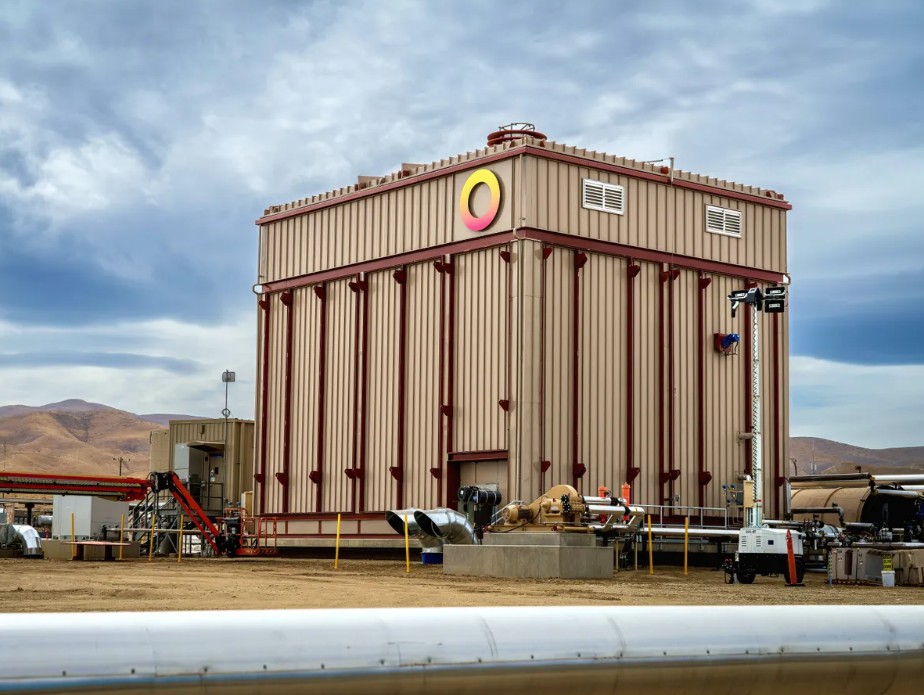
Startup Rondo Energy has deployed what it calls the world’s largest thermal battery: a 100-megawatt-hour system that stores clean electricity as high-temperature heat and supplies it to industrial processes. Unlike batteries that output electricity, this system targets sectors such as concrete, steel, and oil-field heating, where high-grade heat rather than electrons is the core need, tells IEEE Spectrum.
The system works by passing renewable electricity through resistance heaters that warm stacks of refractory bricks to roughly 1,500°C. During discharge, ambient air is driven through the hot brick mass, heats up to over 1,000°C, and exits as hot air or steam, ready for industrial use. The company calls it like a toaster crossing a blast furnace.
Crucial to the design is the ability to charge rapidly and discharge continuously at a uniform temperature. The 3D checkerboard layout of bricks and voids ensures even heat distribution across the mass and avoids large thermal gradients that could damage materials.
Rondo’s first commercial project is paired with an enhanced oil-recovery site in Kern County, California: instead of a natural-gas boiler, steam is generated from the thermal battery, cutting about 13,000 tons of CO₂ emissions annually for that facility. While using the battery in oil-field heating raises eyebrows for some, the engineering principle remains: convert spare renewable electricity into a storable and dispatchable heat source.
This represents a shift in thinking: it treats thermal demand like electricity demand. Instead of oversizing boilers or relying on fossil-fuel heating, the path opens for flexible, dispatchable heat-storage systems built around high-temperature thermal batteries. The implications touch materials engineering, heat-exchange design, control systems, lifecycle cost modeling, and grid integration.
