

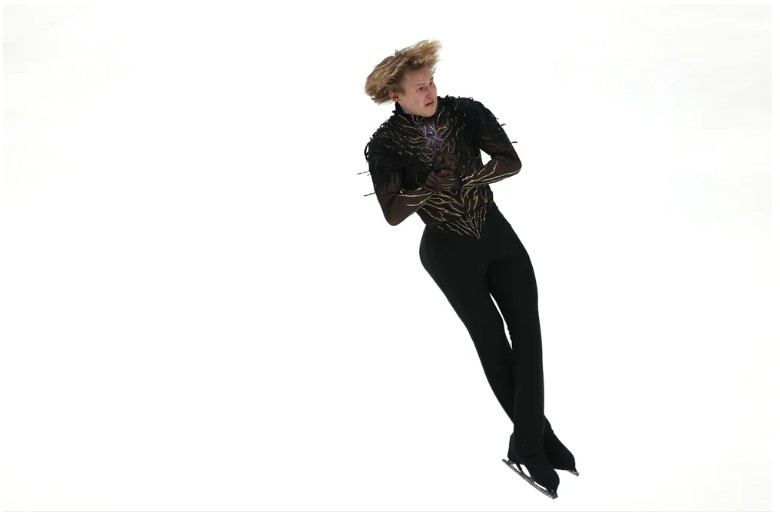
Ilia Malinin, the American figure skater nicknamed the “Quad God,” has redefined what elite skating can look like by landing a move that was once considered almost impossible: the quadruple axel. That jump, 4.5 rotations in midair, had long been skating’s white whale, a technical challenge that resisted mastery throughout the 2010s. Malinin first landed it in international competition in 2022 and has since made it a signature part of his repertoire, one his peers and coaches describe as nearly faultless in execution, tells Scientific American.
Scientific American’s deep dive into Malinin’s accomplishments shows that his success isn’t just astonishing athleticism but also a convergence of biomechanics, training methods, and evolving judging incentives. For decades, skating rewarded increasingly difficult jumps because technical scoring under modern systems has no cap, prompting athletes to push beyond triples into quads. Malinin stands at the forefront of that trend, pushing the sport into realms once thought unreachable.
The science behind these feats lies in maximizing rotational speed and airtime. Skaters generate angular momentum before takeoff, then reduce their body’s moment of inertia by tucking tightly into the spin, allowing more revolutions before landing. With a forward takeoff unique to the axel jump, the quadruple axel adds an extra half rotation compared with other quads, making it substantially more demanding.
Malinin’s mastery came from incremental progress building on earlier generations’ expansions of jump difficulty and an intense focus on technique, strength, and on-ice training. Coaches and biomechanical experts note that Malinin’s rotations and form make even the quad axel seem routine, a testament to both his physical gifts and the evolving science of athletic preparation.
As figure skating eyes even more audacious feats, including quintuple rotations, Malinin’s performances are reshaping perceptions of what is physically and technically possible. His influence extends beyond records: he has changed the sport’s narrative about gravity, rotation, and the boundaries of athletic performance.
