

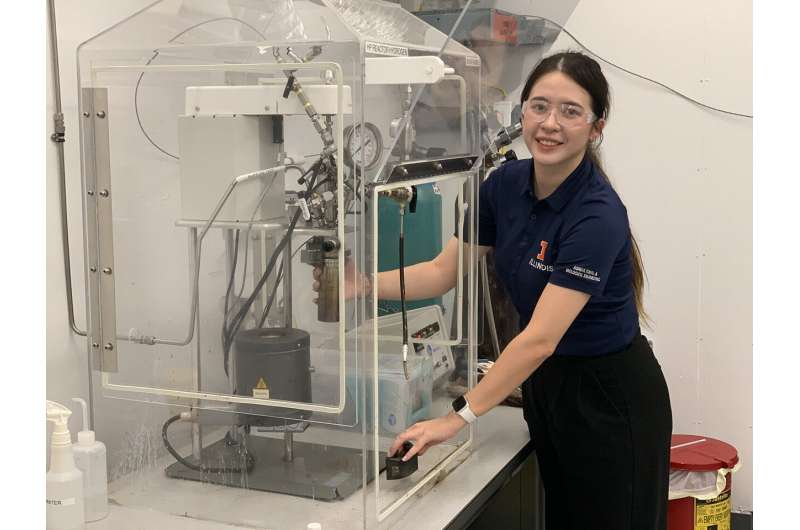
A team from the University of Illinois Urbana-Champaign has developed a pathway to transform food-processing waste into drop-in sustainable aviation fuel (SAF), reports Tech Xplore. The process begins with hydrothermal liquefaction (HTL) of waste feedstock, such as by-products from a nearby food-processing facility, turning organic waste into a biocrude oil. This biocrude then undergoes catalytic hydrotreating using a cobalt-molybdenum catalyst to strip out unwanted elements such as nitrogen, sulfur, and oxygen. The result: a hydrocarbon blend that passes Tier Alpha and Beta pre-screening by the American Society for Testing and Materials (ASTM) and meets specifications for conventional jet fuel.
The researchers emphasize that food waste is just one viable feedstock; the HTL platform can process a wide range of biowaste, including sewage sludge, algal blooms, swine manure, and agricultural residue. That flexibility helps avoid the food-versus-fuel debate, supporting a true circular bio-economy model. According to lead author Sabrina Summers, the engineering work “solves the science and engineering problems” so that industry can scale the approach.
From a design and engineering perspective, this work is significant for several reasons: it provides a drop-in solution that operates within existing jet-fuel infrastructure; it addresses the twin challenges of carbon emissions and waste management; and it creates business-model opportunities at the intersection of food processing, waste conversion, and aviation fuel supply. The path to commercial scale remains: cost control, feedstock logistics, catalyst lifetime, and refinery integration must still be addressed. For engineers involved in process design, systems integration, and sustainability road mapping, this research underlines that waste streams can become high-value inputs in high-energy domains such as aviation.
Turning food-industry leftovers into certified jet fuel signals a tangible advance in aviation decarbonization and a compelling example of circular design in action.
