

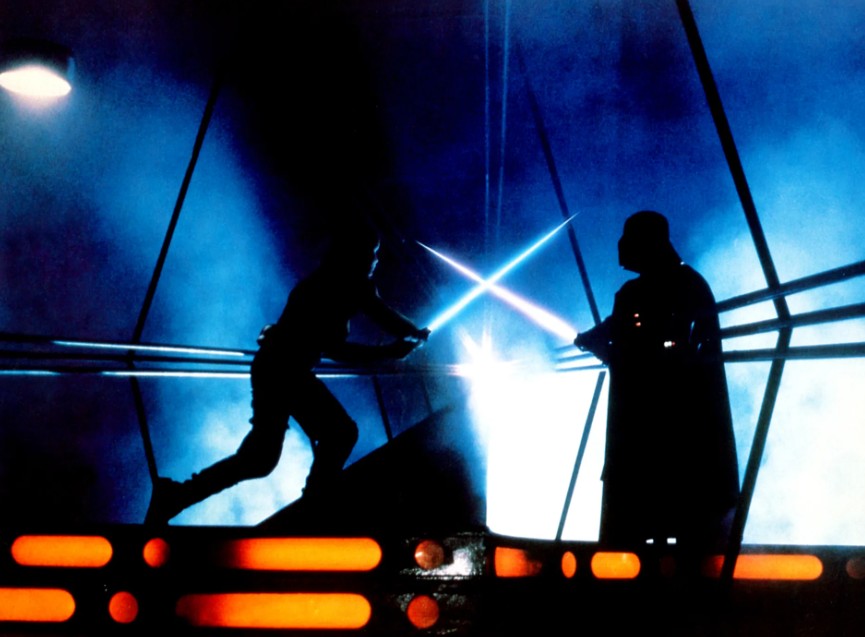
The Wired.com article (full article available to subscribers) examines a deceptively simple question from Star Wars: do lightsaber blades have mass? While the weapons are fictional, the analysis uses real physics to interpret how they would behave if they existed. The conclusion challenges a common assumption. Despite their glowing appearance, lightsabers cannot function like pure beams of light.
The article first rules out the idea that lightsabers are lasers. Real laser beams are invisible from the side, extend indefinitely, and cannot collide with each other. Yet lightsabers are clearly visible, have fixed lengths, and clash like solid objects during combat. These inconsistencies suggest that the blades must be made of something other than light.
To explore this further, the article turns to classical mechanics, particularly Newton’s laws of motion. If a lightsaber blade had no mass, it would offer no resistance when swung, behaving more like a weightless beam. Instead, on-screen duels show characters exerting effort and controlling momentum, much like handling a physical sword. This implies that the blade contributes to the weapon’s inertia, meaning it must have mass.
Rotational motion provides even stronger evidence. The concept of moment of inertia, which depends on both mass and its distribution, explains how objects resist changes in rotation. When a lightsaber is swung, its motion resembles that of a solid rod rather than a massless beam. A key example appears in Return of the Jedi, where Darth Vader throws his lightsaber. The way it spins indicates that the center of mass lies partly within the blade, confirming that the blade itself carries mass.
This reasoning leads to a clear conclusion: lightsaber blades do not behave like pure light and therefore must possess mass. The article speculates that a more plausible explanation would involve some form of contained plasma or unknown energy field.
Ultimately, the analysis highlights the appeal of science fiction. By applying real physics to imaginary technology, it reveals both the limits of current understanding and the creativity that keeps such ideas compelling.
