

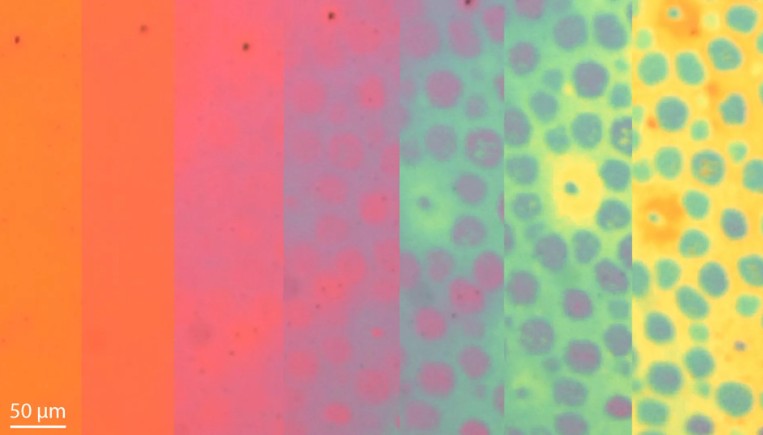
A new class of adaptive materials is bringing scientists closer to replicating one of nature’s most sophisticated abilities: dynamic camouflage. Researchers have developed a flexible material that can simultaneously change both its color and surface texture in real time, mimicking the skin of cephalopods such as octopuses. The work represents a major step toward materials that can actively respond to their environment rather than remain static, tells Science Daily.
At the core of the innovation is precise control over how a polymer interacts with water. By carefully engineering this swelling behavior, the material can form nanoscale surface patterns that alter how light is reflected. This enables it to shift colors while also modifying its physical texture, creating effects that go beyond traditional flat displays or coatings.
Unlike earlier approaches that treated color and texture as separate problems, the new system integrates both into a single mechanism. This is critical because, in natural camouflage, visual appearance depends not only on pigmentation but also on the way surfaces scatter light and create shadows. By combining these elements, the material can generate more realistic and dynamic visual effects.
The changes occur at extremely small scales, with features finer than a human hair. Despite this precision, the transformations are reversible and can happen within seconds, allowing the material to adapt quickly to changing conditions. Researchers demonstrated the ability to create detailed patterns and textures that could potentially mimic real-world surfaces.
Looking ahead, the system could be paired with sensing technologies and artificial intelligence to enable automatic adaptation. Such materials might one day adjust their appearance in response to surroundings without human input, opening applications in soft robotics, adaptive clothing, and dynamic displays.
The broader significance lies in shifting material design from passive to active behavior. By embedding responsiveness at the nanoscale, engineers are beginning to create surfaces that not only exist in an environment but also interact with it, marking a new direction for smart materials and engineered skins.
