

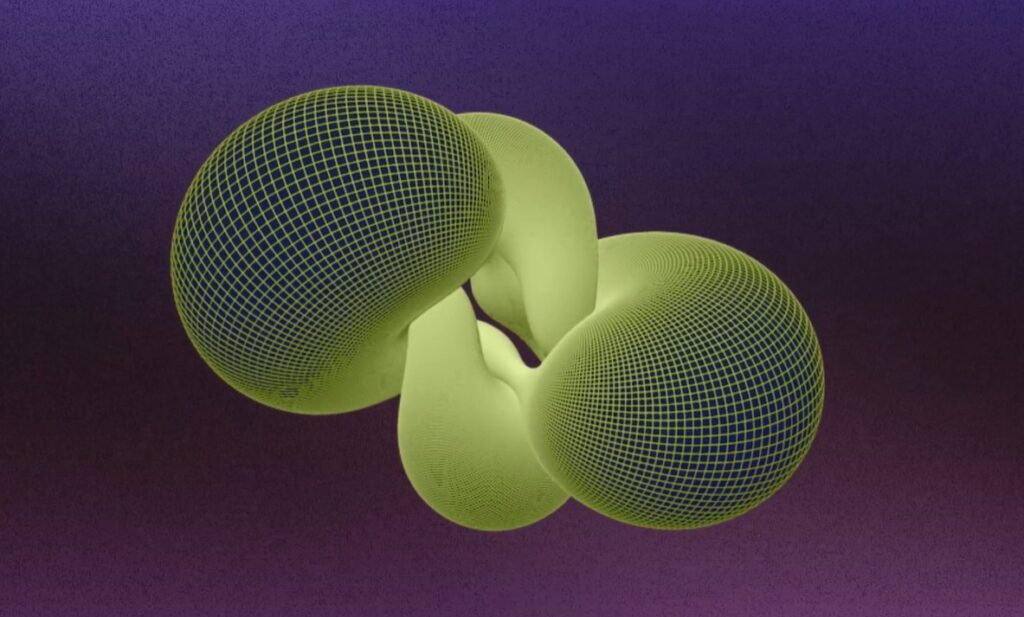
Mathematicians have resolved a century-and-a-half-old question in topology by identifying two compact shapes that share the same local geometric information yet differ in global structure. The result, reported in Quanta Magazine, comes from work by Alexander Bobenko, Tim Hoffmann, and Andrew Sageman-Furnas. They showed that the traditional belief, that local measurements uniquely determine a surface, can fail even for well-behaved compact surfaces such as tori, which resemble doughnut shapes.
The problem traces to a theorem by 19th-century French mathematician Pierre Ossian Bonnet, who proved that a surface’s metric (how distances behave locally) combined with mean curvature (average bending at each point) usually fixes the surface’s shape. For many surfaces such as spheres, this is true. But the question of whether two different compact surfaces could share these local measurements had remained unanswered for tori, which have a hole and thus a more complex topology. Mathematicians had only found exceptions—surfaces with the same local data but infinite extent or loose ends—not compact examples.
Using a combination of computational exploration and advanced geometric theory, the team began with a discrete “rhino” surface, a spiky, torus-like form identified through computer search. That model suggested ways to construct a continuous, smooth surface that defied the classical rule. After adapting formulas from 19th-century work by Jean Gaston Darboux and refining them rigorously, the researchers produced a compact Bonnet pair: two twisty tori that have identical metric and mean curvature data but distinct overall forms. These shapes remain closed and compact, unlike earlier known exceptions.
The discovery overturns long-held assumptions about how geometry constrains topology, showing that even neat, familiar surfaces like tori can evade unique determination by local geometric measurements. It expands understanding of the relationship between local and global geometry and highlights the power of combining computational methods with deep theoretical insight. The work opens new avenues in differential geometry and suggests that the landscape of possible shapes, even in classical settings, is richer than previously believed.
