

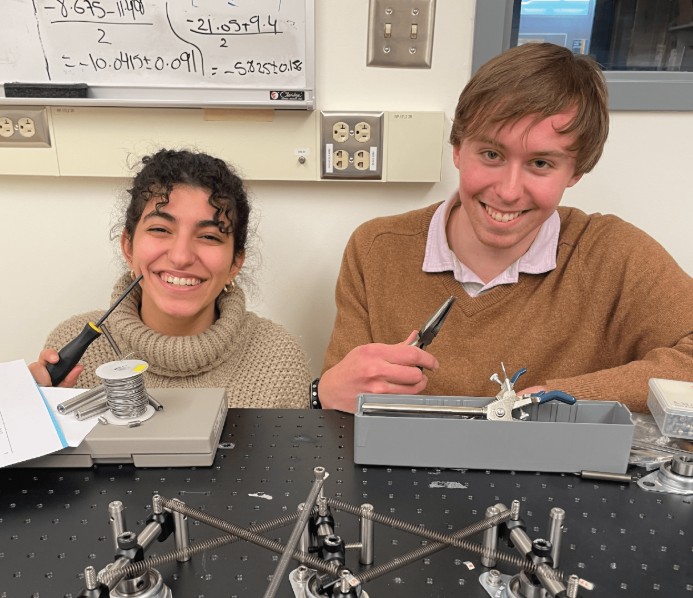
A team at St. Olaf College has demonstrated that computation does not require electronics by building functional mechanical computers from simple components such as springs and bolts. Instead of relying on electric currents and digital circuits, these devices harness physical forces and material behavior to perform logical operations and store information. The research centers on the concept of “mechanical memory,” where materials retain information based on their deformation history. Much like a stretched rubber band remembers its prior state, carefully designed mechanical elements can encode and process inputs. By organizing these elements into systems, the researchers created three distinct devices capable of computation.
One device functions as a counter, translating repeated physical actions into a numerical tally. Another performs a parity check, determining whether a sequence of inputs is odd or even. A third combines sensing and memory, detecting whether a specific force threshold has been exceeded and retaining that information. Together, these systems demonstrate that fundamental computing tasks can be achieved through purely mechanical interactions.
A key innovation lies in the use of “hysterons,” mechanical components that switch states depending on applied forces and maintain those states over time. By tuning how these elements interact, the researchers effectively built mechanical logic gates, the building blocks of computation.
Because these systems operate without electricity, they offer unique advantages. They are inherently resistant to electromagnetic interference, power disruptions, and extreme environmental conditions where conventional electronics might fail. This makes them promising for applications in space exploration, industrial sensing, and harsh environments.
While still in early stages, the work points toward a broader rethinking of computation. Rather than being tied exclusively to silicon and electronics, computing can emerge from the physics of materials themselves. In that sense, these spring-and-bolt machines represent not a step backward, but a new direction for resilient, low-energy information processing.
