

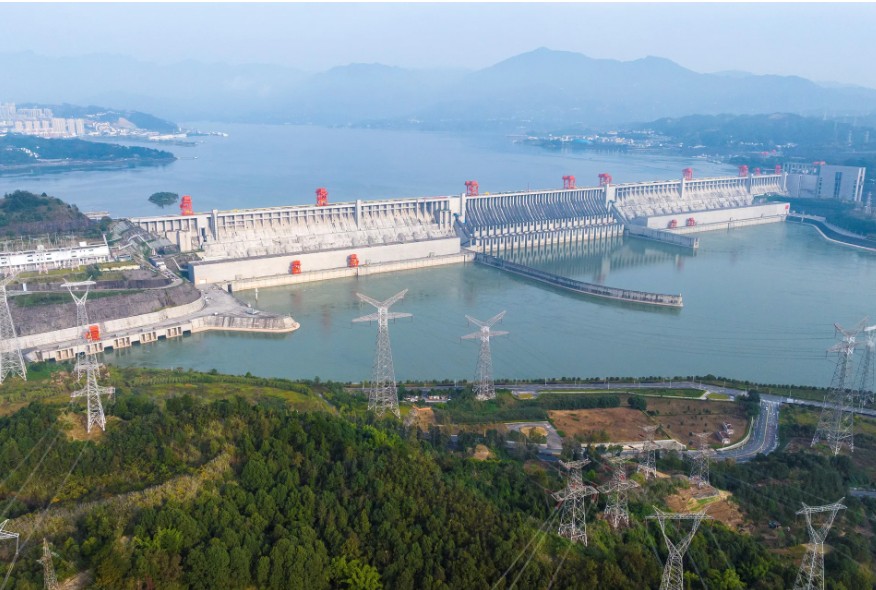
In this article from Wired.com, physicist and educator Rhett Allain explains how the construction of the Three Gorges Dam in China actually lengthened Earth’s day by a measurable amount. He starts by walking us through the core physics: angular velocity (how fast something rotates), moment of inertia (how mass is distributed relative to the axis), and angular momentum (the product of velocity × moment). Because angular momentum is conserved in an isolated system, spreading mass farther from the axis slows rotation.
When you build a dam, you hold back vast amounts of water at higher elevation and a certain latitude; this effectively moves mass farther from Earth’s rotational axis. In layman’s terms: like spreading your arms on a spinning chair, you slow your spin. That is exactly what the dam’s reservoir does on a planetary scale.
Allain runs the numbers (with simplifying assumptions) for the Three Gorges project and arrives at an extra 5.3 × 10⁻⁶ seconds (5.3 microseconds) added to each rotation of Earth. He acknowledges this is far too small to notice in daily life, but the result is real and underscores that human infrastructure can influence planetary motion. The article also explores playful scenarios, such as if we built more skyscrapers, had everyone stand up at once, or placed mass near the equator, we could, in theory, slow the rotation even more.
In closing, the article offers an accessible physics lesson and prompts reflection: our engineering feats might power cities and drive sustainable energy, but they also have subtle, wide-ranging consequences. The Earth’s “day” isn’t immune to human touches.
