

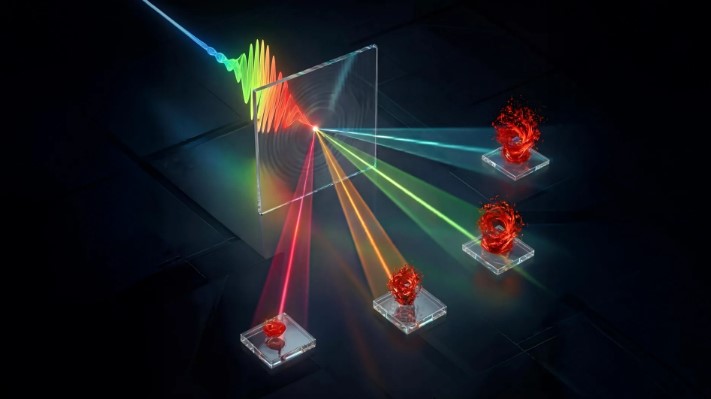
Researchers have developed an advanced imaging technique that significantly improves the ability to observe ultrafast processes occurring at the microscopic level. These events, which unfold in femtoseconds, have traditionally been difficult to capture due to their speed and complexity. The new method, called compressed spectral-temporal coherent modulation femtosecond imaging (CST-CMFI), enables scientists to record both the brightness and internal structure of such phenomena in a single measurement, tells this Science Daily article.
Unlike earlier ultrafast imaging approaches that focused primarily on light intensity, CST-CMFI also captures phase information. This allows researchers to understand how light interacts with materials, including changes in speed and direction, providing a more complete picture of dynamic processes.
The technique combines multiple advanced methods, including time-spectrum mapping, compressive spectral imaging, and coherent modulation imaging. A chirped laser pulse, composed of multiple wavelengths arriving at slightly different times, links temporal changes to spectral variations. When this pulse interacts with a rapidly evolving event, it encodes spatial, spectral, and phase data into a single image. A physics-informed neural network then reconstructs this data into a sequence of frames, effectively creating an ultrafast “movie” from a single exposure.
Experimental demonstrations highlight the method’s capabilities. Researchers observed plasma formation in water triggered by a femtosecond laser, revealing detailed changes in both intensity and phase within the plasma channel. They also examined charge carrier dynamics in zinc selenide, gaining insights into how electrons move after excitation, information critical for improving electronic and optical devices.
The ability to detect subtle phase variations, even when intensity changes are minimal, marks a significant advancement. This sensitivity opens new possibilities for studying chemical reactions, material transformations, and biological processes that occur at extremely short timescales.
Looking ahead, researchers aim to expand the method’s capabilities by integrating it with additional imaging techniques to better separate spectral and temporal data. This would broaden its applicability to more complex systems.
The development of CST-CMFI represents a major step forward in ultrafast imaging, offering a powerful tool for exploring the fundamental behavior of matter and advancing technologies in fields ranging from materials science to energy research.
