

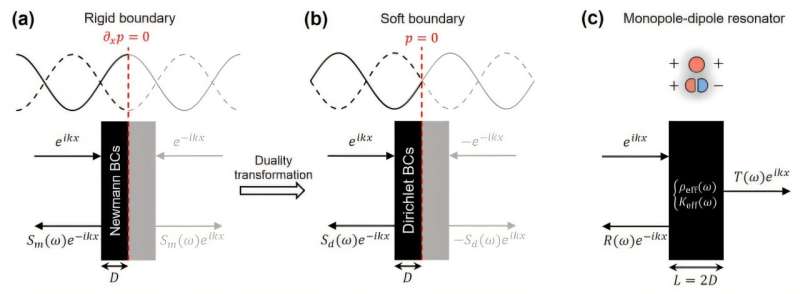
Engineers at the University of Hong Kong have identified a new physical principle that could change the way sound-absorbing materials are designed for ventilated environments, tells Tech Xplore. Traditional absorbers trade airflow for noise reduction: foams block noise well but also block air, while ventilated structures let air through but struggle to damp sound. The research team led by Professor Nicholas X. Fang looked beyond conventional approaches and found that a mathematical concept known as duality symmetry can govern the limits of sound absorption in systems that allow free airflow. This insight comes from field theory and reveals a deep connection between symmetry properties and absorption bandwidth that had not been exploited before.
Using duality symmetry as a design guide, the researchers built a new type of ventilated absorber made of two coupled acoustic chambers. Air can pass through the structure, but sound waves entering it interfere destructively in a way that converts acoustic energy into heat, significantly dampening the noise. In laboratory tests, samples built on this principle absorbed over 86% of sound energy across a wide range of frequencies, from about 300 Hz up to 6,000 Hz. That performance outstrips conventional foam panels of the same thickness and maintains airflow, a combination hard to achieve with earlier designs.
The team also proposed a new metric called the figure of merit to evaluate absorber designs by balancing bandwidth, physical thickness, and airflow. This measure helps compare different concepts and clarify performance trade-offs that matter in real applications.
Breaking the long-standing limits defined by the classical causality constraint, this work points to new ways to build quieter environments without sacrificing ventilation. Potential uses range from building interiors and mechanical equipment enclosures to aircraft ducts and industrial silencing systems. With support from advanced simulations and AI optimization tools, designers could extend these principles to other noise control challenges in engineering.
