

Particle accelerators are typically used to smash atoms together at extreme speeds, producing debris that helps scientists study the building blocks of matter. However, the MIT News article highlights a different approach: focusing on particles that nearly collide but instead pass just close enough to interact in subtle ways.
In these “near-miss” events, particles traveling at nearly the speed of light generate intense electromagnetic fields. When they pass close to one another, these fields flatten and produce high-energy photons. Occasionally, a photon from one particle interacts with another, creating a fleeting but measurable interaction without a direct collision.
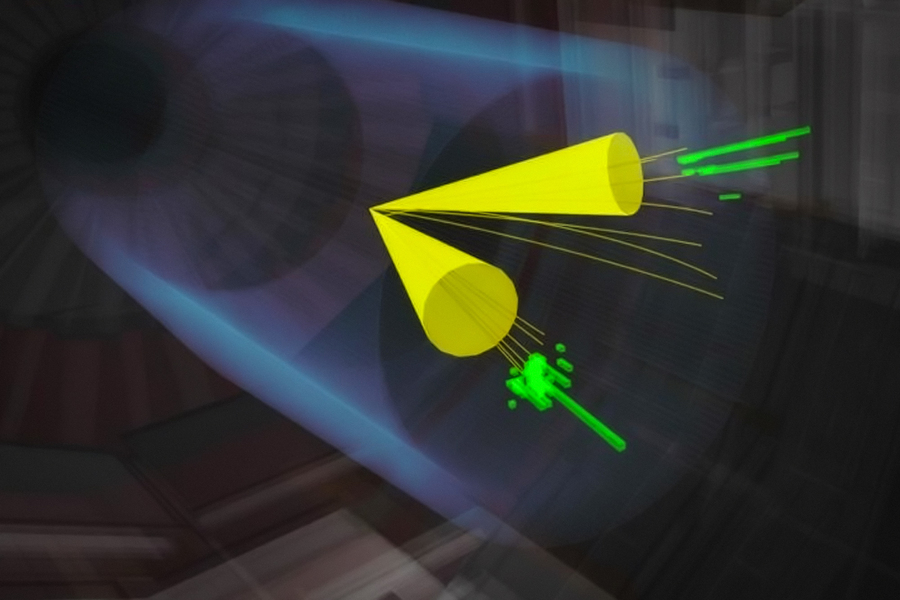
An MIT-led team analyzed such events at the Large Hadron Collider, the world’s most powerful particle accelerator. Instead of examining collision debris, they treated these near-misses as a new kind of probe, effectively turning the accelerator into a precision microscope for studying the forces that bind matter.
This method revealed previously unseen behavior in the strong nuclear force, the fundamental interaction that holds atomic nuclei together. By observing how particles respond to these photon-mediated interactions, researchers gained insights into how quarks and gluons behave under extreme conditions.
The significance lies in the technique itself. Traditional high-energy collisions are chaotic and produce complex data, making it difficult to isolate specific interactions. Near-misses, by contrast, create cleaner conditions where electromagnetic effects dominate, allowing scientists to study certain processes with greater precision.
The findings suggest that particle accelerators can be used in more versatile ways than previously thought. By shifting focus from violent collisions to controlled close encounters, researchers can explore new aspects of fundamental physics that were harder to access before.
This approach opens a new pathway for discovery. Rather than relying solely on smashing particles apart, physicists can now examine what happens when they almost touch, revealing hidden properties of matter and the forces that govern the universe.
