

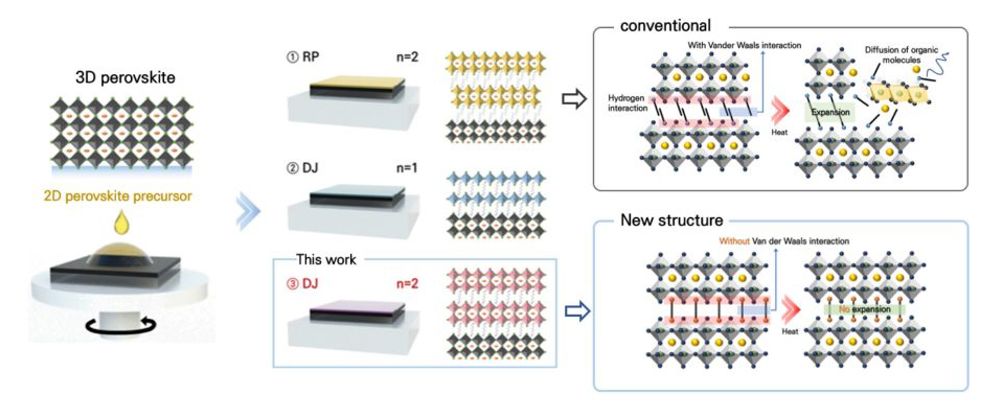
Perovskite solar cells have long promised high efficiency at low cost, but their instability has slowed real-world adoption. The article from The Engineer reports a significant step forward, with researchers achieving more than 25% efficiency while also improving durability under real operating conditions.
The breakthrough centers on refining the internal structure of the solar cell, particularly the interfaces between layers. These interfaces have historically been weak points where defects form, leading to energy loss and material degradation. By engineering these regions more precisely, the researchers reduced charge recombination and improved the overall flow of electricity through the device.
A key challenge for perovskite technology has been maintaining performance under stress, especially heat, humidity, and prolonged light exposure. The new design demonstrates strong operational stability, retaining efficiency even under conditions that typically degrade similar devices. This marks an important advance, as stability has been one of the main barriers preventing commercialization despite rapid gains in efficiency over the past decade.
The reported efficiency, exceeding 25%, places these cells in direct competition with established silicon technologies. Perovskites have already shown remarkable progress, rising from below 5% efficiency in the late 2000s to levels comparable with conventional solar cells. What distinguishes the latest development is the combination of high performance with durability, rather than optimizing one at the expense of the other.
The researchers also demonstrated scalability by applying the approach to larger-area devices, an essential step toward practical deployment. This suggests the technology is moving beyond laboratory-scale experiments and toward manufacturable systems.
While further work is needed to confirm long-term reliability and cost-effectiveness, the results signal meaningful progress. By addressing both efficiency and stability, the research narrows the gap between promising laboratory results and viable commercial solar solutions, bringing perovskite technology closer to widespread use in the global energy mix.
