

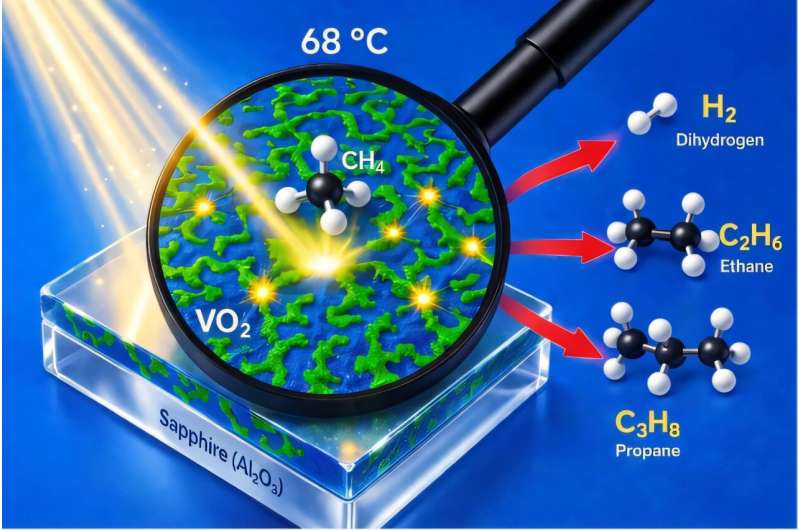
A new approach to methane conversion is emerging from research that combines photocatalysis with phase-changing materials, offering a potentially more efficient way to produce valuable fuels and chemicals. At the center of this work is vanadium dioxide (VO₂), a material known for its ability to switch between insulating and metallic states at relatively low temperatures, tells Tech Xplore.
Methane, the primary component of natural gas, is abundant but difficult to transport and utilize efficiently due to its gaseous form. Converting it into higher hydrocarbons such as propane or into hydrogen can significantly expand its usefulness. Propane is easier to store and transport, while hydrogen is a key clean energy carrier for fuel cells and other applications.
The research team developed a photocatalytic system that takes advantage of VO₂’s phase transition at around 68°C. As the material shifts between insulating and metallic phases, it creates dynamic electronic environments that enhance chemical reactions. This transition enables more effective activation of methane molecules under relatively mild conditions compared to conventional high-temperature processes.
Using this method, the system converts methane into a mix of products, including propane and hydrogen. The ability to generate both simultaneously is particularly significant, as it combines two valuable outputs in a single process. Traditional methods for methane conversion often require extreme temperatures or produce unwanted byproducts, limiting efficiency and scalability.
Another advantage lies in the use of light-driven catalysis. Photocatalytic processes can potentially be powered by solar energy, reducing reliance on fossil-fuel-based inputs and lowering overall emissions. This aligns with broader efforts to develop cleaner pathways for hydrogen production and hydrocarbon upgrading.
While still at the experimental stage, the findings point to a new direction in energy and chemical engineering. By combining phase-transition materials with photocatalysis, researchers are demonstrating that methane can be transformed more selectively and efficiently. If scaled successfully, this approach could contribute to more sustainable fuel production and improved utilization of natural gas resources.
