

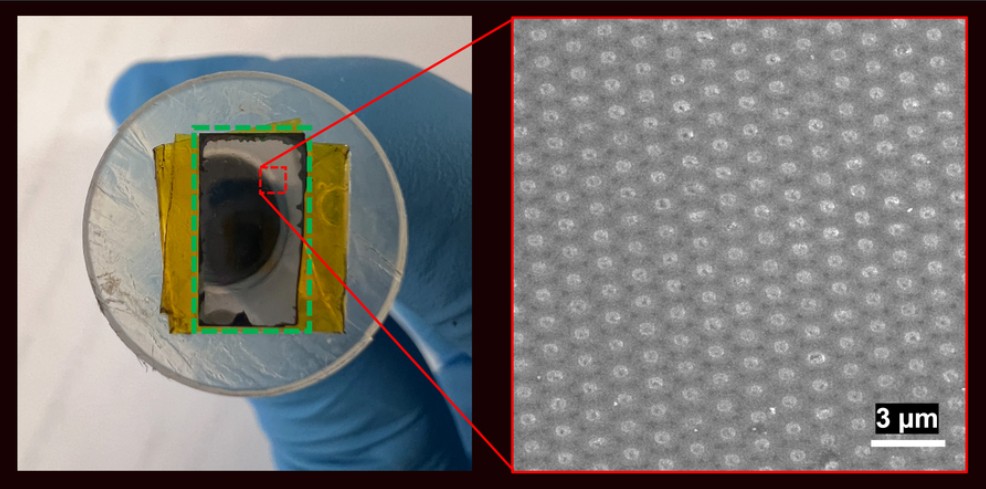
MIT engineers have unveiled a novel palladium membrane that could address a key hurdle in clean hydrogen production: withstanding extreme temperatures during gas separation. Traditional palladium membranes work well up to about 800 K, but above that, they degrade, losing selectivity and structural integrity. The new design replaces the continuous palladium film with discrete “plugs” embedded in pores of a supporting substrate, giving it much higher thermal resilience, tells MIT News.
The innovation lies in geometry. Instead of coating a support with a palladium film, the team deposits palladium directly into the pores of a porous support, letting the metal form snug plugs. These plugs resist deformation and agglomeration at high temperatures, preserving selective hydrogen permeation. In lab tests, the membranes held up even after 100 hours at 1,000 K, a significant improvement over conventional films.
What does this mean for hydrogen systems? Two promising applications are compact steam methane reforming and ammonia cracking, both of which operate at elevated temperatures. With a thermally stable membrane, you can place separation stages closer to the reaction zone, reducing the need to cool gases extensively before filtering. That cuts complexity, energy losses, and cost.
The researchers are candid that the work is still early. Scaling up, testing under real industrial gas mixtures, long-term durability, and integration into reactors need further work. But the plug architecture offers a path to using less palladium (since only the plugs, not the entire surface, carry the burden) and better performance in harsher environments.
Overall, this concept reframes how we approach high-temperature membrane design. Instead of pushing materials to their limits in film form, controlled nanostructures offer a route to greater stability. If this can be engineered robustly at scale, it could unlock more efficient, lower-cost hydrogen infrastructure.
