

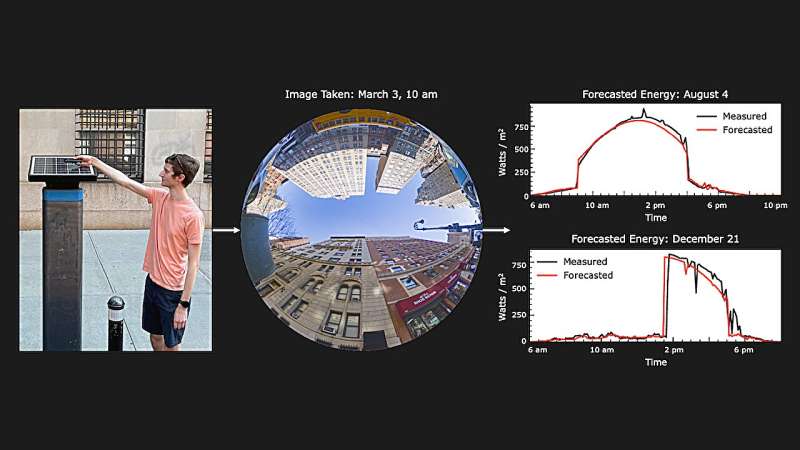
A recent study featured on Tech Xplore highlights a surprising inefficiency in urban solar installations: many panels are not positioned to capture as much energy as they could. The research introduces a novel method that uses computer vision and imaging techniques to evaluate how much sunlight a specific surface can realistically receive over time, accounting for shadows, reflections, and surrounding structures.
The approach relies on analyzing a single image of a location. By examining visual cues such as shadows, building geometry, and sky visibility, the system can predict how sunlight interacts with that environment throughout the day and across seasons. This allows researchers to estimate not only current energy output but also how much more could be generated if panels were optimally oriented.
The findings reveal that even small adjustments in panel orientation can significantly improve performance. In one example, solar panels used to power bike-sharing stations in New York City were found to be underperforming due to suboptimal positioning. By reorienting them, researchers estimated that energy generation could increase by as much as 30% annually.
This inefficiency is particularly relevant in dense urban settings, where buildings create complex lighting conditions. Unlike open environments, city installations must contend with limited sky exposure, moving shadows, and reflected light from surrounding surfaces. The new method captures these factors in a way that traditional planning tools often overlook.
Beyond technical insights, the study points to a broader shift in solar deployment strategy. As the cost of solar panels continues to decline, installation and planning have become the dominant expenses. Accurate predictions of energy output are therefore critical for determining return on investment and ensuring efficient use of space.
The research demonstrates that improving solar performance does not always require new materials or hardware. Instead, better placement and orientation, guided by data-driven analysis, can unlock substantial gains.
This work underscores a key transition in renewable energy systems. As solar becomes widespread, optimization at the system level, rather than just technological advancement, will play a central role in maximizing efficiency and accelerating adoption.
