

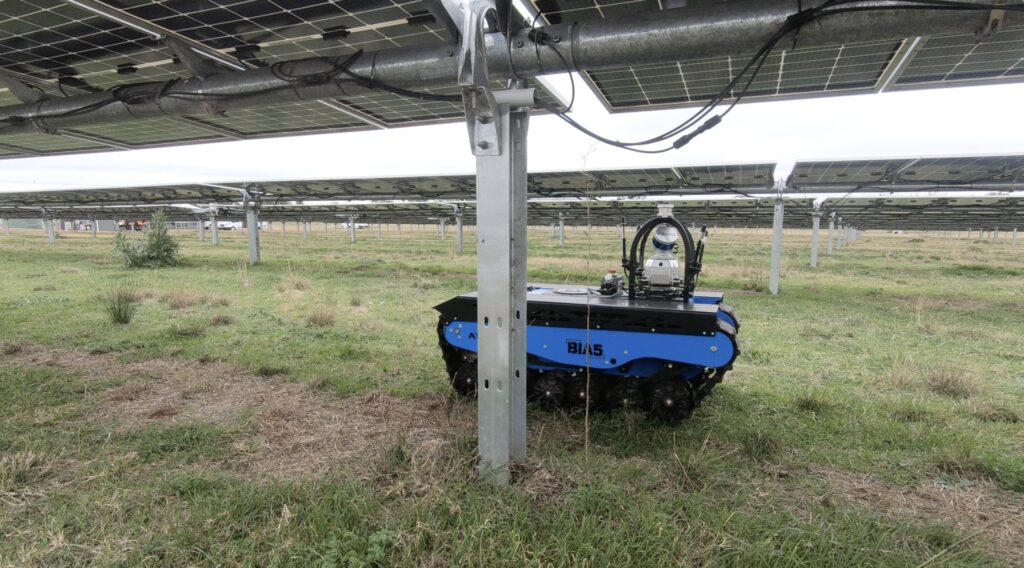
Maintaining utility-scale solar farms is becoming an increasingly complex and hazardous task as installations expand across remote, high-temperature environments. A recent study highlights the growing role of AI-powered robots in taking over this demanding work, particularly in regions such as Australia where solar farms span vast, uneven terrain, tells Tech Xplore.
These robots, originally developed for the mining industry, have been adapted to inspect and maintain solar infrastructure. They can travel long distances across rugged ground, identifying faults in panels and supporting structures without exposing human workers to extreme heat or physical risk. Traditionally, such inspections required technicians to walk extensive sites, a process that is both time-consuming and potentially dangerous.
The scale of modern solar farms underscores the need for automation. Large facilities can generate more than 500 megawatts of electricity, enough to power hundreds of thousands of homes, but maintaining that output depends on continuous monitoring and timely repairs. Even minor faults, if undetected, can reduce efficiency across thousands of panels. Robots equipped with sensors and AI systems can detect these issues early, improving overall performance and reducing downtime.
Beyond safety, cost reduction is a key driver. Automated inspection minimizes labor requirements and increases the frequency and accuracy of maintenance checks. By operating consistently and autonomously, robots can cover more ground than human crews and deliver more reliable data for decision-making.
The trial demonstrates a broader trend in renewable energy infrastructure, where robotics and AI are being integrated to manage large-scale systems more efficiently. As solar farms continue to grow in size and importance, these technologies are likely to become essential for ensuring reliability and maximizing energy output.
While still in early stages, the deployment of such robots signals a shift toward more automated energy operations. By removing humans from the most physically demanding tasks, the technology not only improves safety but also supports the long-term scalability of solar power.
