

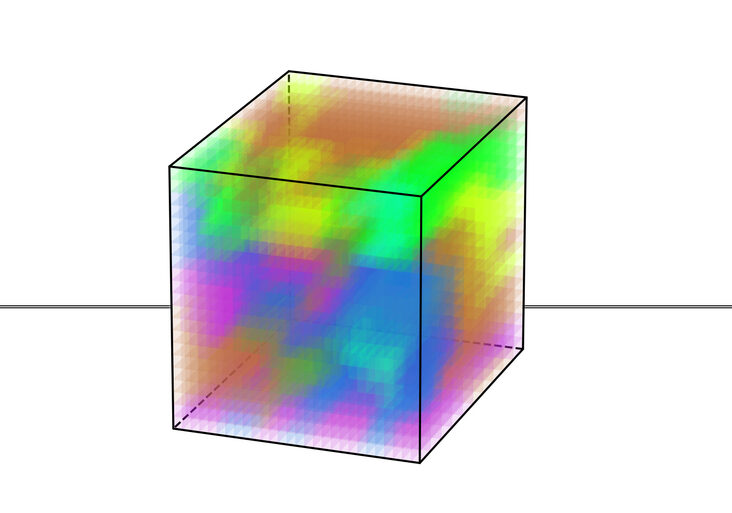
Materials known as relaxor ferroelectrics have powered technologies such as ultrasound machines, microphones, sonar systems, and precision sensors for decades, yet scientists never fully understood the atomic structure responsible for their unusual behavior. Now, researchers at MIT have directly mapped the three-dimensional atomic arrangement inside one of these materials for the first time, uncovering hidden structural patterns that could improve the design of next-generation electronic and energy systems, tells MIT News.
The study focused on the way electric polarization forms within relaxor ferroelectrics. These materials contain regions where atoms shift slightly, creating localized electric fields that give the material exceptional sensing and energy-storage properties. Although scientists had long theorized about these nanoscale regions, directly observing their internal organization proved extremely difficult because the structures are highly disordered and constantly fluctuating.
To investigate the problem, the MIT-led team used a technique called multi-slice electron ptychography, or MEP. The method scans a nanoscale electron probe across a material while recording diffraction patterns from overlapping regions. Researchers then reconstruct a highly detailed three-dimensional image of the atomic structure.
The imaging revealed a surprising hierarchy of structural organization spanning multiple scales. Researchers discovered that chemical disorder inside the material plays a much larger role than previously believed. Instead of broad polarization regions predicted by older models, the material contains far smaller and more complex domains of atomic displacement.
The team combined the experimental observations with computer simulations to refine theoretical models describing relaxor ferroelectrics. According to the researchers, understanding the exact relationship between chemical disorder and electric polarization could help engineers better predict and tailor material properties for specific applications.
The findings may influence the future development of advanced sensors, energy-storage devices, and low-power computing technologies. Relaxor ferroelectrics are already widely used because they respond strongly to electrical and mechanical signals, but a more complete understanding of their internal structure could enable materials with higher efficiency and more precisely engineered behavior.
