

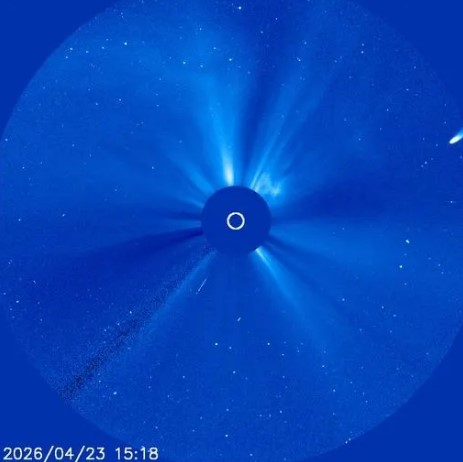
A burst of solar activity has pushed the likelihood of northern lights displays higher, following multiple eruptions from the Sun that include both powerful flares and coronal mass ejections (CMEs). According to a recent Forbes report, an X-class solar flare and accompanying CMEs were detected within a short span, sending charged particles toward Earth and setting the stage for potential geomagnetic storms.
Solar flares are intense releases of radiation, while CMEs involve massive clouds of magnetized plasma expelled into space. When these events are directed toward Earth, they can disturb the planet’s magnetic field. The interaction funnels charged particles toward the poles, where they collide with atmospheric gases and produce auroras.
The current surge in activity is linked to the Sun’s approach to solar maximum, the peak phase of its roughly 11-year cycle. During this period, sunspots multiply and the frequency of flares and CMEs rises sharply, increasing both the intensity and geographic reach of auroras. As a result, displays that are usually confined to high latitudes can sometimes be seen much farther south than usual.
Forecasts suggest that if the incoming CMEs interact strongly with Earth’s magnetosphere, auroras could become visible across parts of North America and similar latitudes. However, visibility depends on several variables, including the orientation of the solar magnetic field and local viewing conditions such as darkness and cloud cover.
Beyond the visual spectacle, heightened solar activity carries practical implications. Strong geomagnetic storms can disrupt satellite operations, interfere with radio communications, and in extreme cases affect power grids.
This latest episode underscores both the appeal and unpredictability of space weather. While it offers a chance to witness rare sky displays, it also reflects a more active Sun that demands closer monitoring as solar maximum unfolds.
