

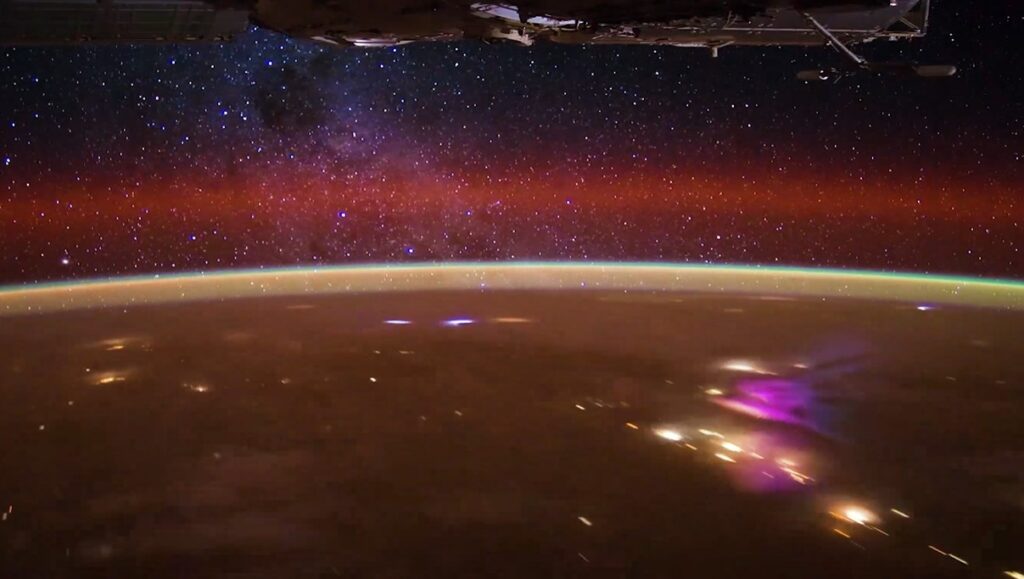
For centuries, lightning seemed straightforward: electric charge builds inside storm clouds until the air breaks down and a giant spark flashes across the sky. That explanation, rooted in Benjamin Franklin’s famous experiments, dominated scientific thinking for generations. But according to recent research explored in Quanta Magazine, physicists now believe the true story is far stranger and far more complex.
The central mystery is simple yet troubling: thunderstorms do not appear to generate electric fields strong enough to trigger lightning by conventional physics. Measurements taken with balloons, aircraft, and rockets consistently show that storm clouds fall below the voltage needed to tear electrons from air molecules and create a lightning channel. Yet lightning occurs constantly around the world.
To solve the puzzle, researchers are increasingly looking beyond ordinary atmospheric electricity and toward high-energy physics. Modern instruments have detected X-rays and gamma rays emerging from thunderstorms, phenomena more commonly associated with supernovas, black holes, and particle accelerators. Scientists suspect that these energetic events may help trigger the first stages of a lightning strike.
One leading theory focuses on ice crystals inside storm clouds. As the crystals collide and fracture, they create tiny conductive regions that intensify local electric fields. These fields can generate branching channels called streamers, which may eventually merge into a conductive lightning leader. High-resolution observations from radio telescope arrays in Europe have provided some of the clearest evidence yet for this mechanism.
Another possibility involves cosmic rays from outer space. Some physicists believe incoming high-energy particles may trigger runaway electron avalanches inside clouds, helping lightning begin even when electric fields appear too weak. While the debate remains unresolved, many researchers now agree that lightning is not merely a giant spark but a complicated interaction involving plasma physics, particle physics, atmospheric dynamics, and radiation.
The result is a growing realization that thunderstorms contain far more violent and exotic processes than scientists once imagined. Even one of nature’s oldest and most familiar phenomena continues to surprise modern physics.
