

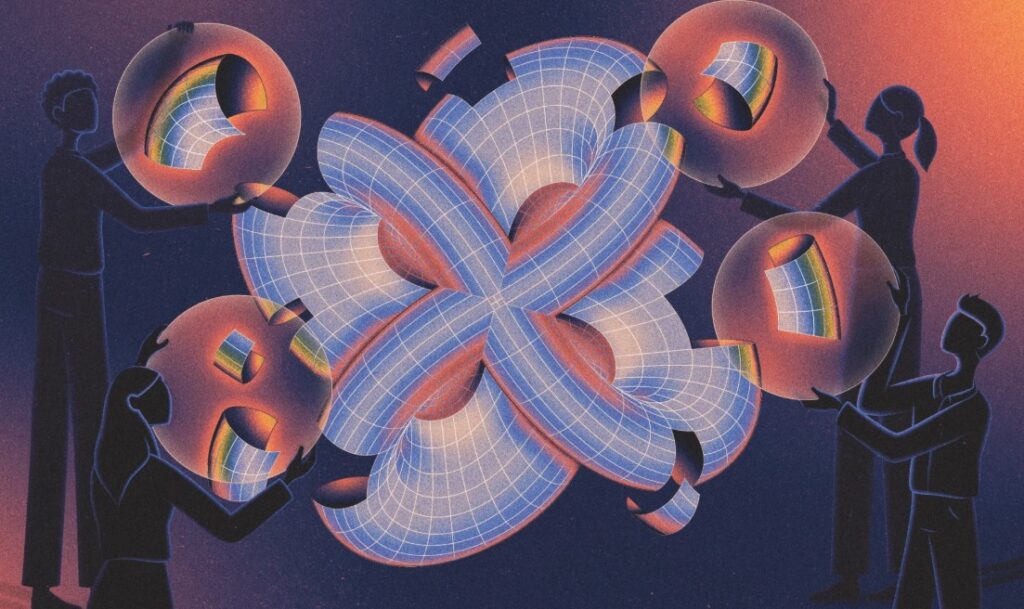
Mathematicians have long understood the behavior of shapes in two and three dimensions, and even in higher dimensions beyond four. But four-dimensional spaces remain uniquely difficult, exhibiting phenomena that resist intuition and standard mathematical tools. This article in Quanta Magazine explores new results that shed light on this puzzling realm, where even simple geometric operations can behave in surprising ways.
At the heart of the work is topology, the study of shapes known as manifolds, which appear flat when examined locally. While mathematicians have developed robust methods for studying manifolds in most dimensions, four-dimensional cases occupy a strange middle ground. As one researcher notes, they offer just enough complexity to produce unusual behavior, but not enough structure for existing techniques to fully apply.
The article focuses on how two-dimensional surfaces can be embedded within four-dimensional manifolds. In earlier work from the 1990s, mathematicians Tom Mrowka and Peter Kronheimer developed tools suggesting that many such surfaces would behave in a relatively predictable way when slicing through these spaces. However, this assumption had never been rigorously proven.
Recent research by Sam Hughes and collaborators overturns that expectation. By constructing explicit counterexamples, they demonstrated the existence of “crazy” surfaces that cut through four-dimensional manifolds in ways previously thought impossible. These examples reveal a far richer diversity of geometric behavior than earlier theories allowed.
The findings have broader implications for the classification of four-dimensional manifolds, a central problem in topology. If surfaces can behave in so many unexpected ways, it becomes significantly harder to categorize these spaces or predict their properties. At the same time, the work resolves a long-standing question from a 1997 list of open problems, marking progress in a field known for its difficulty.
Ultimately, the research underscores a central theme in modern mathematics: even familiar concepts such as slicing a surface can become profoundly complex in higher dimensions.
