

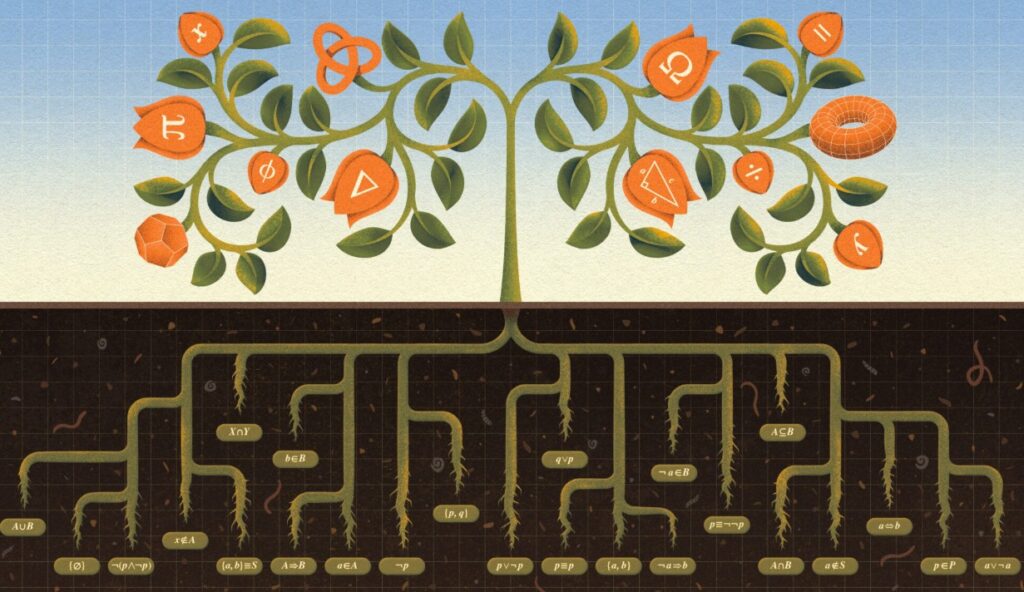
Modern mathematics rests on a small set of assumptions known as axioms, yet one of them, the axiom of choice, has sparked more controversy than any other. The Quanta Magazine article traces the historical and philosophical debates surrounding this “final” axiom within Zermelo–Fraenkel set theory, the framework underpinning most of contemporary math.
Axioms are accepted without proof, serving as the starting point for all mathematical reasoning. For many mathematicians, these principles feel intuitive or self-evident. However, the axiom of choice challenged that comfort. Introduced by Ernst Zermelo in the early 20th century, it allows mathematicians to select elements from infinitely many sets, even when no explicit rule for doing so exists. While powerful, this idea struck many as philosophically unsettling.
The controversy intensified because the axiom leads to counterintuitive results. One famous implication is the Banach–Tarski paradox, which suggests that a solid object can be divided and reassembled into multiple identical copies. Such outcomes, though mathematically consistent, appear to violate physical intuition and raise doubts about whether the axiom should be accepted as truth.
Opposition also came from alternative schools of thought. Intuitionists argued that mathematical objects should only exist if they can be explicitly constructed, rejecting abstract assumptions about infinite sets. Others questioned whether asserting existence without a constructive method undermines the meaning of mathematical proof.
Despite early resistance, the axiom of choice gradually gained acceptance because of its usefulness. It simplifies proofs, enables major results across fields, and fits seamlessly into the broader structure of set theory. Today, most mathematicians adopt it without hesitation, even if philosophical concerns remain.
The debate over this axiom reveals a deeper truth: mathematics is not purely objective but shaped by human judgment about what counts as acceptable reasoning. The “final axiom” may now be standard, but its history shows that even the foundations of math are open to challenge and reinterpretation.
