

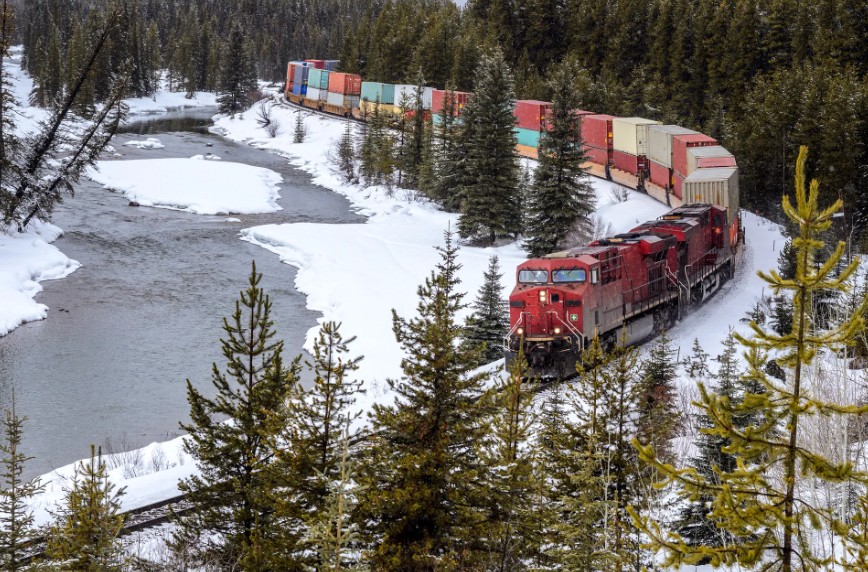
At first glance, it seems impossible for a locomotive to pull a train that weighs many times more than the engine itself. The explanation lies in the physics of friction, rolling motion, and the mechanics of train couplings. While the train may be extremely heavy, the force needed to keep it moving is surprisingly small because of the way wheels interact with rails, tells this article from Wired.com.
The key factor is the difference between sliding friction and rolling resistance. If a heavy object were dragged across the ground, the friction between surfaces would be very large, requiring a great deal of force to move it. Train cars, however, roll on steel wheels along steel rails. When a wheel rolls, the contact point continually changes instead of sliding across the surface. As a result, the resistance to motion becomes extremely small compared with sliding friction.
Another source of efficiency comes from the design of train axles. Inside each wheel assembly, bearings allow the axle to rotate with minimal resistance. With lubrication and modern roller bearings, the effective friction coefficient can be reduced to extremely low values. This means the locomotive does not need to overcome the full weight of the train, only the relatively small resistive forces acting on the wheels and bearings.
The locomotive itself relies on static friction between its steel wheels and the rails to generate traction. Static friction is stronger than kinetic friction, enabling the engine’s wheels to push against the rails without slipping. The enormous weight pressing the locomotive onto the tracks increases the normal force, which in turn increases the available traction needed to pull the train forward.
Starting a long train still requires special techniques. Train cars are connected with couplings that contain small gaps, allowing “slack” between cars. When the locomotive begins moving, it pulls the first car, then the next, and so on, rather than moving the entire train at once. This sequential motion reduces the initial force needed to start the train rolling.
Together, low rolling resistance, efficient bearings, and clever coupling mechanics allow locomotives to haul thousands of tons while using relatively modest pulling forces.
