

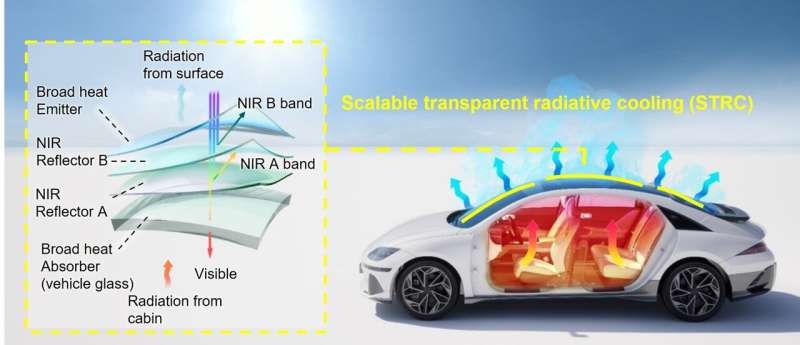
A newly developed transparent cooling film offers a passive solution to one of the most persistent problems in vehicles: excessive cabin heat under sunlight. Designed by researchers at Seoul National University in collaboration with industry partners, the technology uses radiative cooling principles to reduce interior temperatures without consuming electricity, tells Tech Xplore.
The film is engineered as a multilayer structure applied to vehicle windows. It allows more than 70% of visible light to pass through, preserving transparency, while selectively reflecting near-infrared radiation, the primary contributor to heat buildup. At the same time, it emits thermal energy from inside the vehicle in the mid-infrared range, effectively releasing heat into the atmosphere.
This combination of properties enables the film to suppress temperature rise inside the cabin even under direct sunlight. Real-world testing across different countries, seasons, and driving conditions demonstrated that the technology can lower cabin temperatures by up to 6.1°C. The reduction is significant enough to improve comfort and reduce reliance on conventional air conditioning systems.
Energy efficiency is a central benefit. By limiting heat buildup, the film reduces the workload on cooling systems, cutting energy consumption by more than 20%. This is particularly relevant for electric vehicles, where climate control directly impacts driving range. Faster cooling times also improve user experience, especially in hot climates.
Unlike traditional cooling methods that depend on compressors and refrigerants, this approach is entirely passive. It leverages the natural process of radiative heat transfer, where surfaces emit heat into space through specific infrared wavelengths. This eliminates the need for power while contributing to lower overall emissions.
The study marks a transition from laboratory-scale demonstrations to real-world validation. Researchers successfully tested the film in operational vehicles, confirming its durability and effectiveness in practical conditions.
As transportation systems move toward greater energy efficiency, materials such as this transparent cooling film could play a critical role. By integrating thermal management directly into vehicle surfaces, the technology offers a scalable path to reducing energy use while improving comfort, without adding mechanical complexity.
