

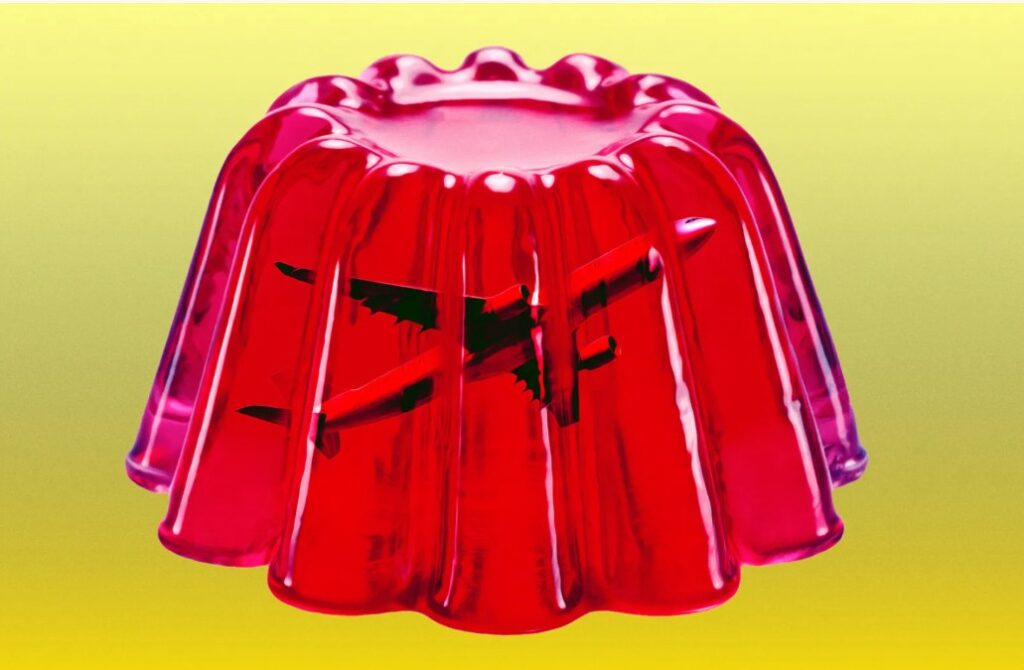
Airplane turbulence often feels alarming to passengers, but pilots say the physics behind it is far less dangerous than it appears. A common explanation used by aviation experts compares a plane flying through the atmosphere to an object suspended inside a bowl of gelatin. The analogy helps illustrate that aircraft are not falling through empty space but are instead supported by the surrounding air, explains this Popular Science article.
In this comparison, the airplane sits inside a thick block of Jell-O, representing the atmosphere. If someone taps or shakes the gelatin, the object inside will wobble slightly but will not drop or crash. Similarly, when turbulence disturbs the air, the aircraft moves with those shifting currents rather than losing its support. The air surrounding the plane behaves like a fluid medium that keeps the aircraft suspended.
Pilots explain that turbulence occurs when air flows at different speeds or directions. This can happen near storms, around mountains, or when warm and cold air masses interact. These uneven currents cause the aircraft to rise and fall slightly, producing the bumps passengers feel in the cabin. Although uncomfortable, these movements typically involve only small changes in altitude and rarely threaten the structural integrity of the plane.
Modern commercial aircraft are engineered specifically to withstand turbulent conditions. Wings and airframes are designed with significant flexibility so they can absorb sudden changes in airflow without breaking. Flight crews also use weather radar, reports from other pilots, and air-traffic coordination to anticipate rough air and avoid the worst areas whenever possible.
The Jell-O analogy, therefore, serves as a helpful mental model for anxious travelers. Instead of imagining an airplane suspended precariously in empty space, it encourages passengers to picture the aircraft embedded in a supportive medium that moves with it. Even when the atmosphere becomes unstable, the plane remains surrounded by air that continues to provide lift.
While turbulence can still be uncomfortable, aviation experts emphasize that it is a routine part of flight and rarely dangerous. The real risk usually comes not from the aircraft itself but from unsecured passengers or objects inside the cabin. Wearing a seatbelt when seated remains the simplest way to stay safe during turbulent conditions.
