

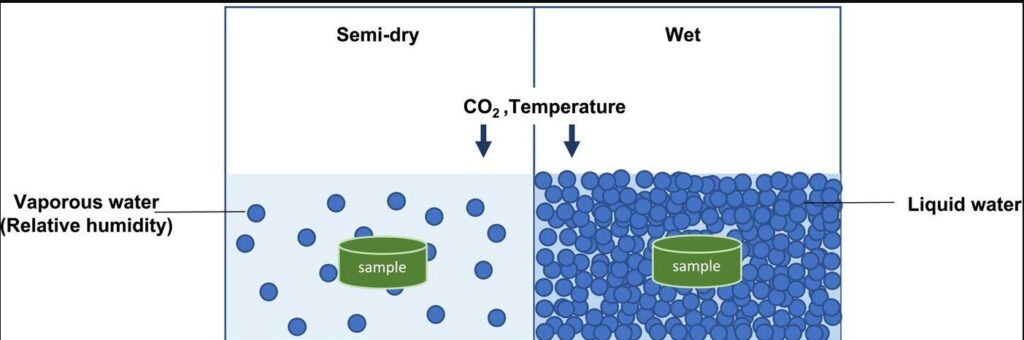
In dense cities such as Hong Kong, demolition produces mountains of concrete waste. Much of it ends up in landfills, even when recycled concrete aggregate (RCA) could substitute for natural aggregates in new construction. But RCA tends to be porous and absorb water, which weakens concrete made with it. To tackle both waste and emissions, researchers at Hong Kong Polytechnic University have developed a semi-wet carbonation technique that strengthens RCA while capturing carbon dioxide, says Tech Xplore.
Traditional carbonation methods fall into two camps: semi-dry, which uses high humidity but limited liquid water, and wet, which immerses RCA in water. Semi-dry is simpler but slow, because CO₂ and calcium must migrate through vapor and minimal moisture. Wet works faster but needs lots of water and energy for drying, filtering, etc.
The semi-wet approach blends the two. It uses a fine water mist over the RCA surfaces, in effect creating a thin film of water rather than immersion, to allow faster CO₂ and calcium mobility. In experiments, this method achieved about 10.6% carbonation in just 30 minutes, rivaling or exceeding wet carbonation at comparable moisture levels.
On top of that, RCA treated this way had 20% lower porosity and 3.6% less water absorption, improving durability. The method also uses sodium bicarbonate as an accelerator: it raises alkalinity slightly, which helps reduce the energy barrier for turning CO₂ into carbonate ions.
Overall, the semi-wet carbonation method offers a promising path to make concrete recycling more effective. It reduces water use, accelerates reaction speed, improves RCA quality, and captures CO₂. For construction-heavy places looking to cut carbon and resource waste, the technique could shift RCA from being a compromise toward being a high-value, sustainable resource.
