

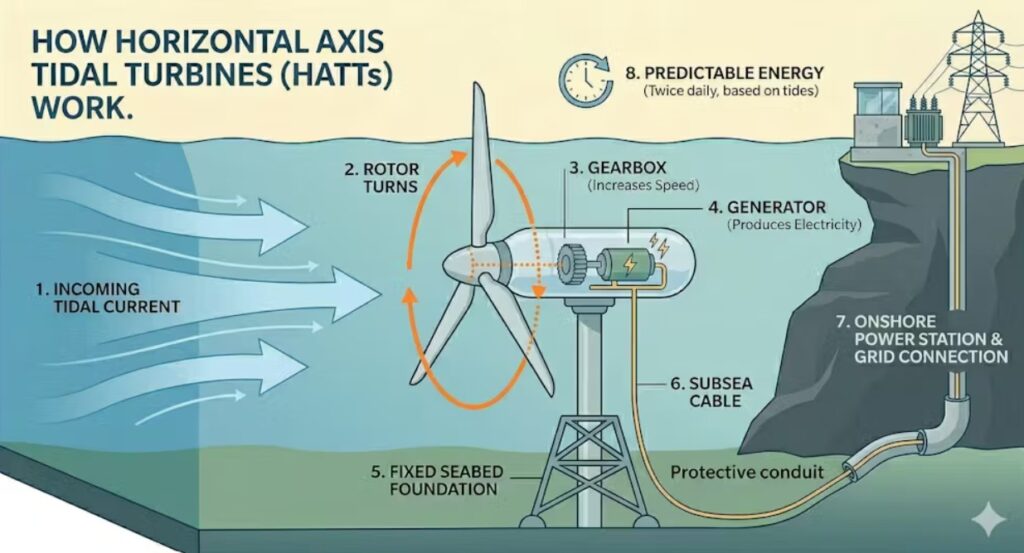
Tidal energy, long overshadowed by wind and solar, is gaining renewed attention as governments look for reliable renewable power. The article from The Conversation examines how underwater turbines, which generate electricity from ocean currents, are attracting policy backing while new research maps their global potential in greater detail.
Unlike wind and solar, tidal energy is highly predictable. Ocean tides follow consistent cycles driven by gravitational forces, allowing energy output to be forecast years in advance. This reliability makes tidal turbines particularly valuable for stabilizing power systems that increasingly depend on intermittent renewables.
The research identifies more than 400 potential tidal energy sites across 19 countries. However, only a fraction of this theoretical resource can be practically harnessed due to environmental, geographic, and economic constraints. Even so, the study finds that 90 of the most viable locations could generate about 110 terawatt-hours of electricity annually, roughly equivalent to the yearly consumption of a country such as Portugal.
Geographically, the strongest opportunities are concentrated in regions with fast-moving tidal currents, such as narrow straits and coastal channels. Countries including the United Kingdom, Canada, the United States, China, and Indonesia stand out as having significant untapped potential. In some cases, tidal energy could supply a meaningful share of national electricity demand.
Despite this promise, the technology faces notable challenges. High installation and maintenance costs, harsh marine environments, and environmental considerations all limit large-scale deployment. Infrastructure such as underwater cables and grid connections also adds complexity.
Government support is helping to address these barriers. Investment programs, pilot projects, and policy incentives are accelerating development, particularly in Europe. These efforts aim to move tidal energy from experimental deployments toward commercial viability.
The article positions tidal turbines as a complementary energy source rather than a replacement for existing renewables. Their predictability and density offer advantages that could fill gaps left by wind and solar. As mapping improves and costs decline, underwater turbines may become an increasingly important part of the global energy mix, especially in coastal regions seeking reliable, low-carbon power.
