

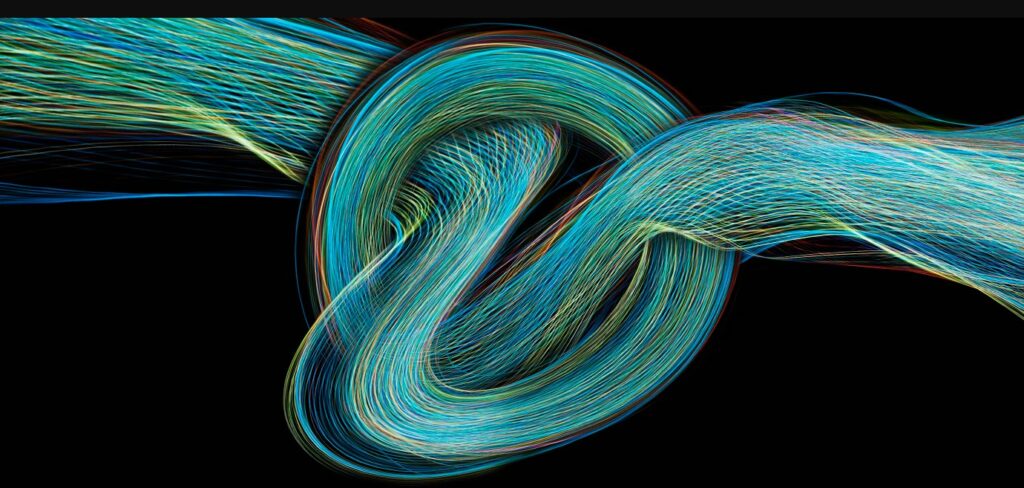
The Conversation article explains a fundamental idea in topology: knots, which are stable in three-dimensional space, cannot exist in four dimensions because the extra dimension allows them to be undone without cutting.
The article begins by clarifying what mathematicians mean by dimension. A dimension represents an independent direction of movement. A line has one, a surface has two, and our physical world has three spatial dimensions. A fourth dimension introduces yet another independent direction, often described through analogies such as moving between frames in a movie.
Knots arise in three dimensions because a one-dimensional object, such as a rope, can cross over itself and become trapped. These crossings create constraints that prevent the rope from being untangled without breaking or passing through itself, which is not allowed in mathematical terms. This is why knots are stable and useful in everyday life.
In four-dimensional space, this restriction disappears. The extra direction allows a strand of rope to move around another strand without intersecting it. The article uses a lower-dimensional analogy: a line drawn on a flat surface blocks two-dimensional creatures, but a three-dimensional being can simply step over it. Similarly, a knot in three dimensions can be undone in four by moving slightly into the additional dimension and then returning.
The article also presents a general mathematical rule: whether an object can be knotted depends on its dimension relative to the space it occupies. A one-dimensional loop can only remain knotted in spaces of up to three dimensions. In higher dimensions, all such knots can be transformed into a simple loop, known as the unknot.
However, knotting does not disappear entirely. Instead, it shifts to higher-dimensional objects. In four-dimensional space, two-dimensional surfaces, such as spheres or sheets, can form complex knots. The study of these structures remains an active area of research, offering insights into geometry and the nature of higher-dimensional spaces.
