

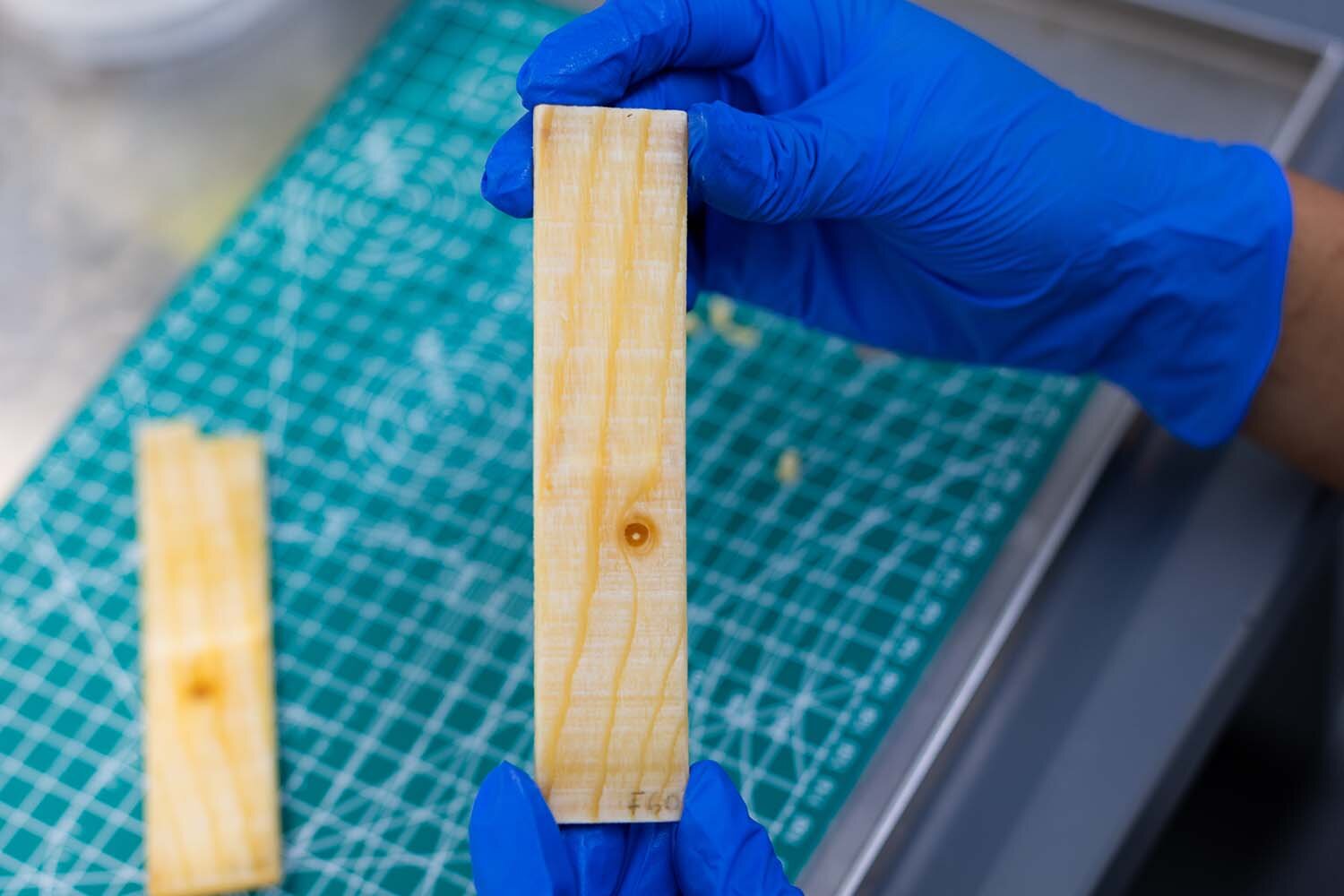
Researchers at the University of Texas at Dallas and collaborators have developed a new wood-based composite that stores and discharges heat, offering a way to manage indoor temperatures without relying on conventional heating or cooling systems. The material functions like a thermal battery: it absorbs heat, stores it, and releases it later, potentially smoothing temperature swings in buildings and reducing energy use for air conditioning and heating, tells Tech Xplore.
The core of the innovation lies in combining a phase-change material with a specially prepared wood structure. Traditional phase-change materials can capture heat as they melt and release it as they solidify, but they often leak when they transition to liquid. To prevent this, the researchers removed lignin from natural wood to create a spongelike, porous framework. They infused this scaffold with a phase-change compound blended with a soft polymer that holds the mixture in place even when it melts. The resulting wood composite retained its mechanical strength through more than 1,000 heating and cooling cycles, a key factor for long-term use in construction applications.
The process leverages the natural structure of wood, transforming what is typically a structural material into one with active thermal properties. This contrasts with conventional building materials that passively resist heat flow; the new composite actively stores energy for later use. In summer, it could absorb excess heat and reduce the rise in indoor temperatures, limiting the need for air conditioning. In cooler periods, stored heat could help maintain comfort without extra energy input.
The development was published in Materials Today Energy as part of a special issue celebrating promising early-career scientists. The research team included doctoral students and collaborators from national laboratories and universities, and they intend to further refine and commercialize the technology. By integrating this composite into drywall, flooring, or roofing, buildings might achieve better thermal performance while cutting electricity demand.
