Gunning for Autodesk, this Time with $46 Million

Brian Mathews, CTO and Amar Hanspal, CEO of Motif
Brian Mathews, CTO (left) and Amar Hanspal, CEO of Motif. Both left Autodesk before they were done with AEC. Image: Motif.
Brian Mathews, CTO and Amar Hanspal, CEO of Motif
Brian Mathews, CTO (left) and Amar Hanspal, CEO of Motif. Both left Autodesk before they were done with AEC. Image: Motif.

Motif has the funding and motivation to unseat Autodesk as the AEC software champ. But it will require harnessing AI.

Autodesk has faced a number of challenges from AEC startups — and has swatted them all away. However, the most recent challenge, Motif, has raised $46 million in funding and, more importantly, is led by two highly motivated ex-Autodeskers, each of whom has a score to settle with their previous employer. Amar Hanspal, CEO of Motif, clawed his way up in 15+ years at Autodesk, from product manager to co-CEO, only to lose to Andrew Anagnost in a CEO runoff. Brian Mathews, Motif’s CTO, was a rising star in his own right, serving as VP of Autodesk’s Reality Capture team that Autodesk unceremoniously dumped. Mathews lasted two more years as VP of different Autodesk divisions before rejoining Hanspal, who, in 2018, resurfaced as CEO of Bright Machines.

Back to the Future

If there is any doubt that the pair is gunning for Autodesk, it is erased by Alex Bard, Managing Director of the VC firm Redpoint, the lead investor in Motif, who does everything but name Autodesk when the refers to Motif’s target as “the leader in this space that is 40 years old and has a $60 billion market cap.”

I saw Amar Hanspal for the first time when at then Autodesk CEO Carol Bartz’s side as she tried to defend AutoCAD’s ill-fated release 13 on stage at a SVAPU user meeting in San Jose. Hanspal went on to manage R14 and revive AutoCAD’s fortunes. Hanspal thrived at Autodesk. His deep product knowledge of Autodesk’s core product granted him the utmost respectability among rank-and-file Autodeskers, as well as high credibility with the CAD media. He took on positions of increasing responsibility, finally being appointed co-CEO after CEO Carl Bass was ousted — only to lose out to Andrew Anagnost in 2017.

Hanspal and Mathews left Bright Machines in late 2021. In its first two years, the company generated $30 million in revenue — almost unheard of a Silicon Valley startup.

It’s good to see Hanspal reunited with what may be his true passion: AEC. He’s an admitted fanboy of buildings, including SFO’s International Terminal and the Manhattan’s Freedom Tower. Motif is not Hanspal’s 1st rodeo. He cofounded RedSpark with Dominic Gallello in 1999 and joined Carl Bass at Buzzsaw in 2002. Both were Autodeskers. Both startups failed. Hanspal returned to Autodesk in 2007.

Revenge Motif

Hanspal expresses his frustration with the AEC industry having to use “20th-century tools to design 21st-century buildings.” It is a knock on Revit, no doubt, though Hanspal still thinks of Revit highly enough to bring along Matt Jezyk and Lira N. (Niolovska), VP of Product and VP of Design, respectively, both “early people at Revit.”

I first met Brian Mathews when he was head of Autodesk Labs. Mathews, with an engineering background (EE, master’s and bachelor’s from Cornell) yet still personable and approachable, stood out in a company that had become marketing first. Mathews went on to lead the Reality Capture group. But Autodesk lost interest in the nascent reality capture market and dumped the whole group, leaving most of us scratching our heads. Where did everybody go? Why would Autodesk abandon a market with tremendous potential in which it was sure to be a leader?

Revit: a Love/Hate Story

It’s too early to evaluate what Motif has to offer architects, as it won’t be releasing any products until the middle of the year. However, we can be sure to expect a cloud-based, database-based AEC design and build platform.

Revit is all too easy a target for a well-funded, well-led, AEC-knowledgeable startup. Revit is, after all, an old, desktop-based application that works only on PCs and stores data in a proprietary file format locally, all hallmarks of yesterday’s software. Modern applications, on the other hand, are cloud-based, store their data store in databases, not files, on the cloud, are device independent and available on subscription. Yet, Revit remains Autodesk’s BIM bread and butter.

Understandably, Hanspal would target Revit with all his rhetoric. However, Autodesk, no slouch in marketing, is able to present itself as a thoroughly modern software company and can easily dodge the slings and arrows of outrageous obsolescence, as cast by Motif, by promoting recent AEC applications developed and acquired. Someone wanting to know what Autodesk is all about has to dig through several layers on the company’s website to find Revit. On the surface, Autodesk shows next-gen AEC applications. At its last annual user event, AU, Autodesk led with Forma and ACC — as if the audience, most of them there to learn about AutoCAD, Revit and Inventor (their MCAD application), knew what ACC stood for [Autodesk Construction Cloud]. For Autodesk, ACC was clearly the company’s center of attention — as well as where development resources were devoted, much to the chagrin of Revit users. In fact, Revit users published an open letter to complain about Autodesk’s inattention to Revit. (Read the full story of the complaint and its aftermath in Martyn Day’s coverage in AEC Magazine.)

Getting Over Autodesk: What Does it Take?

Autodesk’s positioning itself as the creator of next-generation AEC software is credit to the company’s marketing and PR departments, both of which have no equal in the industry. To learn that Autodesk’s core AEC design product has a 30-year-old code base takes a bit of digging.

Still, even with genuinely next-generation software, will Motif be able to separate Autodesk from its flock? The millions of AutoCAD users stuck to AutoCAD even after a swarm of AutoCAD clones offered DWG compatibility at a fraction of the cost. BricsCAD, perhaps the most successful challenger, only managed an insignificant slice of the AEC pie, even though founder Erik de Keyser was a trained architect. (Undeterred, de Keyser is trying again with Qonic). Autodesk’s Revit declared itself the inventor of BIM even though Graphisoft’s Archicad was the first to pioneer BIM principles. Autodesk never suffered from SketchUp’s runaway success, even though the amazingly easy-to-use SketchUp had more users than AutoCAD.

Hey, AI. Give Them a Hand

How will Motif be received when it launches in June(?) will be interesting. I would suggest Motif use every available hour and resource to go full-tilt building AI-enhanced features. To go a step further, Motif should consider delaying the launch until it can position itself as totally AI-enabled — and for good reason: it is the lack of AI that makes established CAD companies most vulnerable.

I’m not suggesting Autodesk is standing still with AI; just that it is not moving fast enough. Autodesk’s Research division, led by Mike Haley, may have more papers published on AI than any other design software company, but the pace at which Autodesk is implementing really useful AI for architects (as opposed to what is easy for Autodesk to implement) has been maddeningly slow. The obvious comparison is to tech giant Alphabet, Google’s parent company, which led the tech industry in AI research but was content to roll it out at its leisure. Alphabet got a rude awakening when AI startup OpenAI introduced ChatGPT on November 30, 2022. ChatGPT was an overnight sensation and is now the perceived leader in AI.

We can argue how ChatGPT, a chat robot, a LLM (large language model), is useless for shapes, horrible at math, wrong too often to be of any use in design engineering, but that misses the point: ChatGPT was just the start of an AI revolution. It showed what neural networks can do. The design software industry needs to do with shapes what ChatGPT did with words. The modeling and behavior of physical shapes, be they products, machines, buildings, or their parts and components, could all benefit from AI.

Yet, CAD companies will not apply machine learning to the vast amount of design data at their disposal. Autodesk has ignored pleas to develop and implement slam-dunk AI solutions, such as automatic conversion of 2D views to 3D models. To this day, I cannot sketch a rough floor plan on a screen, have it made precise, much less made into 3D. I cannot take a photo of elevations of my home remodel drawn by a tech-phobic architect and have it automatically turn into an immersive fully rendered environment, either.

AI or Go Home

It is only with AI assistance that Motif could present a clear and dramatic distinction between itself and the established CAD vendors. With a weak implementation of AI, Motif can argue that it is modern until its last breath. We understand Motif will (probably) be database-based, cloud-based and local, with a single source of truth and device independence that lets users work anywhere. For each and all, Autodesk could counter with “Yeah, we got that,” citing examples from Autodesk Construction Cloud and a myriad of internally developed and acquired applications. But rolling out Motif with all the capabilities of next-generation software plus really smart and useful AI functionality would leave Autodesk speechless.

Should Motif take this advice, we have just the slogan for their mid-2025 rollout: “Motif — we’re motiv-AI-ded.”

You’re welcome, Amar.

__________________

CORRECTED February 5, 2025: Hanspal left Autodesk to cofound RedSpark with Dominic Gallello then moved on to Buzzsaw with Carl Bass, not RedSpark with Carl Bass, as initially reported.

This article first appeared in its extended version on LinkedIn here.


photobooth photo of Amar Hanspal and Roopinder Tara
Amar and me. Image: Photobooth at Bright Machines open house.

AI Should Have Detected SoCal Wildfires Early. What Happened?

An ALERTCalifornia camera in Cohasset, California, captured this view in July of the approaching Park Fire, the state’s largest wildfire of 2024. Image courtesy of ALERTCalifornia, the University of California San Diego.

I’ve lived in California for over 25 years. I balance the daily dread of impending disaster, be it earthquake, mudslides, flood or fire, with the beauty, the climate and, very importantly for a tech journalist, being at the center of technology. Although I am in the San Francisco Bay Area, the recent deadly wildfires in Southern California, 500 miles away, still gave me pause — and left me wondering how technology, for which the state is famous, could help detect wildfires.

Surely, I couldn’t be the first person to expect AI to help nip wildfires in the bud. Sure enough, a team at the University of California San Diego had been at this for years. They took it upon themselves to create a wireless network that uses high-definition cameras to monitor quite a bit of the state of California for fires in their early stages when they can be easily contained and extinguished. The result: ALERTCalifornia.

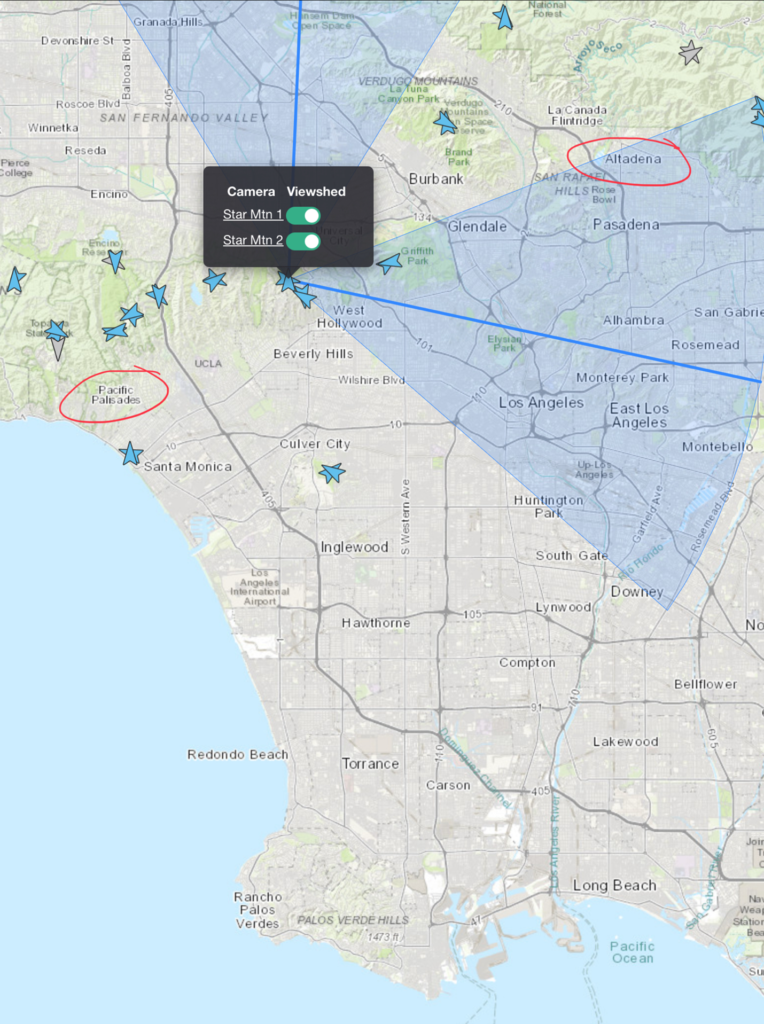
I admit my first act upon hearing about ALERTCalifornia was utterly selfish: I checked if my house was covered. It was. Two cameras were on top of Mt Burdell, a mile from my home, and were scanning my neighborhood. Remembering the poor, wretched people of Southern California, I pull myself out of my well-protected neighborhood to see what coverage was afforded those in the Los Angeles area, those hardest hit by the recent wildfires. They were. There were, in fact, a ring of cameras around the city of Los Angeles.

My excitement at finding out that AI had been on the job quickly gave way to a question: Why with quick AI-assisted wildfire detection did the wildfires get out of control and burn down entire neighborhoods? Was ALERTCalifornia able to alert the fire departments in time? If not, why not?

ALERTCalifornia, an AI-based wildfire detection system, had several watchtowers overlooking the recent California wildfires, including the Palisades and the Altadena fires (circled). Image: ALERTCalifornia.

ALERTCalifornia, California’s Best Kept Secret.

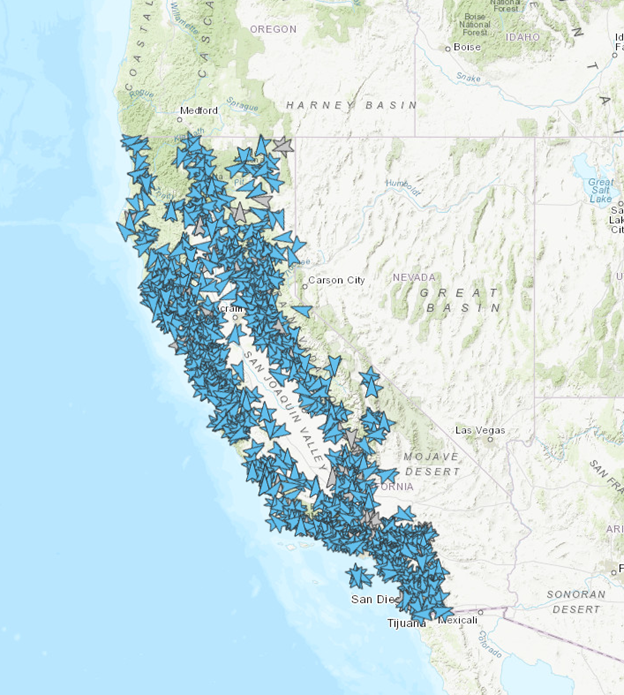
Why had I not heard of a wildfire detection system as big as ALERTCalifornia? Over 1100 camera systems, including two that were visible from my favorite hiking path. Could this be California’s best-kept secret or is it just me that needs to get out more? A quick survey of friends and family convinced me of the former. Everyone I asked about ALERTCalifornia thought it was a good idea but none had heard of it.

ALERTCalifornia 360-degree camera station powered by solar. Image: ALERTCalifornia.
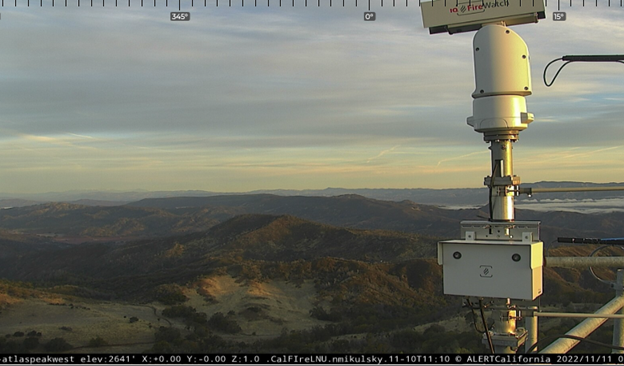
High-definition camera system on Atlas Peak. Image: ALERTCalifornia.

The ALERTCalifornia network relies on over 1100 cameras, many of them with a 360-degree view, most mounted on towers, many on hilltops. The high-definition cameras are able to pan, tilt and zoom. Camera control is limited to first responders; however, the public is limited to routine sweeps or, in the case of a fire, a human operator has locked into a fire, seeing what they see.

The high-definition cameras do a 360-degree sweep approximately every two minutes, capturing 12 high-definition frames per sweep. They also provide 24-hour monitoring with up to 60 miles on clear days and with near-infrared night vision, 120 miles on clear nights.

An enclosure below the camera houses the transmitting hardware that wirelessly connects to fire monitoring hubs operated by CAL FIRE fire, plus a power supply and backup batteries.

ALERTCalifornia seems to make use of existing towers wherever possible, taking advantage of electric power supply but in remote areas, they construct their towers and use solar panels for power.

Hills of Fire

Forty-five of the over 1100 ALERTCalifornia live feeds were offline at the time of this writing, including Mt. Diablo, the tallest point in the East Bay area of the San Francisco Bay Area. There is no information made public on the cause, but running out of power is certainly a possibility.

The Hughes Fire burned over 10,000 acres across Los Angeles and Ventura counties, while fires in Riverside County tragically took three lives and destroyed dozens of homes. In Altadena, a fast-moving fire consumed several hillside acres, threatening neighborhoods before firefighters managed to contain its spread. It was the Palisades Fire that got most of the attention as it scorched a heavily wooded area in one of the more affluent areas of Los Angeles neighborhoods, home for celebrities and millionaires.

Map of California showing locations of live camera feeds for UC San Diego’s ALERT California program. ALERTCalifornia, run by the University of California in San Diego, has established a statewide network of more than 1,140 cameras equipped with AI.
CAL FIRE firefighters monitor ALERTCalifornia cameras and AI for active incidents. The award-winning AI tool helps reduce watch fatigue and improve response times to fires across California. (Credit: CAL FIRE)
ALERTCalifornia was selected as one of the best inventions of 2023 after early successes in detecting wildfires.

Compilation of the Palisades Fire, the single most destructive fire in terms of property damage in California. CREDIT: ALERTCalifornia | UC San Diego

Human in the Loop

ALERTCalifornia is intended to augment California’s full-time fire spotters, not replace them. I imagine it to be a welcome technology, saving fire spotters from the dreary task of watching absolutely nothing for over 99% of the time. In addition, the human fire spotter is limited by fog and darkness. The AI system doesn’t get bored, and with FLIR, forward-looking infra-red, able to see through fog and darkness.

Upon detection of what might be a fire, ALERTCalifornia’s AI scans camera images looking for “anomalies,” explains Sean Landavazo, Intel Battalion Chief at Cal Fire.

“When we go in and look at the anomalies, it [the AI] gives us a 55% chance that it smoke—not fog, dust, shadows,” says Landavazo in a video shot about a year ago, “and we are training it to get better.”

The Competition

Private companies, such as Pano AI, also offer AI-assisted wildfire detection. Pano’s system is very similar to ALERTCalifornia in that it also integrates ultra-high-definition cameras, satellite data and sensors to deliver real-time wildfire detection. Pano systems have been deployed in California, other western states, Texas, and other states and countries, including Australia and Canada.

Pano AI’s customers include government agencies, power utilities, private forest owners, and ski resorts. It charges $50,000 per year as an all-in fee, covering its camera stations as well as software, maintenance, notifications, and services.

The company says its systems now monitor nearly 20 million acres around the world and have spotted almost 100,000 fires.

Other startups, including Dryad and Robotics Cats, are also using sensors, satellites, cameras, and AI to improve wildfire detection.

Little Fires, Big Wins

ALERTCalifornia makes a big deal out of putting out small wildfires. That is exactly how it should work. It is intended to be the canary in the coal mine, so to speak. When it works, it is an almost insignificant fire — but a bit AI story.

ALERTCalifornia scored an early success in detecting a fire in Grass Valley at 5:19 am on September 11, 2023. The first 911 call reporting the fire did not come in until 40 minutes later. By then, firefighters were already on the scene.

In the first two months of its implementation, ALERTCalifornia issued 77 alerts of wildfires before 911 calls were made, according to Time magazine.

ALERTCalifornia alerted the Orange County Fire Agency of an “anomaly’ which turned out to be a vegetation fire in the Black Star Canyon area at 2 am on December 4, 2024. The fire department swooped down on the fire and limited the burn to less than a quarter-acre.

Blind Spots

But as extensive as the coverage of ALERTCalifornia may seem, it may not be enough. California is a big state and 1,100 cameras provide a fishnet rather than blanket coverage. My house, for example, is not in the line of sight of any of the close-by cameras as a hill obscures it. ALERTCalifornia desperately needs more cameras yet does not allow Californians to volunteer their cameras, according to the FAQs on the ALERTCalifornia site.

It’s possible that ALERTCalifornia cameras spotted the fire and the message did not get to firefighters. Or so many alerts were issued that harried fire departments could not keep up. Fire crews could have undermanned or run into other snags, like no water supply, that prevented them from containing the fires. Or did the Santa Ana winds, blowing at gale force make fire spread inevitable?

We can only hope that the official investigations that are sure to follow will shed some light on the failures, whether they be the AI, infrastructure, manpower or bureaucratic missteps. Or will corrections and blame be of little use in a state that must come to terms with inevitable firestorms, with every rainy winter growing vegetation that turns into fuel in dry, hot summers?

Gauzy, Ambarella Partner on AI-Powered ADAS Tech

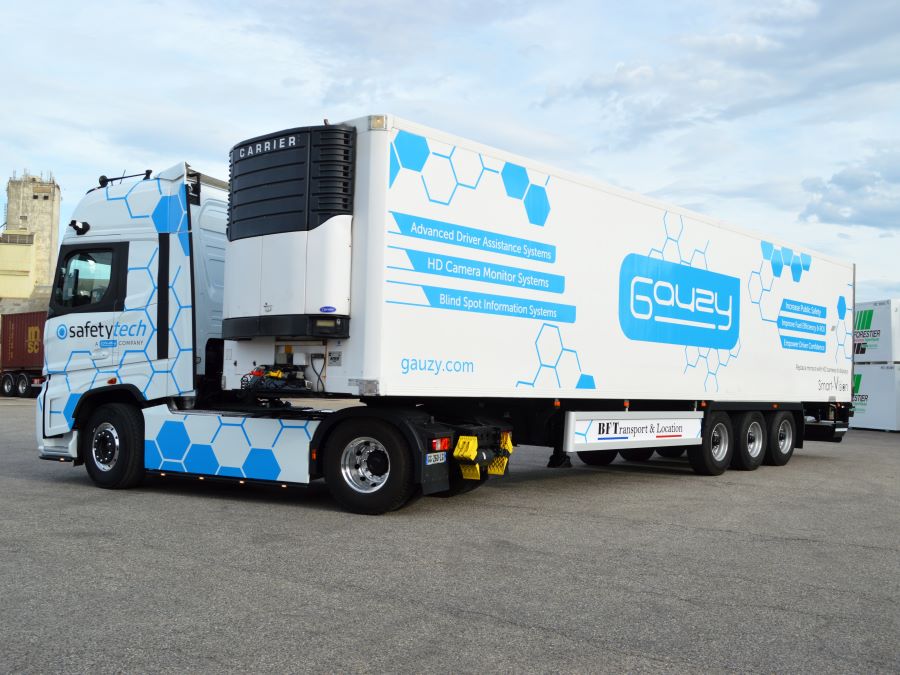
NEW YORK and SANTA CLARA, CA, Feb 3, 2025 – Gauzy Ltd. has announced that its partnership with edge AI semiconductor company, Ambarella, Inc. , has led to innovations in the AI-ification of advanced driver assistance systems (ADAS) and their potential to enhance road safety and redefine urban mobility. Incorporating a CVflow AI system-on-chip (SoC) from Ambarella’s portfolio into the design of Gauzy’s AI-powered Smart-Vision camera monitor system (CMS) enhances road safety for drivers of commercial vehicles. The Gauzy solution, based on Ambarella’s CV2FS AI SoC, is already operational in Ford Trucks.

CMS replaces conventional side and rearview mirrors with high-resolution cameras fitted on the vehicle. Often called e-mirrors, these systems stream live video footage on interior screens. They provide a wider field of view, reduce blind spots, and enhance road safety and visibility.

AI-powered Smart-Vision CMS, based on Ambarella’s CVflow AI accelerator, features self-learning and predictive capabilities. These include adaptive maneuver lines that are displayed while a vehicle is in motion and during trailer calibration to provide drivers with better visibility of their surroundings, as well as the ability to analyze large amounts of data and imagery for reduced latency and real-time visibility. Moreover, Smart-Vision system is designed to spot potential road hazards early, helping to significantly lower the risk of accidents or fatalities. The system delivers rich visibility with quality images, across a wide variety of weather or lighting conditions. The Smart-Vision CMS’s monitoring feature helps prevent theft and vandalism, works with different truck models and configurations, and integrates easily into existing fleets.

“It’s highly rewarding for us to be working so closely with Ambarella, a global leader in edge AI vision processing, to advance the functionality and quality of Smart-Vision,” stated Eyal Peso, CEO of Gauzy. “World-renowned brands like Ambarella trust Gauzy to utilize their proprietary technology to their full potential, and partner with us because of the success our products can have on saving lives and reducing costs. We recognized early on the monumental impact AI will have in redefining mobility and are proud to have already developed what we believe is the most sophisticated AI-powered ADAS solution on the market. We believe that enhancing our Smart-Vision® system with Ambarella’s CVflow AI SoCs, which provide industry-leading AI performance per watt, provides OEMs with an innovative solution as part of their ongoing efforts to improve the safety of their fleets.”

The advanced smart-vision system is more popular with OEMs due to its cost, safety, and environmental advantages over traditional mirrors. As a result, OEMs are upgrading existing fleets with ADAS technology like Smart-Vision and integrating it into the designs of new models an escalating pace.That is a reason why the commercial-vehicle ADAS market is expected to reach more than $43 billion by 2030, according to Research and Markets. Replacing standard mirrors on trucks and buses with smart-vision improves safety by reducing errors, improved night vision, fewer blind spots, and enhancing obstacle and pedestrian detection. Additionally, the system offers better fuel efficiency, lower upkeep costs, and higher productivity.

Peso added, “Despite the tremendous advancements we have already made in ADAS, we are still at the beginning of the AI-ification of vision control. We will continue to innovate and improve the quality of our products, to retain our competitive edge and produce for our shareholders. We are energized by the strong demand for our Smart-Vision® CMS and believe that we are well-positioned to capitalize on the renewed emphasis on safety in urban and intercity transport.”

One key feature of Gauzy’s smart-vision system using Ambarella’s CVflow AI SoCs is its advanced image processing ability. This reduces latency and supports tasks like detecting vulnerable road users (VRUs), classifying objects, recording data, and streaming video. The architecture also lets Gauzy’s development team adjust settings to achieve better image quality with accurate color and contrast, essential for reducing driver fatigue.

“Our partnership with Gauzy demonstrates the power of what’s possible when two forward-thinking organizations with similar values work together to tackle industry challenges,” commented Fermi Wang, president and CEO of Ambarella. “We were motivated to help Gauzy and its OEM customers address the millions of road traffic fatalities that are estimated to occur each year, and we believe the Smart-Vision® CMS, with our CVflow AI SoCs, has the potential to drive this number lower. There is universal support for making our roadways safer, and we are pleased to help play a role in this effort through the application of our technology.”

The smart-vision CMS has passed homologations and certifications for safety, including United Nation (UN) R46, UN R10, UN R118 and UN R151, as well as cybersecurity Automotive Spice standards set by OEMs, including UN R155 and UN R156.

About Gauzy

Gauzy Ltd., established in 2009 and headquartered in Tel Aviv, Israel, is a leader in vision and light control solutions. The company specializes in developing, manufacturing, and marketing technologies such as suspended particle devices (SPD) and liquid crystal (LC) films for smart glass applications, as well as advanced driver assistance systems (ADAS) and camera monitoring systems (CMS). Gauzy serves various industries, including automotive, aeronautics, architecture, and safety technology. As of 2024, the company employs approximately 640 people. In the trailing twelve months ending June 30, 2024, Gauzy reported revenues of approximately $90 million. With a global presence, including production facilities in Israel, Germany, Canada, China, Singapore, France, United Arab Emirates and the United States, and sales and marketing centers in multiple countries, Gauzy continues to innovate in light and vision control technologies, transforming user experiences across various sectors.

About Ambarella

Ambarella, Inc., founded in 2004 and headquartered in Santa Clara, CA, is a fabless semiconductor design company specializing in low-power, high-definition (HD) and Ultra HD video compression, image processing, and computer vision processors. The company’s system-on-chips (SoCs) are utilized in various applications, including video security, advanced driver assistance systems (ADAS), electronic mirrors, drive recorders, driver and in-cabin monitoring, autonomous driving, and robotics. Ambarella serves industries such as automotive, security, consumer electronics, and industrial automation. As of 2024, the company employs approximately 915 individuals. In the fiscal year ending January 31, 2024, Ambarella reported revenues of $226.5 million.


SICK Acquires Accerion, Expands Autonomous Mobile Robot Solutions

WALDKIRCH, Germany, Jan 31, 2025 – SICK has announced the acquisition of the Dutch technology company Accerion. Accerion specializes in AI-based image processing with a focus on positioning technologies for mobile robots. Autonomous Mobile Robots (AMR) are primarily used in logistics and manufacturing. They improve efficiency by automating tasks in warehousing, intralogistics, manufacturing, and other industries. With the acquisition of Accerion, SICK will offer a complete solution portfolio of positioning solutions.

Innovation Hub for Software-Driven Localization

Accerion was founded in 2015 in the Netherlands and has established itself as a tech startup specializing in AI-based image processing for the positioning of autonomous mobile robots. With the software-driven positioning solution “Triton”, Accerion introduced the world’s first industrialized, infrastructure-free localization solution for floor structures based on camera technology for mobile robots. Since 2021, SICK has been partnering with Accerion to support industrial customers worldwide in the precise localization, positioning, and navigation of mobile robots.

Accerion Now Part of the SICK Group

With the acquisition, the entire product portfolio and the Accerion team with technology and sales experts, fully transitioned to SICK on January 16, 2025. The product development of the new SICK subsidiary “SICK Accerion B.V.“ will continue at the current location in Venlo, Netherlands.

SICK Expands Software Portfolio for Autonomous Mobile Robots

Dr. Niels Syassen

“We are very pleased to welcome the Accerion team to SICK and to further strengthen our software portfolio for autonomous mobile robots for the future,” says Dr. Niels Syassen, executive board member for Technology & Digitalization at SICK. “The market for sensor solutions for autonomous mobile robots offers enormous growth potential, as the demands on industrial companies for an efficient supply chain in terms of throughput, availability, flexibility, and safety are steadily increasing. To best support customers worldwide in their automation projects, we are further developing our own sensor solutions and investing in new technologies,” adds Dr. Niels Syassen.

Vincent Burg

Vincent Burg, CEO of Accerion, says: “With our dedicated team, we built Triton, a cutting-edge localization solution, entirely from the ground up. Today, Triton delivers high-performance localization for thousands of robots around the globe. Our close collaboration with SICK has shown how perfectly our products and cultures complement one another. We are thrilled to officially join the SICK family, where we can leverage this synergy to scale localization solutions worldwide.”

Autonomous Mobile Robots – a Global Growth Market

The global market for Autonomous Mobile Robots is valued at about four billion euros. With growth rates exceeding 15 percent, industries like intralogistics focused on efficiency are increasingly adopting these robots. Advanced sensors and software for navigation, localization, and positioning allow mobile robots to move accurately and safely in changing environments. When working near people, it is critical for autonomous robots to detect surroundings and human presence.

About Accerion

Accerion is a technology startup based in Venlo, Netherlands, established in 2015 by Willem-Jan Lamers. The company specializes in developing advanced, infrastructure-free positioning technology for mobile robots and automated guided vehicles (AGVs). Their innovative sensors provide sub-millimeter accuracy, enabling precise navigation in dynamic environments without external infrastructure. This technology is particularly beneficial in industries such as warehousing, manufacturing, and logistics, where automation and efficiency are paramount. As of 2025, Accerion operates in 13 countries, serving key customers across multiple markets.

About SICK

SICK AG, founded in 1946 by Dr. Erwin Sick, is a global provider of sensor-based solutions for industrial applications. Headquartered in Waldkirch, Germany, the company specializes in intelligent sensors and systems that improve automation across various sectors, including factory, logistics, and process automation. SICK’s product portfolio comprises of photoelectric sensors, safety light curtains, laser scanners, and identification solutions like barcode scanners and RFID readers. These technologies are integral to industries such as automotive, electronics, food and beverage, and packaging, where they ensure efficient process control, safety, and environmental protection. With nearly 60 subsidiaries and numerous agencies worldwide, SICK employs over 12,000 people and reported a group revenue of €2.3 billion in the 2023 fiscal year.

Source: SICK AG

ENGtechnica Introduces “Best Green Tech Award” at CES 2025, Honoring Innatera for Energy-Efficient Innovation

LAS VEGAS, NV, Jan 31, 2025 – Inspired by the groundbreaking advancements showcased by Innatera at CES 2025, ENGtechnica is proud to introduce its inaugural “Best Green Tech Award.” The first-ever recipient of this distinction is Innatera, recognized for its T1 SNP (Spiking Neural Processor)—a pioneering technology that, by being located near the sensor and remaining dormant most of the time, consumes just 1/500th of the energy of a GPU-based system.

“With data centers full of GPU-based servers proliferating, it’s good to know that companies like Innatera offer an energy-considerate alternative to the considerable energy demands made to satisfy AI demand,” said Roopinder Tara, Editor-in-Chief of ENGtechnica, as he presented the award.

The T1 SNP represents a significant step forward in sustainable computing, helping to redefine the balance between performance and energy efficiency. As AI workloads continue to grow, Innatera’s innovation provides a compelling, eco-conscious solution that could reshape the future of AI processing.

“We are truly honored to be the first recipient of this award, which reflects Innatera’s commitment to addressing the environmental challenges posed by the growing adoption of AI technologies,” said Sumeet Kumar, CEO of Innatera. “At Innatera, we strongly believe that sustainability and innovation must go hand in hand. Furthermore, our vision for Ambient Intelligence is central to everything we do. The energy-efficient Spiking Neural Processor embodies this vision, enabling technology to seamlessly integrate into our environments, respond intelligently to context, and operate sustainably at the edge.”

To learn more about Innatera’s T1 SNP:

🔗Read more here

About ENGtechnica

ENGtechnica is a trail-blazing technology-centric media platform dedicated to covering innovations that shape the future of engineering, computing, and sustainability. With a focus on design, engineering, manufacturing and building, emerging trends in AI, modern product design, and green technology, ENGtechnica provides broad news coverage and offers in-depth analysis and insights to engineers, technologists and industry leaders. The “Best Green Tech Award” is part of ENGtechnica’s commitment to designing and engineering while considering social consequences and environmental cost.

For media inquiries, please contact:
Roopinder Tara
Editor in Chief, ENGtechnica
roopinder@engtechnica.com

📧 roopinder@engtechnica.com
📞 415.328.4309
🌐 engtechnica.com

Buildots, Revizto Integrate for Centralized Construction Management

TEL AVIV, Israel and LAUSANNE, Switzerland, Jan 31, 2025 – Buildots and Revizto have announced a strategic integration that enables construction teams to maximize the full capabilities of both platforms while centralizing issue management and streamlining construction management workflows.

Image: Buildots

The integration allows construction teams to leverage Buildots’ comprehensive AI-driven performance tracking and analysis while managing project communication and collaboration through Revizto’s platform. Teams can now transfer construction issues identified by Buildots’ AI-powered progress tracking platform into Revizto using the BCF format. Each exported issue contains documentation, including photos taken by Buildots and exact BIM model locations. This helps teams understand and resolve issues before they turn into expensive delays or complications. By simplifying workflows and speeding up issue resolution, this integration boosts efficiency and improves project performance.

Roy Danon, co-founder of Buildots said, “This integration represents a step forward in our mission to help construction teams deliver on time and on budget through data-driven insights. By connecting those insights identified by Buildots directly with Revizto’s collaboration platform, we’re providing teams with a simple, unified, issue management workflow from end to end, enabling them to collaborate and solve problems more effectively than ever.”

Key Features of the Integration Include:

  • Centralized issue management across platforms
  • Rich visual context with real-world photo documentation
  • Export of Buildots-detected construction deviations to Revizto via BCF integration
  • Precise BIM model location mapping for each issue

Arman Gukasyan, founder and CEO of Revizto said, “Construction teams need effective ways to identify and mitigate potential issues before breaking ground. With Revizto they can automatically detect clashes in the design phase, enabling them to preempt expensive project delays and overages. The integration with Buildots brings the power of AI-driven predictive analytics directly into our platform, helping teams maintain better project oversight and work more efficiently.”

About Buildots

Buildots, founded in 2018 and headquartered in Tel Aviv, Israel, specializes in AI-driven construction management solutions. Their platform leverages AI and computer vision to transform construction sites into fully digitized environments, presenting features such as progress tracking, work planning, predictive analytics, and delay forecasting. These tools provide project managers and owners with actionable understandings to enhance operational efficiency and reduce delays by up to 50%. Serving the construction industry, Buildots has secured significant investments, including a $15 million funding round led by Intel Capital in July 2024, bringing its total financing to $121 million. As of 2024, the company employs approximately 200 people.

About Revizto

Revizto, established in 2008 by Arman Gukasyan and headquartered in Lausanne, Switzerland, offers an integrated BIM collaboration platform tailored for the architecture, engineering, construction, and operation (AECO) industry. Their software facilitates real-time coordination by unifying 3D and 2D workflows, enabling project stakeholders to manage issues within an environment. Key features include automated clash detection, issue tracking, and support for various file formats, enhancing project efficiency and reducing rework. Serving a global clientele, Revizto’s platform is utilized by over 100,000 AECO professionals across 150 countries. As of 2023, the company employs more than 140 individuals.

Source: Revizto

Altair Names Sistemi HS as Channel Partner for Italy

TROY, MI, Jan 31, 2025 – Altair has named Sistemi HS as a channel partner for Italy. Sistemi HS will offer Altair’s comprehensive portfolio of electronics, data analytics, and simulation solutions to customers throughout Italy.

“Altair’s mission is to help customers transform their businesses by leveraging world-leading computational intelligence,” said Kimon Afsaridis, managing director of Eastern Europe and vice president of indirect EMEA sales, Altair. “By partnering with Sistemi HS, we further expand our reach in Italy and provide even more organizations with advanced technologies that accelerate innovation and drive meaningful outcomes.”

“We are thrilled to announce our partnership with Altair strengthening our commitment to delivering cutting-edge technology solutions,” said Domenico Condelli, general manager, Sistemi HS. “This collaboration helps us combine our expertise with Altair’s best-in-class technologies, creating exceptional value for our clients and driving digital transformation across key industries.”

About Altair

Altair Engineering Inc., founded in 1985 and headquartered in Troy, Michigan, is a global leader in computational science and AI. The company offers software and cloud solutions across various domains, including product development, high-performance computing (HPC), simulation, AI, and data analytics. Altair’s comprehensive, open-architecture platforms empower organizations to design more efficient and sustainable products and processes. Serving industries such as automotive, aerospace, and manufacturing, Altair has established itself as a key player in engineering and enterprise analytics. In 2024, Siemens announced its agreement to acquire Altair for $10.6 billion, aiming to strengthen its position in industrial software.

About Sistemi HS

Sistemi HS, is an Italian system integrator headquartered in Collegno, Italy. The company specializes in providing IT infrastructure and managed services to a diverse clientele, including large corporations, small and medium-sized enterprises, professional firms, and public administration. Their offerings encompass servers, storage solutions, software, networking, security, cloud services, connectivity, and telecommunications. Sistemi HS has formed strategic partnerships with leading global IT vendors and holds significant certifications, such as being a Platinum Partner with HP and Hewlett Packard Enterprise for over two decades. As of recent data, the company employs approximately 200 individuals.

Source: Altair

Oxyle Raises $16M to Scale PFAS Removal Technology

ZURICH, Switzerland, Jan 31, 2025 – Swiss startup Oxyle has announced a $16m funding round to scale its breakthrough solution to destroy, not just relocate, PFAS from wastewater. This builds on its $3M pre-seed round in 2022, growing support for its mission.

360 Capital led the seed round, that included participation from Axeleo Capital and returning investors Founderful and SOSV.

Industries have faced challenges in PFAS treatment, as existing methods like filtration and adsorption transfer PFAS from water to solid waste streams. The existing processes often require incineration or landfilling, that can lead to potential environmental contamination through air or soil. Some technologies are capable of breaking down PFAS, however, their high energy consumption makes large-scale implementation costly for many organizations.

Oxyle’s technology represents the world’s first economical and permanent solution to PFAS contamination. Oxyle’s system destroys PFAS molecules, achieving over 99% elimination rates while consuming at least 15 times less energy than alternative destruction methods. The system’s three-stage process combines foam fractionation, catalytic destruction, and real-time monitoring powered by machine learning – all housed in a modular system that eliminates the need for secondary waste disposal through incineration or landfilling. Whereas traditional solutions require weeks-long lab analysis, Oxyle’s proprietary monitoring system provides instant feedback and continuous treatment optimization.

“Five years ago, Oxyle was two of us founders and one big idea: get rid of forever chemicals from our water. Today, that idea is proven, implemented, and ready to scale. This funding is a game-changer. It gives us what we need to take our technology to the industries and communities that need it most. To our investors, old and new, thank you for joining us on this mission to make clean water a reality for all.” says Dr. Fajer Mushtaq, CEO & co-founder, Oxyle.

CTO Dr. Silvan Staufert and CEO Dr. Fajer Mushtaq

The company was co-founded by Fajer Mushtaq and Silvan Staufert at ETH Zurich, where Mushtaq earned her PhD in micro- and nanosystems focused on water remediation – inspired by her experiences with water scarcity in Delhi – while Staufert completed his PhD in mechanical and process engineering. Understanding that water treatment innovations couldn’t come soon enough, they developed a technology to degrade “forever chemicals” in minutes. They knew their breakthrough could change the world, but only if it moved from lab to reality.

In just four years, the duo transformed Oxyle from innovation to implementation. The company has grown to a team of 26, completed over 20 customer projects, and secured prestigious recognition including the Swiss Technology Award, SEIF, and WEF’s Uplink Top Innovators.

The technology’s effectiveness has been proven across multiple applications. In groundwater treatment, PFAS concentrations are reduced from 8,700 ng/l to below 14 ng/l. It achieves 99.8% removal of 11 different PFAS species for soil wash water. It eliminated 98% of short-chain PFAS and reduced trifluoracetic acid (TFA) concentrations by 96% in trials with an industrial customer. Most significantly, in November 2024, Oxyle deployed its first full-scale system in Switzerland, treating 10 cubic meters of contaminated groundwater per hour at less than 1 kWh/m³.

“We are proud to lead the investment in Oxyle, whose pioneering technology addresses the massive global challenge of PFAS pollution,” says Thomas Nivard, partner at 360 Capital. “Unlike traditional methods that merely contain these harmful chemicals, Oxyle’s solution destroys them permanently, setting a new standard for tackling this urgent environmental crisis. This is a game changer. The team’s exceptional commercial and technical momentum has laid a strong foundation for establishing a true technology leader in the coming years.”

The need for Oxyle’s solution is urgent. Increasing PFAS-related lawsuits and billion-dollar settlements in the U.S. are pressuring companies to find preventive solutions. Tightening regulations in the EU and U.S. are driving demand for advanced treatment technologies to meet compliance standards and reduce risks. Data from the Forever Lobbying Project reveals the high cost of inaction. Cleaning up Europe’s soil and water from PFAS contamination could cost €100 billion per year, totaling €2 trillion over the next 20 years.

Looking ahead, Oxyle aims to treat 100 million cubic meters of contaminated water in the next five years. The company plans to expand its solution across industries, from chemical and consumer goods manufacturing to semiconductor production and municipal water treatment – ultimately restoring and protecting our waters from Forever Chemicals, down to the very last drop.

About Oxyle

Oxyle is the world’s first economical, sustainable, and permanent answer to PFAS contamination. The breakthrough PFAS catalytic destruction technology empowers industrial and environmental remediation companies in their fight against PFAS. Oxyle doesn’t just filter or adsorb PFAS; it eliminates it entirely to below detection limits. With a 15x lower average energy consumption than other destructive treatments, it is the most energy-efficient, cost-effective treatment on the market. Established in 2020, Oxyle is is on a mission to protect water from PFAS. As of Jan 2025, Oxyle has secured a total of $26 million in funding, including non-dilutive grants and awards. The company employs approximately 30 people.

Select Keysight, UMA Open 6G Research, Innovation Lab

SANTA ROSA, CA, Jan 31, 2025 – Keysight Technologies and the University of Malaga (UMA) have opened a 6G research and innovation Lab. The facility is dedicated to advancing 6G technology through comprehensive solutions that address key use cases and technological challenges.

The Malaga 6G Research and Innovation Lab plays a key role in Keysight’s European operations. Keysight Laboratories works with customers, markets, universities, and research groups while contributing to various consortia, industry organizations, and standards committees.

The lab features three main workspaces: Monitor, Measurement, and Experience. The Monitor workspace enables real-time monitoring of the 5G and 6G mobile network experimentation platform Victoria Network. The Measurement workspace will be equipped with Keysight’s latest hardware and software test and measurement solutions, while the Experience workspace will showcase 6G use cases and technology demonstrations, providing a hands-on experience.

Research at the lab will focus on the following areas:

  • New Spectrum and Components – Satisfying the demand for high speed and data throughput with innovative frequency technology and novel component design.
  • AI and ML Networks – Enhancing network performance by integrating intelligent and efficient artificial intelligence and machine learning solutions.
  • Digital Twins – Creating virtual replicas of physical entities, providing a zero-risk environment for testing and development.
  • Networked Sensing – Utilizing the network to sense and interact with the world around us, enabling new applications and services.
  • New Network Topologies – Developing open and scalable network architectures to ensure extreme connectivity and reliability.
  • Security and Privacy – Ensuring that network infrastructure components are robust and secure against cyberattacks, supporting critical services with high reliability.


Giampaolo Tardioli, vice president, 6G and next generation technology at Keysight, said, “The new lab will serve as a hub for innovation and collaboration in the 6G space, driving the development of next-generation technologies that will shape the future of connectivity and communication. By providing an environment that offers a cohesive set of design and development building blocks across interconnected technology domains, we enable researchers to spark new insights. The 6G Research and Innovation lab will be pivotal in bringing use cases to life, enhancing human interactions, improving enterprise efficiencies, and accelerating innovations that will transform society.”

Pedro Merino, director of Institute of Software Engineering and Technologies (ITIS) at the University of Malaga, said: “The establishment of the Victoria Network and the 6G Keysight-UMA laboratory positions us as an international benchmark for fostering collaborations with companies and governmental bodies in the 6G sector. This initiative represents a significant opportunity for advancing research and innovation, and it is instrumental in driving forward our mission to lead in 6G technology development.”

About Keysight Technologies:

Keysight Technologies, established in 2014 as a spin-off from Agilent Technologies, is a leading provider of electronic design and test solutions. Headquartered in Santa Rosa, California, the company offers a portfolio of hardware and software products, including oscilloscopes, signal generators, and electronic design automation (EDA) software. The solutions serve industries, such as telecommunications, aerospace and defense, automotive, energy, semiconductor, and general electronics. As of 2024, Keysight employs approximately 15,500 people and reported annual revenue of $5.0 billion. The company’s global presence spans the Americas, Europe, and Asia Pacific, supporting over 30,000 customers in more than 100 countries. Keysight is known for driving innovation, with over 3,800 patents and a focus on research and development.

Source: Keysight

ABB to Acquire Sensorfact for Energy Management Expansion

ZÜRICH, Switzerland, Jan 31, 2025 – ABB is acquiring Sensorfact BV, a fast-growing energy management company headquartered in Utrecht, Netherlands. The acquisition will expand ABB’s digital energy management offering and is expected to close in Q1 2025. Financial terms were not disclosed.

Massimiliano Cifalitti, President of ABB’s Smart Power division, said: “ABB and Sensorfact are on a mission to help companies improve their energy efficiency, reduce maintenance costs and boost production. ABB is expanding its portfolio of energy management solutions that use big data and AI to make electrical distribution and energy management both efficient and intelligent. This acquisition advances our digital strategy and provides an innovative way for customers to digitalize their manufacturing operations – helping them to become leaner and cleaner.”

Sensorfact’s SaaS solution includes plug-and-play sensors that measure consumption on machine-level and connect to a smart software platform. The company uses algorithms to analyze the data, identify energy-saving opportunities and provide easy-to-implement advice that is unique to each customer’s operations.

Sensorfact CEO Pieter Broekema said: “Sensorfact provides a single smart factory platform that enables customers to easily collect utility and production data and to reduce costs and carbon emissions. We help customers achieve significant savings and continue to innovate to help customers further reduce their industrial waste. We are one of the market leaders in Europe, and together with ABB we will bring our solutions to new global markets, faster.”

About ABB

ABB Ltd., headquartered in Zurich, Switzerland, is a global leader in electrification and automation technologies, committed to enabling a sustainable and resource-efficient future. Formed in 1988 through the merger of Sweden’s ASEA and Switzerland’s Brown, Boveri & Cie, ABB has over 140 years of combined experience in the industry. The company operates in sectors such as electrification, robotics, automation, and motion, serving industries including utilities, transportation, and infrastructure. As of 2023, ABB employs approximately 108,000 people worldwide. The company operates in over 100 countries, providing a global presence in the electrification and automation sectors. ABB reported revenues of approximately $32.24 billion in the last financial year.

About Sensorfact BV

Sensorfact B.V., established in 2016 and headquartered in Utrecht, Netherlands, specializes in delivering innovative energy efficiency solutions tailored for the manufacturing sector. The company provides a scalable software-as-a-service (SaaS) platform that enables small and medium-sized enterprises to integrate AI into their operations and energy management, thereby enhancing efficiency and reducing costs. Sensorfact offers advanced smart monitoring systems that provide real-time insights into machine-level electricity consumption. This capability enables clients to identify areas of energy waste and implement effective cost-saving initiatives. The product suite includes tools for predictive maintenance, overall equipment effectiveness (OEE) monitoring, and the management of utilities such as gas, compressed air, and water. Sensorfact employs over 250 full-time professionals in offices located in Utrecht, Amsterdam, Barcelona, and Berlin and serve more than 1,900 customers across Europe. The company has identified over 250 GWh in potential energy savings for its clients, underscoring its impact on promoting industrial energy efficiency.

Source: ABB

0FansLike
0FollowersFollow
0SubscribersSubscribe
Google search engine

Recent Articles

Trending Now