Engineers Can’t Use AI to Design. Not Yet. They Won’t Have to Wait Long.

Famous last words

We are a generation that has witnessed one technology revolution after another. There was the personal computer revolution, followed by the Internet revolution. Now we find ourselves in the midst of the AI revolution.

The AI revolution may be the most consequential ever. Computer revolutions have added jobs. AI sweeps jobs away. Not since the Industrial Revolution have so many jobs disappeared — and AI is just getting started.

AI is a tsunami moving at supersonic speed, says Elon Musk. AI poses an existential threat to companies, too. Software companies once considered AI a boon, enabling them to generate code faster than or instead of employees. Now they worry about their customers ditching their software in favor of AI.

Elon Musk knows a thing or two about taking jobs away. He said on The Joe Rogan Experience, “Anything that is digital, which is someone on a computer doing something, AI is going to take over their jobs.”

AI is starting to replace Google search for people looking for answers. It is replacing Photoshop when people want to make an image, replacing Word when creating articles (not this one, though). Claude can generate spreadsheets and PowerPoints. AI has also made inroads into design and engineering. 3D scenes can be rendered by AI and AI can replace simulation.

How long before AI does away with CAD as we know it?

Google Issues Code Red

On November 30, 2022, OpenAI released ChatGPT. If you are an optimist, human history split neatly into a before and after. If you’re a pessimist, humans entered their final chapter. If you are a tech CEO, you were busy responding to demands to get on the AI wave but secretly praying the fad would soon be over.

It would have been easy for Alphabet’s CEO, Sundar Pichai, to dismiss ChatGPT as a fad Here was a chatbot barely out of the lab. Google, part of Alphabet, on the other hand, was in a very comfortable place. Forgotten now is that Alphabet was actually leading the industry with AI. Google had been supplying answers to questions for years when ChatGPT burst upon the scene. You could ask Google how your team was doing and it would give you the up-to-the-second score. ChatGPT couldn’t do that. Google’s immense computing power seemed capable of indexing every site and reacting to changes by the second. No startup could do that.

But ChatGPT was friendlier and eager to please. Its answers were longer and more impressive. You could ask it for an answer to an essay question and practically guarantee a good grade. It could have a conversation with you, make jokes, be your companion, plan your vacation. It could be serious, too, talk you through a depression, help you diagnose your symptoms. Never mind that it would sometimes make things up. It was fun.

And suddenly, Google was what your parents used.

Sundar could have done nothing. Instead, he issued a Code Red. In a series of meetings that redefined Google’s AI strategy, he redirected several groups within the company to release Google’s answer to ChatGPT, which was still being tested and tweaked.

Gemini was launched on December 6, 2023, a little over a year after ChatGPT was released. Gemini’s answers today are on par with ChatGPT and Claude.

Crisis averted.

Pretty Pictures

Getting an image today requires only that you ask Gemini for it — and you can do it in plain English. Unlike software applications that force you to learn their language, ChatGPT, Gemini, Claude and other LLMs (large language models) understand your language. To use Photoshop, you have to know what all the icons mean (no, they are not self-explanatory), memorize where they are and what they do, plus learn the menu structure and all of the terminology. Like most professional software programs, it takes months to learn, years to master. Photoshop veterans say it is easy to use. Sure, easy to use if you know how. Everyone else is banging their head on the screen.

I pay dearly for a subscription to all Adobe has to offer only to use it on occasion. I stay at the beginner level. What may take a Photoshop veteran a few minutes becomes 10 minutes watching how-to YouTube videos, a half hour floundering through the commands and giving up after an hour of videos that have nothing to do with Photoshop.

Last week, I had an epiphany. I needed to replace text in an image. Instead of using Photoshop to replace the text, I asked Google’s Gemini to do it. In about as much time as it would have taken to start up Photoshop, Gemini had called upon Nano Banana, its image engine and neatly and perfectly replaced two text strings.

I pay nothing to use Gemini. I wondered if I’d ever use Photoshop again.

Meanwhile, Back in the Office

Microsoft spent a generation unsuccessfully trying to keep up with Google’s search, so it was not about to be caught flat-footed when AI burst upon the scene. Perhaps realizing that generative AI would reduce sales of its Office suite, Microsoft invested heavily ($13B) in OpenAI and licensed ChatGPT for its Office Copilot, which is directly in the core of Office applications. The company recently rolled out “agentic” modes in Word, Excel and PowerPoint that let users describe what they want and have the software generate a whole document.

Satya Nadella, CEO of Microsoft, may have expected the crisis to be over, as did Sundar Pichai of Alphabet.

PCWorld doesn’t think so.

“A quick survey of our office reveals no one uses Copilot — and we’re PCWorld for Pete’s sake,” says senior editor Mark Hachman in his July 2, 2026 Smart Mode column. “And while millions of users have grown up with the Office apps, is anyone really a ‘fan’ of them? Feature creep has given Word, PowerPoint and Excel extremely heavy, often indecipherable interfaces, while the LLMs are basically just single-field chatbots.”

Claude can easily create impressive-looking spreadsheets and PowerPoints. My documents look quite drab next to Claude’s, which are neatly formatted, attractive, colorful and even have pictures and charts.

Is That a Silent Alarm I’m Hearing?

In the underrated 2002 comedy Big Trouble, Eddie Leadbetter (played by Johnny Knoxville) says to Snake Dupree (Tom Sizemore), “Let’s get the hell outta here. I think I hear one of them silent alarms.”

Stand-alone AI is getting more useful while keeping things simple, which traditional software has failed to do. While in some software categories, alarms went off and companies reacted, in others they did not.

Adobe is only too well aware of the threat from AI as growth has slowed down in the age of AI. A SWOT (strengths, weaknesses, opportunities, threats) analysis on Investing.com points to pricing pressure as AI tools reduce the perceived value of Adobe software’s strengths. This has led to faster-than-expected market share losses in Adobe’s consumer and small-business segments. Adobe’s shares declined approximately 22% in 2025.

Adobe, with an $87B market cap, is bigger than Autodesk ($61B) and once had an unassailable position in image content creation and modification. It has withstood challenges from lower-priced software and SaaS. Adobe must have thought it was too big to fail. Then AI showed up.

I’m reminded of the large mammals that once roamed the Earth, too big to fall to predators. Then man showed up.

The software industry’s incumbents — Microsoft, Adobe, Oracle— are the large mammals of enterprise software: large, established, dominant in their categories. They do fine in a world without disruption. But AI is like man, the smart, new hunter. The large incumbents may not know how to deal with the threat.

But CAD is Safe from the AI Threat, Right?

Since ChatGPT took the world by storm, I have attended several conferences held by design and engineering software companies. All have been under the cloud of AI. AI is the main subject on the main stage, the sessions, the hallways and at the table for meals. But the actual implementation of AI has been like watching a revolution in slow motion.

At the annual SolidWorks conference (3DEXPERIENCE World) in February 2023 in Nashville, EVP Suchit Jain of Dassault Systèmes talked excitedly about ChatGPT after using it to generate code to model a staircase.

“It was 95% correct,” he said.

Still, there was no mention of implementing AI in the product.

Most of the early discussion was about LLMs and CAD companies deflected expectations of AI implementation. LLMs may be useful for less serious applications, I was told more than once, but entirely useless in doing CAD, which is all about geometry, shapes, NURBs, etc.

Autodesk took an early lead in downplaying LLMs while claiming they had AI all along. True, they had introduced auto-dimensioning in drawing views but it was only a modest improvement over the previous capability. They pointed to generative design (AKA topology optimization), their software to generate strange, unmanufacturable shapes, as another example of AI.

Downplaying LLMs and deflecting AI demands gradually gave way to the implementation of LLMs. LLMs have now been harnessed to sift through help documentation and answer natural-language questions about which commands to use and when.

That’s nice but I’d still rather find a YouTube video for that. With so many users posting video tips, I usually have no trouble finding one.

In-app AI would be more useful if, instead of telling me how to do something, it would actually do it. I dream of in-app AI that, when asked to create an extrusion, it responds with “What shape do you want to start with?” If I answer “circle,” it asks “What diameter?” The dream continues. I’m a bike designer and I work with round tubes to make diamond-shaped frames. The AI already knows the OD and wall thickness I prefer in my tubes and asks “What size frame?”

AI as the Engineer’s Assistant

In my role as an editor in tech media, I have plenty of opportunities to interact with executives and product managers in design and engineering software. To them I direct my impatience. I am tired of hearing about yet another CAD that can read and answer from help docs. That’s just you guys going after low-hanging fruit. I demand that you do more with AI, actually make usable designs. But almost always, I am told “That’s not how it works,” lectured about the limits of LLMs and reminded that LLMs are large language models. They cannot handle geometry, shapes, matter, forces…

But I want it to. I want it to understand what I’m trying to create and help me create it? I am spoiled by Google which finishes my search term. It’s called typeahead or autocomplete.

Why can’t CAD do that? Why can’t an AEC application know when I make a line, I mean a wall? And if that wall is part of residential construction, it should be made with 2×4 framing, sheathing and drywall. And by the way, the 2×4 measures 1.5 by 3.5 inches. Know that. I want my CAD to understand context, history, standards… It’s only been watching me do all that year after year. Why can it not remember? Isn’t that what AI should be helping CAD do?

Let’s Get Physical

LLMs are nice but what AI engineers really need is one that understands geometry, shapes, matter, forces — not just words — and AI that understands the world we live in, a world in which objects cannot move through each other, a world with gravity, resistance to touch, impermeable solids… CAD companies may have found this AI in an unlikely place.

Physical AI was introduced by Nvidia’s Jensen Huang at CES in January 2025 to make humanoid robots more human. Here was AI that could give robots a light touch — so important for robots that are being butlers, cooks and maids in the presence of their masters. Unlike industrial robots that operate within protective cages, humanoid robots must interact socially and carefully around humans. Being able to get a beer from the fridge without stepping on the dog’s tail is preferable. Being able to shake a hand without crushing it is desirable. Getting a knife out of the drawer without slashing someone is a must-have.

Physical AI is not about language but about shapes, forces and physics… It claims to understand the physical world. The exact level of understanding of the physical world remains to be seen. Physical AI has not appeared in the real world as of yet. It is currently little more than a concept.

Nonetheless, physical AI is now the buzzword. All those who saw LLMs as worthless in the world of engineering now have something they can’t deny. Engineers can dream of their designs behaving as they would in real life, not just pixels on the screen. We imagine parts that come into contact with each other and snap into place like in real life. We won’t have to do clash detection because pipes simply cannot occupy the same space as a steel structure. Like real life. The office furniture in the newly designed office space stays on the floor. Real life.

What is Physical AI?

Physical AI isn’t a single product — it’s an umbrella term for four interlocking NVIDIA platforms that are meant to usher in humanoid robots, the next big thing, according to Jensen.

Physical AI consists of 4 parts.

  • Omniverse, a simulation/digital-twin platform
  • Isaac, a robotics development stack
  • Cosmos, “world foundation models,” launched at CES 2025
  • GR00T, robot-specific foundation models

Only the Omniverse and Cosmos parts of Physical AI are of interest in this story.

Design/engineering software vendors (except one, more on that later) have all jumped at the chance to use Omniverse and Isaac. Not usually for robots, though. It turns out that what is useful for designing robots can be applied to any product. Physical AI imparts a physical sense unavailable with CAD or LLMs. Whereas CAD lets you move solid models through one another, physical AI does not. Physical AI has the potential to mate parts correctly, sliding and snapping into position. With physical AI, furniture will sit on the floor because it understands gravity and hard floors.

NVIDIA has made Omniverse and Isaac free for R&D. Dassault and PTC already plan to embed them in their own products, if they have not already, as do all major players in the design and engineering software world except one. (Autodesk. Wait for it).

Jensen says NVIDIA, despite its leadership in GPU chip manufacturing, is a software company. He is correct insofar as NVIDIA has created software and software platforms for developing applications that use its chips. NVIDIA did not create AI software but it certainly benefits from it, since machine learning thrives on GPUs.

  • Siemens (Digital Industries Software) was among the first-wave adopters of NVIDIA software, alongside Ansys and Cadence, integrating NVIDIA Omniverse into its solutions since at least GTC 2025 and expanding further in 2026.
  • Dassault Systèmes and NVIDIA announced a long-term strategic partnership in February 2026 to establish a shared industrial architecture for mission-critical AI, combining Dassault’s Virtual Twin technologies with NVIDIA AI infrastructure to build science-validated “industry World Models.”
  • PTC has two separate NVIDIA tracks: integrating NVIDIA Omniverse technologies into Creo and Windchill, announced in July 2025 and a March 2026 workflow that connects Onshape directly to NVIDIA Isaac Sim, enabling teams to simulate robot designs and support downstream robotic training in NVIDIA Isaac Lab.
  • Cadence integrated Omniverse into Allegro (its electronic CAD tool) and its Reality Digital Twin platform, part of NVIDIA’s original physical AI push at CES 2025.
  • Trimble was exploring the integration of NVIDIA’s Omniverse smart-city blueprint into its reality capture workflows and the Trimble Connect digital twin platform, announced in mid-2025.
  • Bentley Systems partnered with NVIDIA on a smart-city physical AI blueprint. Cesium, its 3D geospatial platform, feeds into Omniverse. However, Bentley’s VP of Civil Infrastructure, François Valois, stated at a 2025 NVIDIA GTC panel that Bentley is training its own model (OpenSite+) using mostly synthetic data.

Autodesk Goes Its Own Way. Again.

Who’s missing on the NVIDIA Physical AI train? Autodesk.

Autodesk has been developing its own brand of AI. We should not be surprised. Remember when Autodesk bought the rights to ACIS so they could fashion their very own geometry kernel when the rest of the design industry standardized on Parasolid?

Autodesk has devoted substantial effort to creating its own physical AI. Autodesk SVP of Research, Mike Haley, claims to have the lead in CAD-related AI with over 100 peer-reviewed research papers published on the subject.

Autodesk has developed “neural CAD,” a proprietary foundation model architecture. This is a fundamental change in the way CAD is built, with a neural engine, essentially an AI black box, instead of hardwired programming code.

But whether AI can behave when making shapes remains to be seen. Text-to-CAD apps attempted by startups can be maddeningly creative when asked to create a shape. What works for “Why would Hamlet wait to avenge his father’s death?” fails when asked to make a spur gear with teeth that can actually mesh. Engineering requires tools that are precise and reliable. We don’t want a bracket that, each time we ask, has to be invented from scratch.

Making a CAD program with an AI engine is a mind-boggling proposition at best and at worst, a mission to Mars. But what do we know?

Mike Haley makes a case for reinventing CAD with a neural network engine. It is “foundationally different,” he says, not just ChatGPT bolted onto regular CAD.

“Anyone can take a large language [model] and put it against a CAD API. You can only get so far doing that. It can’t reason in 3D or the physical world. These models work natively in that 3D space.”

AI for UI

Physical AI does not rule out the use of LLMs, which should be quite useful in design and engineering software applications as user interfaces. A natural language interface could conceivably help first-time users get up to speed on the most sophisticated simulation applications, as TSFwaves for HFSS and the Ansys app for radiation analysis do. It could generate design variations for exploration and help identify optimal shapes, as nTop does. It could do what FEA and CFD codes do for the behavior of solids or fluids, as Neural Concept does. It could work in concert with existing LLM-based applications, or in their stead, using physical AI.

Consider CAE and simulation during its earliest days. NASTRAN, one of the first finite element codes available to engineers, was limited to the most privileged, most educated among us. Today, simulation software is available to designers without an engineering education. The interface was once punch cards and the results were picked up on green bar sheets the next day. Now, the simulation is run on Windows laptops. There was a time you fretted over the mesh being just right; now you are content to let the mesh be created for you. Never mind that there are a million elements; today’s CPUs and GPUs will take care of it and show the results in minutes or even seconds. AI could make simulation even more accessible and faster and further submerge meshing, solution and review. The engine is still under the hood but with AI, there may never be a need to pop the hood.
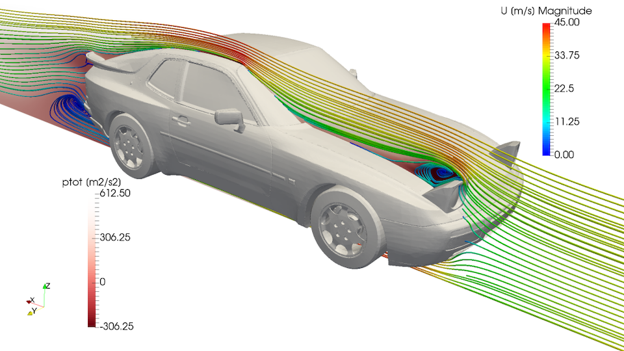
Flow simulation using computational fluid dynamics (CFD) is one of the most sophisticated engineering applications. But with AI, you could get CFD-level results without doing the simulation. Image: Neural Concept.

Neural Concept, an AI-based start-up, gives reliable answers to fluid flow problems without actually doing any calculations. It does not solve fluid flow’s governing equations, or use handbook simplifications, or the gold standard: a CFD solver. The company does it by essentially making an educated guess. It may not be as controlled or fine-tuned a model as you would get from an analyst using Ansys but results are quicker. And if Neural Concept is to be believed, it is close enough to what you would get with the old, time-honored methods.

Really? Are we that close to asking AI to “Will this break?” or “Will this fly?” and having the AI figure out how, either by inference, as does Neural Concept, or by calculation, as does ANSYS? How close are we to an AI agent that can handle the laborious tasks of defeaturing, meshing, solution, result review and then repeating the process with modifications over and over again?

If this is the way simulation is going the way of AI, with simple prompts that generate a flurry of computing out of sight and of no concern (until you get the bill for tokens, anyway), deliver pat answers and ask, “Would you like a detailed report?”

What engineer would say “No” to that? We love the stress contour plots and the streamlines. We hate writing reports.

Consider AI progress with visualization. Photorealistic rendering using ray-tracing is the gold standard. But rays can bounce around indefinitely. If you see ray tracing in progress, the image gets sharper and sharper, the lighting more and more lifelike, etc. It could literally go on forever but at some point the refinement exceeds what you can discern and there is no point in further calculation. But as they say for coding and which also applies to simulation, which converges asymptotically to a result, “The last 10% takes 90% of the time.” Converging to a result is just one of AI’s superpowers. AI can, in theory, tell an object in an image starting to form and finish the job, for example.

NVIDIA’s RTX, including 3D rendering and CAD-adjacent software, doesn’t use object recognition but nevertheless dramatically improves ray tracing, speeding up final renders to near-real-time in interactive situations, such as CAD and gaming. It’s the same underlying RTX/Omniverse technology that Dassault, PTC and others are now building with physical-AI.

Is AI-based Design Around the Corner?

With AI making such progress in visualization and simulation, how long before we can ask AI to create shapes for machines, cars, buildings…

Image: Impact

A Belgian employment agency dared AI to finish a building in August of 2023. Almost three years later, it’s no longer a joke.

Autodesk’s first AEC-related foundation model, neural CAD for buildings in Forma, is already designing buildings. They may be crude renditions of block shapes at the moment but, as Autodesk promises, increased detail is coming, followed by the design of the building’s systems (electrical, plumbing, HVAC, etc.). We will have to wait a bit longer for robots to finish the building, still very much a labor-intensive process in the AEC industry but we have to look further than the other side of Autodesk’s business for all-the-way-AI. It is in manufacturing, more digitized than AEC, where an engineer can fire and forget. Send the model to the shop and have the machines (CNC machines in this case) produce the part. CNC (computer numerical control) machines run on code (known as G-code), which is a cinch to create with ChatGPT or Claude.

Engineers can easily dismiss AI’s attempts at creating parts, products and buildings as superficial. Indeed, most of them are only creating shapes without any regard to what’s inside. Engineers, more than architects, know it’s what’s inside that makes it all work.

We can reassure ourselves that the process- thinking of a product, making it work, manufacturing it… it’s all still too much to hand off to AI. AI is not ready for it. What engineers are doing is far too complicated. Too precise. And besides, let’s not forget that AI is good with language and lousy with math and physics.

Money Pours into AI for Design and Engineering Software
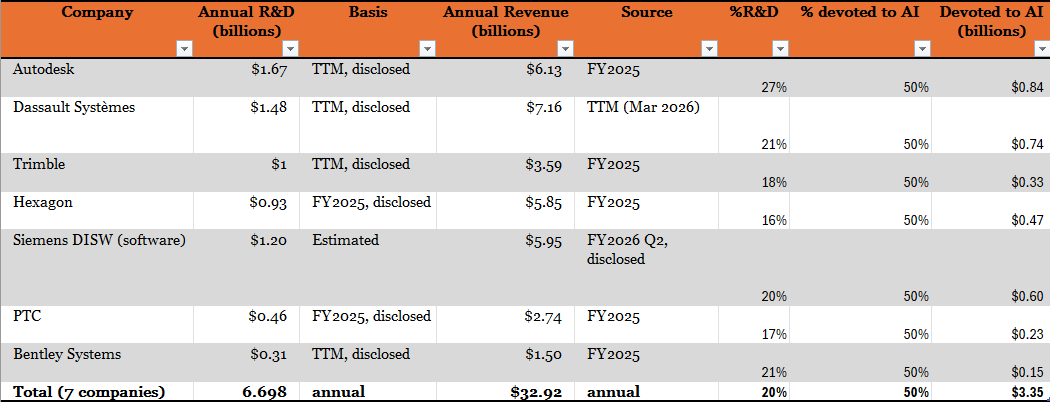
Michael Finocchiaro has documented over 779 startups that use AI for some aspect of design, engineering, PLM and manufacturing. He estimates those companies have received $19B in funding over the last 3 years. If you include Project Prometheus, partially funded by Jeff Bezos, the total funding doubles to $37B.

Compare that to the sum total of R&D for design and engineering software, which we’ll estimate to be $7 billion (about 20% of total revenue) and as much as half of that is being spent on AI and you arrive at a total of $3 billion per year being invested by incumbents on AI.

If we say that half of all funding was received in the last year, we see that VC funding for startups is more than 3 times incumbents’ R&D spending.

Someone Is Going to Get This Right

With this much money pouring into AI design and engineering and so many ideas and startups racing to crack the code, somebody is bound to get it right. It doesn’t take all 779 of Finocchiaro’s companies. It takes one.

Project Prometheus, with a war chest north of $18 billion and Jeff Bezos’s backing, could conceivably pull it off alone. That’s more than the combined R&D budgets of Autodesk and Dassault Systèmes, pointed at a single goal: AI that designs like an engineer, not a chatbot playing pretend.

It doesn’t have to be Prometheus. Motif, founded by Amar Hanspal, briefly Autodesk’s own co-CEO before the board chose Andrew Anagnost instead, has raised $46 million to rebuild building design from scratch, cloud-native and unburdened by decades of legacy code. Leo AI, led by the charismatic Maor Farid, raised a comparatively modest $9.7 million but already has 20,000 mechanical engineers using it.

Wake Up, Sleeping Giants

The incumbents ought to sound the alarm, as Sundar Pichai did at Alphabet. Most are still hitting snooze.

Autodesk deserves credit for building something of its own instead of bolting an LLM onto a CAD API. But even if Autodesk changes course tomorrow and adopts NVIDIA’s physical AI, a working AI-based design application is still years away.

The rest of the giants seem content to wait out the storm, confident only they alone know how to make precise shapes, such as Parasolid, the geometry kernel of choice. They forget precise shapes aren’t the only shapes that matter and their geometry kernels choke on organic freeform shapes, point clouds and mesh models; in fact, most of the shapes in the real world. They insist their software is easy to use but only for those who know how to use it. And like every professional software maker, from CAD to simulation to SQL databases, they still insist we learn their language instead of building software that learns ours.

But we know the natural language interface works. Thanks, ChatGPT.

The dinosaurs didn’t have years to adapt to dark skies and cold after the meteor struck. Their world changed quickly. CAD companies don’t have years either.

Meet Patrick Hanley, the Aerodynamicist Who Writes His Own Code

Watching butterflies and birds is an idle pastime for most of us. For a young Patrick Hanley growing up in St. Kitts and Nevis, a Caribbean nation composed of two islands so small I could not find them on my globe, it was the start of a career in aerodynamics.  Patrick loved to watch objects fly, whether they be living or man-made. He would study how each object flew. Growing up in the tropics and under an airport approach, he had plenty of opportunity to observe.


It led to experimental aircraft designs, many of which were not in the air for long.

“One of the best ways to learn about something is to have it not work,” he says. “If it works, what are you going to learn?”

Patrick went on to earn a PhD from MIT in fluid dynamics. Yet, Patrick is kind and humble. To my modest understanding of structural simulation, he defers,

“You could give me ten questions about structures, and I will get 8 wrong,” he says.

From a Small Island to MIT

Patrick lived with his family in Basseterre, the capital and largest city of Saint Kitts and Nevis with an estimated population of 14,000 in 2018. St. Kitts was part of the British Commonwealth. His school would send the O-level exams[i]  to Cambridge for grading. The results were printed afterward in the local newspaper — often to the embarrassment of students and their parents.

While waiting for the results, Patrick and his family moved to New York City. He was sixteen. In his first year of high school, the found the citywide physics exam easy, scoring a 98. The next-highest student got 78.

“Everybody else failed,” he recalls.

Math and physics came easily to the young Patrick. He enrolled in New York’s Polytechnic Institute in New York — now part of NYU — and graduated summa cum laude with a bachelor’s degree in aeronautical engineering. He worked his way into a professor’s lab by showing up week after week until the professor relented. That professor collaborated with MIT faculty on acoustics and recommended him for graduate studies at MIT.

Patrick was a research assistant at MIT “from day one.” That was in 1983. His stipend was $900 a month. “That was a lot of money back then.”

You know that picture of a hundred engineers over drafting tables, all in identical white shirts, all just about guaranteed to be anonymous forever and bored every day? One of them was Patrick. He interned at Fairchild the summer of 1982. Fairchild made the iconic Warthog, the affectionate name for the A-10 Thunderbolt II.

An A-10 Thunderbolt II, AKA Warthog, produced by Fairchild. Patrick Hanley’s internship at Fairchild had him studying the air conditioning in the aircraft. (U.S. Air Force photo/Master Sgt. William Greer)

You can’t say enough about the A-10. Designed for use against tanks, firing depleted uranium rounds, the A-10 was the last thing enemy tank crews never saw. The aging, slow-moving, heavily armored aircraft is the  US Air Force’s beloved tank-killer, a life-saver for the Army’s ground troops. The A-10 was recently brought into the Iran war for something else entirely: it has an amazing ability to loiter, to fly for hours over the Persian Gulf and Strait of Hormuz. Plus, it flies slow enough that pilots can distinguish boats that pose a threat from those that do not. The Navy has nothing like the A-10 on its carriers.

As exciting as all that sounds, Patrick’s job was mundane. He found himself feeding an IBM 360 punch cards for the aircraft’s air-conditioning system.

He did not see his future at Fairchild. Or any company with a room full of engineers.

Three Comebacks

Patrick graduated into academia with a a tenure-track position at the University of Connecticut, teaching courses in fluids, heat transfer and aerodynamics. In 1993–94, he left to start a software business of his own, which he recalls as “a terrible decision as far as our standard of living.” His first product, VisualFoil, borrowed its name from the “visual” spirit of Windows 3.1. He sought to undercut the expensive aerodynamic packages of the day on price.

Then Mark Drela, the MIT professor whose XFOIL is still the gold standard for airfoil analysis, released his code free under an open-source license (source: XFOIL documentation, MIT)  —  and Patrick’s software business collapsed.

Patrick decided to focus on what XFOIL and other software could not do. He came up with MultiSurface Aerodynamics, a panel and vortex-lattice code.

But then OpenVSP and a wave of free vortex-lattice tools. His software business collapsed again.

Patrick came back with Stallion 3D, his Navier-Stokes solver.

For someone influenced by birds and airplanes, why name your program after a horse?

It turns out one of Patrick’s kids (Emma, one of six children) was into horseback riding. She was also a good artist. She drew her dad the logo of a horse.

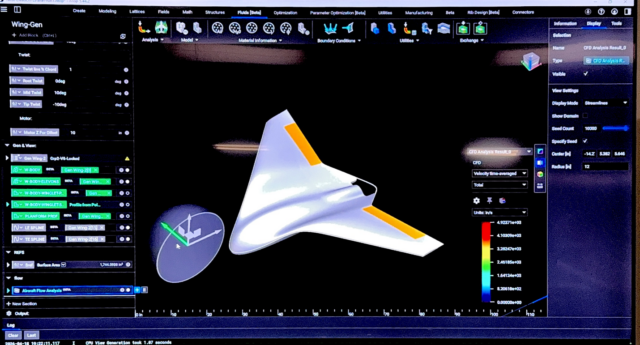
“My kids are very good artists,” he says. “I can do stick drawings. They can do masterpieces.”

How do customers find him in Ocala, a remote town next to Florida’s Ocala National Forest used by the Air Force for bombing runs?

Patrick does a little advertising and uses LinkedIn to spread the word.

Customers find Stallion 3D cheap and accurate.

“A lot of the big companies, when they were just starting out, bought my code,” he says. “After they graduate from my code, that’s when they buy Ansys.”

Stallion 3D is kinda like a gateway drug, I suggest.

“Exactly,” he says. “But the code has to be extremely accurate.”

The Tiles Tell Tales

Accuracy is the main pitch Patrick makes for his software. Around 2017, he was trying to port Navier-Stokes equations into what had been Euler code, and his Cartesian grids — without cut cells — kept producing terrible results at the wall. The fix arrived at his kids’ school. “I’d go to pick them up in the afternoon, and all I was looking at on the ground was tiles,” he says. “And it came to me how to make a Cartesian grid without cut cells that works with high accuracy. I’m not going to tell you how, but it worked.”

He points to the ONERA M6 wing, the standard transonic validation case in CFD, run near Mach 0.84. Early NASA validations missed the double shock. Stallion 3D, on a two-million-cell mesh small enough to run on a PC, resolves it. Structured prism-and-hex grids, he notes, can be ten to thirty times more accurate than unstructured ones at the same cell count — and that margin is the product.

Why Not Design the Airfoil?

As no conversation these days is complete without mention of AI, I had to ask Patrick his thoughts on the subject. The nTop conference, still fresh in my mind, had demonstrated how people with no aerodynamics background, zero knowledge or Euler or Bernoulli, could generate damn-good airfoil shapes by the thousand.

“What good are thousands of airfoils?” Patrick asks. “An aircraft only needs only two or three.

“How about you just sit down for a day and figure out which two or three might be best, based on your experience,” he suggests.

His real objection to designing airfoils is liability.

He’s careful to supply a disclaimer for his software: don’t use it to design an airfoil. All it does is the math. The user supplies the shape and Hanley software analyzes it.

Patrick offers the Series 6 airfoil as an example of something gorgeous but deadly.

“Airplanes designed with six-series airfoils tend to hit the ground,” says Patrick. The mission, the control surfaces, what happens past the stall angle. Airfoil shapes, even when optimized for lift and drag, don’t tell the whole story.

“The whole story has to come from you,” he says.

AI is certainly not without its purposes, though. Patrick’s son, a computer scientist, has fully embraced AI; Patrick uses it himself “as a means to an end” — to speed up coding, geometry, and advertising.

What Does an Aerodynamicist Think is Fun?

Patrick has worked for the emerging new phase of air transport, that which may look like things for whom flight is uncertain at best. Think again of flying cars.

Analyzing for flying cars was the most fun Patrick has had. For example, his stint at Terrafugia.

“It was one of the funnest. The most fun I’ve ever had.”

Terrafugia, founded by Carl Dietrich, an MIT PhD whom Patrick rates among the smartest and kindest people he’s met. Dietrich hired him by inventing a role on the spot — “he created a job in the interview for me,” a technical fellow rather than the engineer slot Patrick had applied for. The eVTOL effort, TF-2, was eventually acquired by Geely, the Chinese automaker that owns Volvo. Geely bought Terrafugia in 2017 (Geely / Terrafugia, 2017).

Where is my Flying Car?

This brings us to the air taxis, arguably the most-funded flying car concept, therefore the most hyped.

What’s holding back air-taxis?, I ask, expecting safety and range issues.

Patrick says safety and range are the wrong worries. The mission isn’t cross-country; it’s the airport. Every airport sits an hour of traffic from downtown. It’s not the last-mile problem — it’s the last-fifty-miles problem. Fly in a straight line and you save an hour of an executive’s time. Add to that the cost of a helicopter helicopter ride and an air taxi is a no brainer.

Again, what’s stopping air taxis, I ask.

It’s the noise, says Patrick.

“You do not want to hear these things buzzing you every five seconds,” he says — and the noise comes overwhelmingly from the propeller, not the electric motor, which by itself is far quieter than an internal combustion engine.

Aeroacoustics, he says, is one of the biggest eVTOL requirements, and the design space is counterintuitive. The most aerodynamically efficient propeller has exactly one blade. Add blades and you lose efficiency and gain noise, which is why a helicopter’s rotor produces that signature whap-whap of shock spikes. Spread the load across multiple rotors with five-bladed props and the signature smears into broadband noise: you don’t hear five sharp slaps, you hear a wash. Multiple rotors also buy redundancy, hence safety. The rest, he thinks, is routing and paperwork — keep the corridor over water and away from heads, and the math gets easier.

Joby air taxi flies over San Francisco. Image: Joby Aviation.

As of spring 2026, Joby had become the first eVTOL maker to clear Stage 4 of the FAA’s five-stage type-certification process, with Archer a stage behind, both targeting type certificates and first U.S. commercial service in late 2026 (FAA via Joby Aviation, March 2026; Archer Aviation Q1 2026 results, May 2026). And Joby’s aircraft carries five blades on each rotor — exactly the acoustic strategy Patrick describes (source: CompositesWorld, November 2025).

A Military Mindset

Patrick has done CFD work for Shield AI, a company known for drones and even more so for Hivemind, an AI pilot that flies drones in GPS- and comms-denied airspace and lets them operate in swarms. Patrick’s job was less glamorous — “pressing the button on the HPC and having it run” — using commercial tools: Star-CCM+, Cadence Fidelity Pointwise, and Flexcompute’s Flow360, which he calls “a joy to use.”

Pointwise gets the nod from Patrick. He calls meshing “therapeutic” — the discipline of coaxing a hundred-million-cell grid out of a complex geometry in under an hour, because a bad grid guarantees bad results no matter how good the solver. Cadence acquired it in 2021 and folded it into its Fidelity CFD line (source: Cadence, April 2021).

Back to Nature

The day before, I’d heard a simulation company claim it wanted to make prototypes obsolete. Patrick argues the opposite. “You’re not going to get an optimized drone unless you crash it a hundred times,” he says — there’s always something you didn’t model. Nature is the best simulator there is, and it keeps inventing failure modes that no code anticipated. Every engineer remembers being forced to watch Galloping Gertie, the Tacoma Narrows bridge that tore itself apart in 1940 because nobody had thought to treat resonance as a failure mode.

The perfect airfoil, as suggested by software, by AI, is still no match for a veteran engineer educated with aerodynamic theory and forged with aircraft experience. The air foil optimization program does not consider the whole aircraft, additions of a camera, a radar, more passengers, a longer wing… Sure, you can ask an AI for a new airfoil for five cents, Patrick says, only to spend millions to clean up after the damage.

__________

[i] O-level is short for [i] General Certificate of Education, Ordinary Level — which were subject-specific exams in the British education system, typically taken around age 16.

Has nTop Finally Arrived?

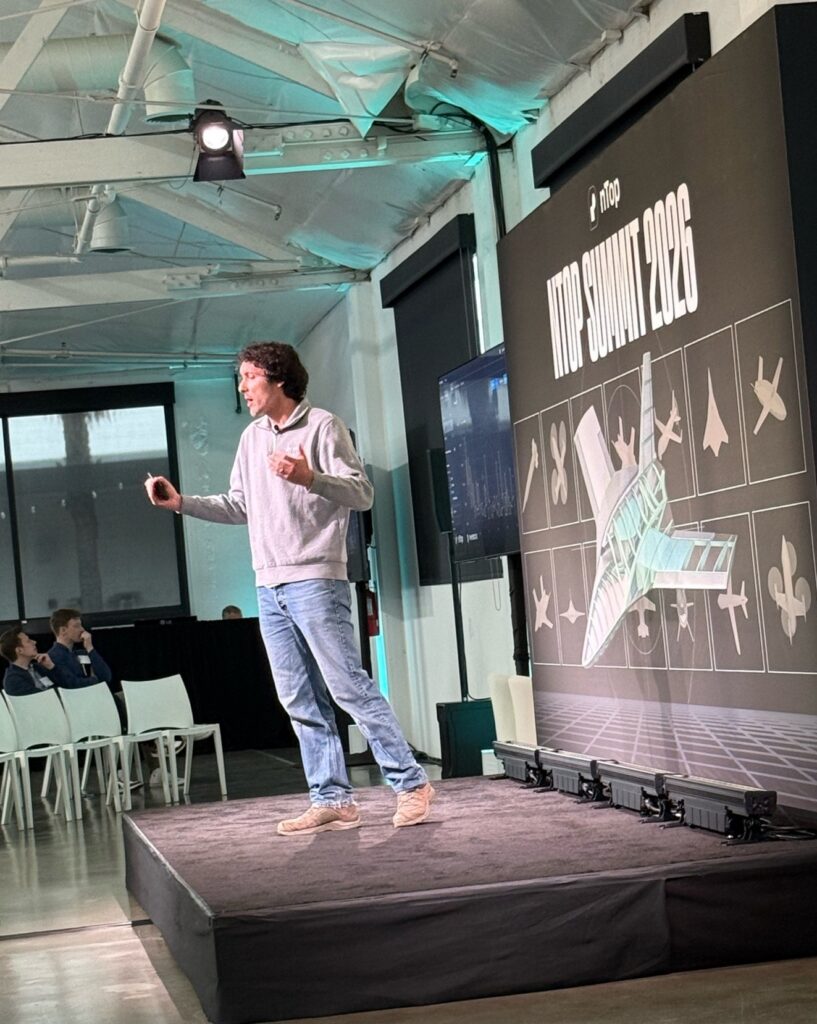
You’ve been doing it all wrong, says Brad Rothenberg during the opening keynote of the 2nd annual nTop Summit. Those are not his exact words, but what I chose to interpret from his presentation at a one-day conference that took place earlier this year in Los Angeles.

Brad is the CEO and founder of nTop, a company that leads the field of computational design. It’s no wonder: they may have invented the term “computational design.”

Over 160 nTop users have shown up for this one-day event, a big relief to nTop’s marketing, led by Andrew Hanno. The previous venue canceled only weeks before the event. The entire marketing team has had to scramble.

Bradley Rothenberg, CEO and founder of nTop, delivers keynote at nTop Summit 2026.

The new venue, Optimist Studio, appears to be a film studio. There may be hundreds of them in LA. The creative community is being shuffled, many displaced by AI, and I imagine there’s little trouble finding space. I read I Work in Hollywood. Everyone Who Used to Make TV Is Now Secretly Training AI about writers who can’t find work and shudder.

“It would have been more except Lockheed Martin is getting ready for its quarterly earnings call,” says Andrew.

Lockheed Martin, a big customer of nTop, is one of the companies that manufactures products or components in the LA area, which continues to be one of the centers of aerospace and aviation, housing facilities for many of the “legacy primes” Northrop Grumman, Boeing, Raytheon, plus L3Harris and relative newcomers such as SpaceX and Palmer Lucky’s Anduril.

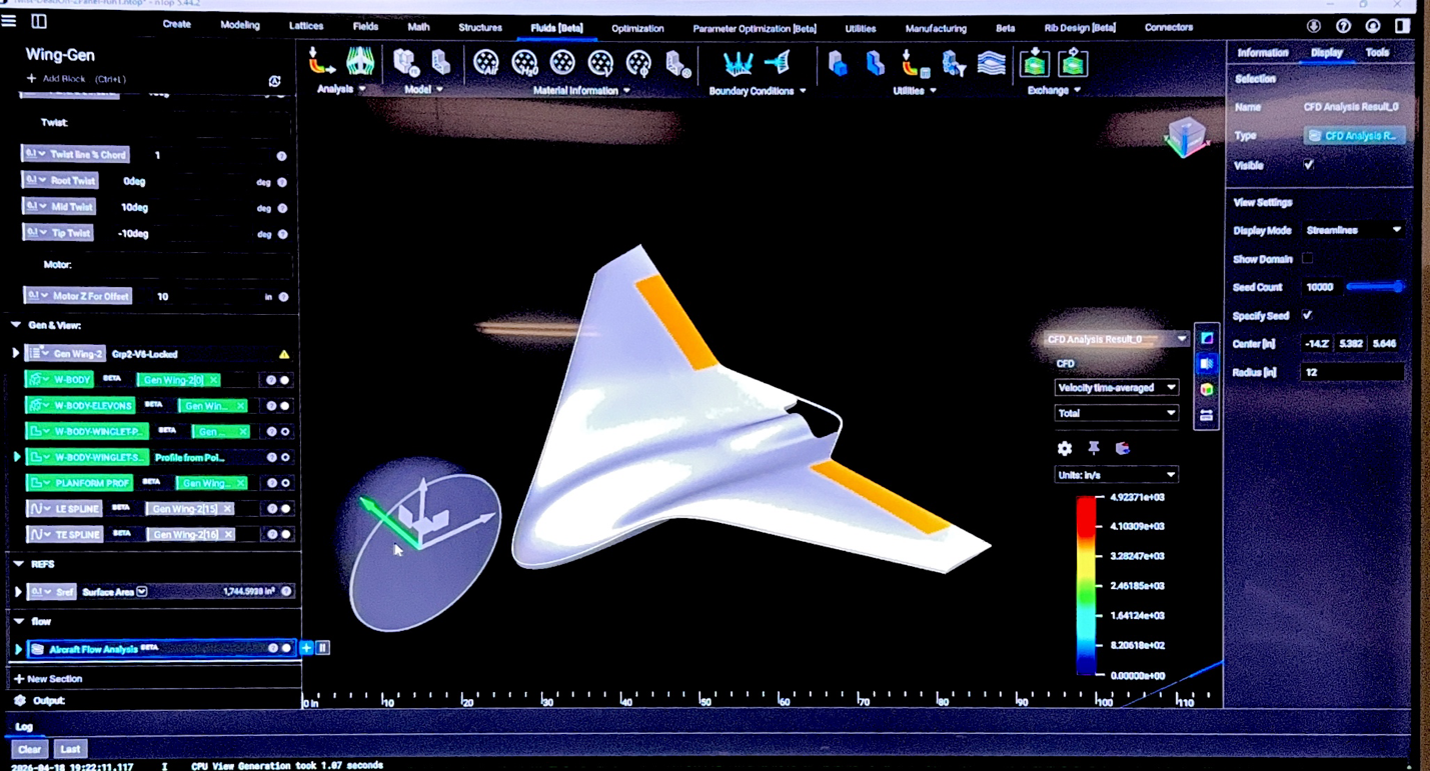
These companies are ideal candidates for nTop and computational design. In presentations, we see turbine blades, air foils, heat exchangers — even whole aircraft (albeit drones or scale models) having their shapes optimized as only nTop can.

Last year’s nTop conference, also in LA, was maybe half the size. Could nTop’s user base be growing? Or could nTop’s marketing budget be growing? Or both? Marketing should indeed increase after a product’s technology is sufficiently mature. Also, nTop received Series D funding of $65 million in 2021. It can now afford to hold user meetings across the country (the company headquarters are in New York City).

What could be more convenient for users than having a user meeting within driving distance? That was no doubt the reason for an LA. venue. I was one of the few who flew in (from San Francisco), but most attendees were local. But as nTop grows, it might follow conventional industry wisdom: hold conferences at travel destinations, and users will fight and beg to attend. For most deskbound designers and engineers, an all-expenses-paid trip is an enormous perk. Sure beats getting out of the office only to get stuck in traffic — and LA’s traffic is among the worst in the US.

Las Vegas, sadly enough, is a favorite venue for conferences. Nashville has become popular in recent years. I would suggest San Francisco entirely for selfish reasons.

But if you consider the size of the audience a measure of the success of the software, you can’t help but wonder: “Is nTop finally catching on?”

The company that started as merely a topology optimizer, one among many, is now able to claim it is nothing less than a complete way to optimize and model.

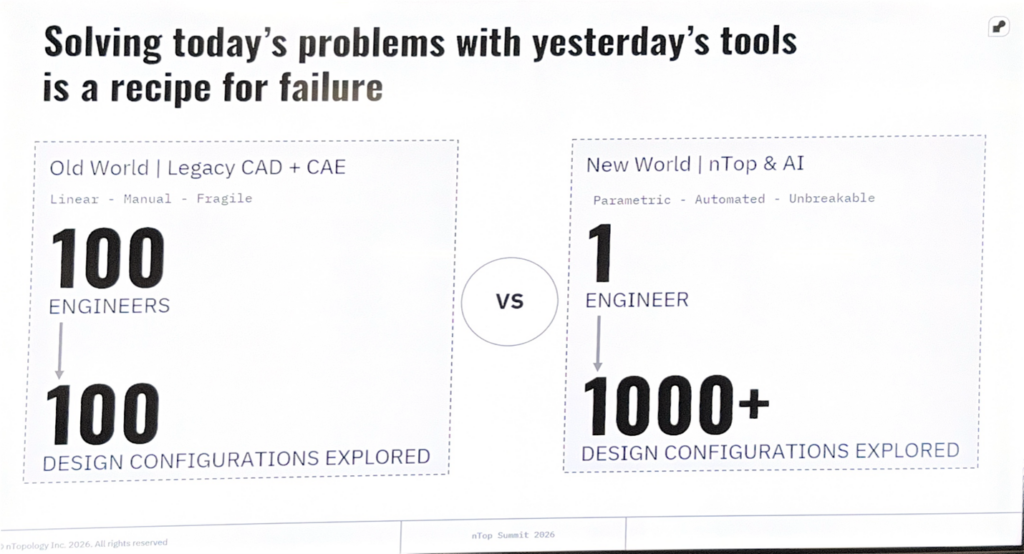
nTop increases design exploration by orders of magnitude, according to company slide.

Unlike every 3D CAD program in use today, Brad’s company, nTop, uses what they call implicit modeling. Implicit models are represented with parametric equations. It’s geometry “infrastructure” rather than the geometry itself, we hear. Geometry is left to the 3D CAD modelers — and they are no good at it, according to nTop.

Implicit vs explicit modeling, as defined above, may seem like semantics to the engineer who knows 3D CAD modelers store geometry as equations, specifically 2nd order polynomials known as B-splines.

Brad would argue, however, that nTop’s equations are superior, better suited to optimization and AI. And in the age of AI, where everyone has to answer “what are you doing with AI?” what could be a better pitch?

NTop’s ability to optimize is impressive. We hear of “10,000 different design points generated in 20 minutes.”

Can your CAD system do that?, says Brad. Again, not his exact words.

The unwritten rule at software conferences is to avoid current references to potentially controversial issues, such as wars. Brad does not play by the rules. Brad plunges into the Iran/US conflict.

“In a high-intensity fight with a near-peer adversary, the US will run out of critical long-range strike weapons in under 7 days. It will take two to three years to replace them,” says Brad, quoting a CSIS analysis.

C-who, you might wonder. That’s Center for Strategic and International Studies, but Brad rattles off military acronyms and nomenclature as if he were a military analyst, not a Pratt Institute-trained architect.

“We’re using million-dollar missiles [Patriots] to destroy $15k drones [Shaheeds],” we hear. Fact check, the low-cost Shaheed drone costs $35k, according to reliable news sources [NYT].

Brad’s enthusiasm for aviation is nothing new. Last year, he told of designing aircraft as a boy and conducting aircraft design workshops at nTop. His solutions for the military, however, are more recent.

I’m reminded of Palmer Lucky, the flamboyant founder of Anduril, who is designing drones and subs for military use. Lucky taste for Hawaiian shirts and Brad’s fondness for sweatshirts may set them apart, but their belief that the US military needs a serious modernization in design, manufacturing and procurement unites them.
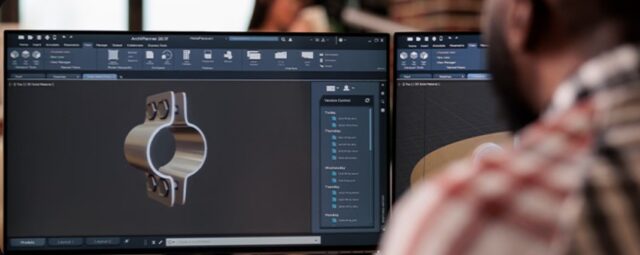
One of the conference sessions is a panel, “Adapting Design Workflows in the Defense Industry.”

Defense contractors are many of those in attendance. There would be more were nTop not beholden to the public cloud. The US military demands the utmost secrecy from its private contractors, so all are averse to applications that use AWS, Google Cloud or Azure.
Says an engineer from Boeing, which has a big military division, “We have our own conversational AI. We can’t have it on the cloud.”

“That is a problem,” acknowledges nTop advisor Jan van der Brand, and formerly, a technical fellow at Boeing, “and we will be addressing it.”

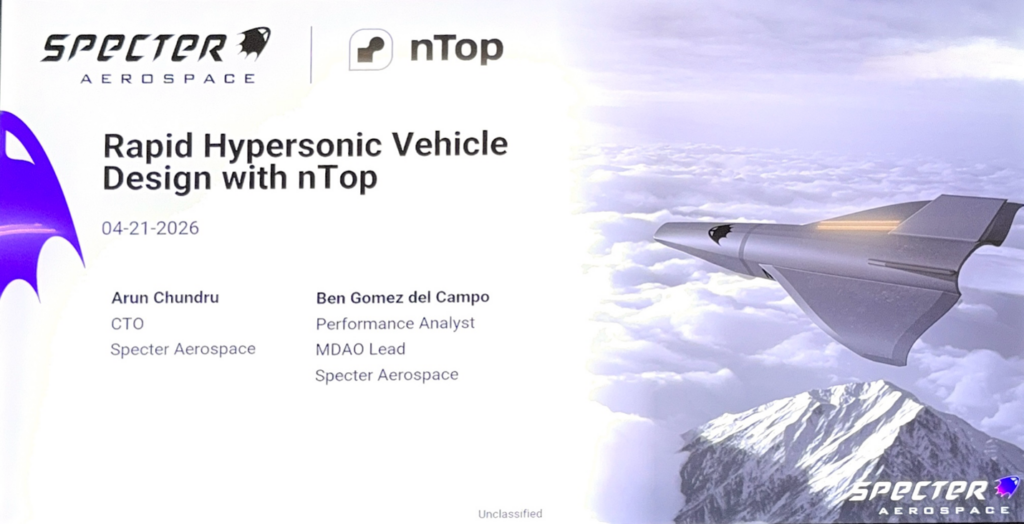
Onstage was Specter Aerospace’s CTO, Arun Chundru, warning of the “trap of modularity.” Modularity is the enemy of optimization. Not his words, but what I perceive to be his message. Modularity may be a favored principle in military hardware. Modular design allows an aircraft to take on various missions; its modules are swapped out to adapt it for different roles, such as surface attacks or air-to-air combat. Specter, in the business of hypersonic missiles, is fighting off the modularity mindset with overall mission-specific design. Having tools like nTop, presumably able to evaluate different shapes for different mission conditions (altitude, payload, range), shapes that morph the fuselage and wings rather than simply extending or shortening the fuselage, may give Specter the edge in competing for defense contracts.

We have to wonder if the massive military machine that is the US military can change in the way that new players like Anduril and nTop envision. To their dreams, Ben Gomez del Campo, an engineer at Specter Aerospace in the audience, reminds all of the reality of bureaucracy and the rules of the procurement process.

Specter addresses secrecy and public cloud issues by using nTop to design solutions similar to actual designs. Their presentations consisted of several slides that showed what appeared to be hypersonic missiles, but were accompanied by the “not the real design” caveat.

That may be fine for some purposes, but when the shape is what is being optimized, for example, for stealth, how can “similar” not expose secrets?

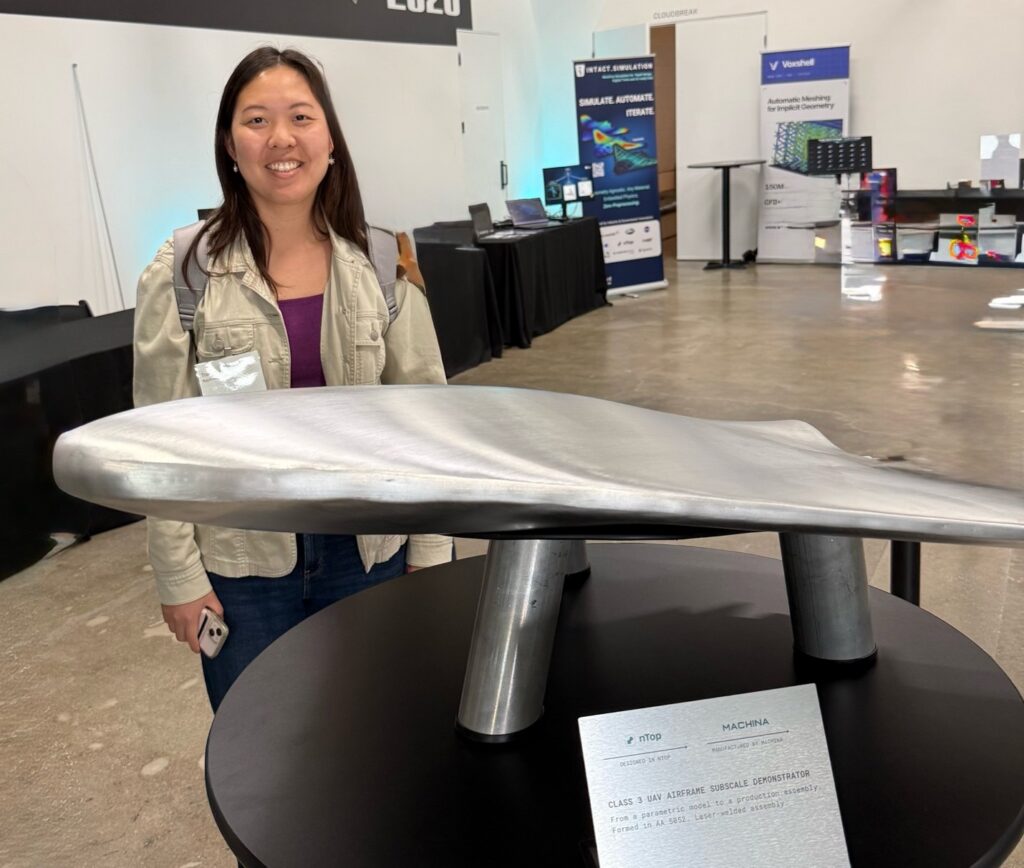
Only nTop could have modeled this, says Tracy Lu of Machina Labs, of a Class 3 UAV subscale demonstrator.

Machina Labs was on hand showing a subscale model of a UAV. It appears to be made of solid stainless steel, but it was really a 5052 aluminum alloy sheet metal laser-welded construction pounded into shape by small round hammers held by giant CNC-controlled robots, making real a shape imagined with the help of nTop. Only we can do that, says Tracy Lu, robotics process engineer at Machina Labs.

Is This Face the Future of CAD?

Maor Farid, CEO and founder of Leo AI, promoting Mechanical Intelligence, a MCAD/AI community (image: LinkedIn).

I get together with Maor for the second time on a Zoom call. It’s 8 am my time. It is 6 pm in Israel, where Maor lives. But Maor is just getting started. He will be talking to customers until 10 pm, then going home to be a Dad. He has a two-month-old daughter now, which is why our call was delayed two months. That’s okay. I preach, if not practice, a family-first doctrine.

Gotta say, Maor looks fresh as a daisy after already putting in what would be for the rest of us, a full day. This may be why he gets so much done. The bio I am making for Maor’s podcast episode is already a mile long. It might be the whole episode. He most recently founded Leo AI, along with classmate, neighbor and close friend, Moti Moravia. Leo AI is perhaps the most advanced use of AI in CAD I have seen. He’s managed to round up investment. He was the youngest PhD at Israel’s Technion. He was a Fulbright scholar and did post-doctoral work at MIT. He founded Learn to Succeed and wrote a book of the same name to motivate poor Israeli youth. He was named in Forbes’ 30 under 30 in 2019. He’s served in his country’s version of the NSA. Only  33 years old, Maor, he already has a Wikipedia page. Despite his accomplishments, he is charming, gracious and forgiving of dumb questions (thank God) — while still keeping a laser focus on the mission, which is nothing less than making AI truly useful for mechanical design.

From War Zone to Workstation

Maor’s story starts not in a Silicon Valley startup incubator but in northern Israel in July 2006. “We were on vacation when the Israel–Lebanon war broke out. Bombs were falling. I realized then that technology was the only way forward — to protect our homes, our families,” he recalls. That moment made him realize he had to become a mechanical engineer.

In high school, by chance, he stumbled onto SolidWorks. “The moment I touched the mouse, I was hooked,” he says. That chance encounter set him on the path through a bachelor’s, master’s, PhD, and a postdoc in mechanical engineering — all fueled by a belief in technology’s ability to protect and improve lives.

Early Disillusionment

Maor’s dream of being an engineer almost did not survive his first engineering job.

“The worst days of my life,” he says of his first months on the job. “Instead of innovating, I was a glorified secretary, searching PDFs and vendor catalogs for bolts and bearings that didn’t even fit”.

It wasn’t just him. He cites staggering attrition rates from Israel’s elite Brakim engineering program: 80% of its graduates left mechanical engineering altogether. “These were the smartest people in the country,” Maor says. “They dreamed of building robots. Instead, they were stuck pushing paper.”

That gap between the promise of engineering and the drudgery of reality would eventually inspire Leo AI.

Why CAD Was Never “Computer-Aided”

Maor is blunt in his assessment of the industry he aims to upend. “CAD is not design. CAD is not mechanical engineering. CAD was never computer-aided. It’s computer-represented geometry,” he says.

What he means is that design still happens in the engineer’s mind. CAD tools are glorified documentation systems, suitable for representing geometry but not for aiding the decision-making process. “Topology optimization? It doesn’t give good shapes. It’s not smart. It’s not intelligence,” he adds.

Leo AI, by contrast, aims to free engineers from the 80% of their workday spent on paperwork, information retrieval, and bureaucratic tasks, so they can focus on the 20% they actually love — building and designing.

The Five Beers

Does Leo threaten to replace engineers?

“God forbid. It’s quite the opposite,” says Maor. “We want every mechanical engineer to focus on what they love and do best, which is build beautiful, fantastic products”.

He knows first-hand how fragile trust in AI can be. Maor is a fan of The Five Whys and has adapted it to The Five Beers. Many engineers he spoke with were skeptical, even fearful. “After four beers, they’d admit they were afraid of AI,” he says. “But after the fifth beer, the truth came out: they didn’t trust it.”

That’s why trust has become Leo AI’s North Star. “Some of our customers say, ‘Leo is the only AI I can trust.’ That’s what we want to maximize,” he says.

How Leo Works

So what does Leo AI actually do? At its core, Leo plugs into a company’s existing knowledge base — CAD files, PLM systems, engineering documents, standards — and becomes a kind of hyper-experienced coworker who never forgets.

“Imagine you need a spring,” Maor says. “You tell Leo the parameters. If you miss some, it runs the calculations for you, checks your standards, and recommends the best fit. It’s like having the smartest engineer in the company sitting on your shoulder.”

If not the smartest, at least the best read and with the best memory, I think.

That ability to digest not just text but geometry is what sets Leo apart from large language models. “Language models are bounded by language. They’ll never catch that there’s a hole in your design. Leo understands CAD. That’s our proprietary breakthrough,” he explains.

Engineers as Decision-Makers

Maor emphasizes that Leo is not about churning out full products. “We don’t want to design a whole robot for you. That’s not how engineers work,” he says.

It’s not how engineers want AI to work, either. Instead, Leo operates at the level of assemblies and subsystems — the same level an engineer would delegate to a trusted assistant, maybe a junior engineer.

“Engineers are in the decision-making business,” he says. “Leo gives you the data, the parts, the comparisons. You stay in control”.

It’s a philosophy engineers can get behind. All engineers need help. No engineers want AI to run away and spit out a design. An aircraft designed by AI is not an aircraft we would fly in. But if AI wants to help us with the design of the plane, that’s another story.

Or a vehicle. For example, can we say at some point “Hey, AI. Help me electrify this car?”

Leo is not able to handle electrifying a car — mot yet, but design assistance of that level is indeed where it appears to be heading.

Adoption and Momentum

Launched in May 2023, Leo has already attracted more than 55,000 users — without spending a dollar on marketing. Customers range from HP to Intel Mobileye to defense contractors. But the testimonials mean more to Maor than the logos.

“One aerospace engineer told us that with Leo, he designed a system in one and a half hours that used to take three engineers three weeks,” Maor says.

The Bigger Mission

Despite dreamy goals of an AI-assisted future, Maor insists he’s not a starry-eyed futurist. He’s allergic to AI hype. It’s not AI, but “IA — intelligence augmentation” he is after. “Find a real use case. Solve a real problem. Don’t sprinkle AI fairy dust”.

That pragmatic mindset has led him to create not just a company but a community. He recently launched the Mechanical Intelligence Community, the first global network focused on AI for engineers. “One rule: no BS. Only real tools, real studies, real results, by and for mechanical engineers,” he says.

The Future of Design?

Is Maor Farid the face of the future of design software? He certainly looks and acts the part. He combines an academic pedigree and real-world experience with a startup’s conviction that a revolution needs to happen and they can lead it, his conviction being that 50-year-old CAD technology can still finally live up to its promise of designs being computer-aided.

Good luck, Maor. Engineers the world over are rooting for you.

AI Agents: We’re Here to Help

Multiple Agent Smiths from the Matrix Revolutions, 2003 movie by Warner Bros. Pictures.

Automated factories are yesterday’s news. The news today is all about AI and the factory of the future is one staffed with AI agents.

Multiple Agent Smiths appear in the 2003 movie Matrix Revolutions by Warner Bros. Pictures.

If the idea of AI agents makes you think of Agent Smith in The Matrix series, you are not far off. Agent Smith, part of the AI that prevailed over humans, was able to assess and evaluate, decide on action, and execute — all on its own. Agent Smith, along with other agents, identified problems that could disrupt the system (like Neo, the human hero of the movie) and attempted to eliminate them. The difference between fiction and fact: Agent Smith helped wipe out humans, whereas in real life, AI agents will help them.

The AI industry does not admit that their agents are derived from The Matrix, claiming they took the term from texts on psychology and philosophy that refer to agency, the capacity to act intentionally. Aristotle discussed the concept of individuals being able to act independently. Centuries later, Immanuel Kant referred to “autonomous agency,” by which individuals can act according to their reasoning.

Back to reality. And into the modern factory. Here is a factory that could be a result of a national reshoring initiative. It should, for reasons explained in The Agentic Shift: Building Intelligence into the Fabric of Industry, an eBook by First Resonance, take advantage of the latest technology. It is not a factory that has been retrofitted; rather, it is the result of plugging in new machines and adding software to manage traditional workflows. That would risk recreating the problems that made manufacturers abandon the factory in the first place. No, it must be a factory created afresh, from a clean screen, from the ground up, with new tactics and workflows and, most important to this story, the latest AI breakthrough: agents.

From Automation to Agency: Why AI Agents Are Fundamentally Different

Traditional automation has been the backbone of industrial progress for decades. It excels at performing repetitive tasks with high precision; however, its limitations are becoming increasingly apparent in today’s volatile and complex manufacturing environment. Automation systems execute fixed, hard-coded sequences—they cannot adapt to unexpected scenarios without manual reprogramming. In other words, automation follows instructions but does not reason with them.

By contrast, agentic AI represents a step-change. AI agents combine machine learning, real-time sensing, and autonomous control to create a closed-loop process of observation, decision and action. Rather than simply carrying out predefined commands, agentic systems sense changes, learn from new data, reprioritize goals and respond dynamically. This makes them more like intelligent, trained human co-workers than programmable controls.

For example, a traditional pick-and-place robot can perform the same sequence regardless of upstream, instream and downstream disruption. A pick-and-place cell may be able to stop action after it senses it has run out of a necessary component, but after that, it can only wait for human intervention. A pick-and-place cell with agentic agents, on the other hand, could anticipate that the hopper is about to run out of components and alert another AI agent to refill it. In theory, AI agents could go much further upstream, up the supply chain to alert purchasing of potential overseas supply issues (think: semiconductor shortages in a time of war or invasion). Agents could monitor instream processes, reading data from cutting machines, production or packaging machines, to assess the need for preventative maintenance and order replacement parts. They could monitor excessive tool wear by measuring increasingly out-of-tolerance parts. Agents could also help downstream of operations, warning of overproduction and that the warehouse shelves are full.

It is this type of adaptive capability that will enable factories to shift from basic efficiency to resilient, reflexive operations.

Agents Everywhere All at Once

A factory foreman, no matter how experienced and intelligent, cannot be like the protagonist in Everything Everywhere All at Once, existing in parallel timelines to see every possible outcome. But AI agents can. Just as in The Matrix Revolutions, where thousands of Agent Smiths replicate across systems, agentic AI deploys intelligent counterparts into every machine, process, and workflow—each able to learn, decide and act on their own, simultaneously.

This distributed intelligence marks a radical departure from the legacy model, which relies on a single central controller or a patchwork of specialized automation scripts. What we have is an agentic mesh, a decentralized ecosystem of specialized AI agents that coordinate with one another in real-time.

Traditional automation relies on periodic human intervention to change its rules. Without human intervention, automation is static and relies on static rules. Agentic AI, on the other hand, is situationally aware and adapts the rules to accommodate the situation. Being in multiple locations, able to act individually and independently, it can appear to be the factory foreman’s assistant, but in many places.

The factory foreman is still the human in the loop. However, their tribal knowledge is spread far and wide. Imagine a big manufacturer could take its most experienced and effective factory foremen, distill all they have learned, add to that their problem-solving superpowers, and multiply it by a thousand. Here are assistants who never sleep, call in sick, ask for a raise, or go on strike. They are assistants who can think a thousand times faster, listen constantly, and watch unblinkingly. They can adapt to changes. They can optimize.

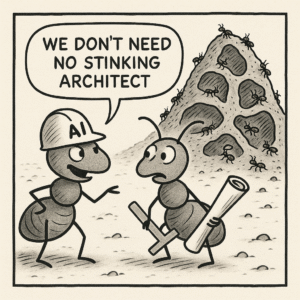
Hive intelligence can overcome centralized systems, such as construction workers creating a building without an architect. Image: ChatGPT

Agents employ the concept of hive learning, where intelligence is distributed across multiple locations rather than being centralized in one location. Think of an architect designing a house in their office and construction workers completing it. Compare that top-down centralized approach to ants making an anthill. The ants build anthills without a chief architect and are, in many ways, better off. They can communicate with each other and respond to conditions as they arise. What is not encoded in their little ant-brains, they manage to figure out. They are driven by a purpose, adapt to changes along the way, and keep the anthill running.

Real-World Examples of Agentic AI in Action

Agentic AI is more than a theoretical upgrade to automation—it is already driving measurable improvements across industries. Whether applied to a simple assembly cell or an entire aerospace production line, these systems share a common DNA: continuous sensing, adaptive decision-making, and autonomous execution.

Here are a few ways AI agents can help:

  • Scheduling. Instead of halting production, an agentic system automatically reschedules the next best job in the queue, adjusts robot speeds, and notifies supply teams to replenish parts, all without requiring manual reprogramming.
  • Visual Inspection. Traditional inspection systems detect defects and alert operators to take action. An agentic quality agent, on the other hand, will take matters into its own hands, so to speak. It can adjust, recalibrate equipment, and re-route suspect parts for rework and further validation—all in real-time.
  • Energy Optimization. In energy-intensive operations like battery manufacturing, agentic AI can help by forecasting power requirements based on production forecasts to make maximum consumption of power during non-peak grid pricing times

Agents Are Already at It

Cutting-edge manufacturers already deploy agentic systems:

  • Tesla uses synthetic vision AI to monitor every stage of production in its Gigafactories, as manufacturing facilities are known, according to Aicadium. “AI-powered quality control systems [AI agents, in effect] can identify defects in real-time, enabling immediate corrections, reducing waste and enhancing overall efficiency”
  • Battery gigafactories are already leveraging agentic energy-pricing agents to reschedule heating processes during off-peak hours, shaving 8–12% off per-cell energy costs.
  • Joby Aviation, a leader in eVTOL (electric vertical takeoff and landing) technology, achieved a 98% reduction in rework during composite manufacturing by utilizing autonomous quality agents to monitor and adjust processes, according to First Resonance.
  • Relativity Space, a rocket company, has improved throughput by 30% in full-stack additive manufacturing workflows by leveraging agentic AI to dynamically allocate jobs and coordinate machine settings across its print fleet, according to First Resonance.
  • K2 Space, a satellite manufacturer, has implemented autonomous quality assurance agents capable of zero-defect part validation, which reduces downstream inspection bottlenecks, according to First Resonance.

How AI Agents Work: For Millions of Events

Agentic AI does not need a single major revelation to be worth the price of admission. Instead, it can be valuable in accumulating minor, continuous improvements that compound over time. In production environments such as machining or assembly, these systems can observe thousands of micro-variables—such as tool wear, cycle times, operator adjustments, and material inconsistencies—and learn from each incident.

For example, a scheduling agent might detect that a particular CNC machine consistently slows down during the third shift. The daytime human supervisor might eventually notice this pattern, or they might not. But an agentic system analyzing around the clock, every 30 seconds, would have a report ready the next morning and may even have a recommendation.

The eBook notes that analyzing every thirty seconds may seem excessive, but over an 8-hour shift, that provides 960 opportunities to catch problems and 960 opportunities to make adjustments. An AI agent could issue a fix in 30 seconds for a problem that would otherwise have to wait for a shift change and human intervention.

How AI Agents Work: For Million-Dollar Events

“The most powerful factory doesn’t just catch errors. It prevents them.”

While many agentic gains accrue incrementally, the same architecture is equally powerful in preventing single catastrophic events. In highly regulated industries, such as nuclear energy, aerospace, and pharmaceuticals, the stakes are too high to rely on reactive intervention after a crisis has begun.

Agentic systems work proactively to detect and defuse looming risks before they escalate into shutdowns or recalls. The eBook highlights predictive-maintenance agents that constantly scan live telemetry and historical patterns to flag early-warning signals—a subtle vibration spike, an unexpected temperature fluctuation, a supply chain delay likely to cascade into line stoppage.

In power generation, this automated and dependable vigilance means that a power plant doesn’t wait for a turbine fault to trip an emergency shutdown. Instead, the AI agent continuously monitors each subsystem, dynamically updating risk profiles and recommending precise preemptive interventions. For example, suppose a forming line in a battery plant deviates from specification. In that case, the system doesn’t just raise an alert—it automatically reschedules other production and orders replacement parts before throughput is affected.

Summary and Conclusion

AI agents have the power not only to optimize day-to-day operations but also to shield entire enterprises from the catastrophic ripple effects of a single unmitigated failure.

AI agents provide incremental intelligence over millions of increments. They are the flexible alternative to the brittle automation of yesterday, which is the automation of fixed systems that operate within static parameters. Instead, AI agents continually expand their understanding of normal and abnormal, steadily tightening efficiency and consistency over time. Fast-acting and far-reaching, they are able to work everywhere at once, requiring no human intervention. Only with a robust factory automation that includes AI agents can U.S. factories compete with factories in countries with cheap labor.

Bunker Buster Coveted by Israel No Sure-Fire Solution

A B-2 Spirit stealth bomber drops a GBU-57 A/B Massive Ordnance Penetrator, the largest of all “bunker busters.” Image: U.S. Air Force.

UPDATE: June 21, 2025 – U.S. has struck three nuclear sites in Iran, including Fordow, using B-2 bombers and probably GBU-57 bunker busters.

Israel has asked the U.S. for a few of its largest “bunker buster” bombs, as well as a bomber to carry them, in order to demolish a nuclear weapon development site in the Fordow region of Iran near the village of Qum. The bunker buster, in this case, is the 30,000 lb. GBU-57 and the bomber, the B-2 Spirit stealth bomber. That combination is the only way to demolish the Fordow site from the air, short of a nuclear strike — and who would want that?

Iran has built the Fordow site that would be the envy of any Bond villain. Instead of setting up in a volcanic crater, Iran has chosen to bore holes into the side of a mountain to create a facility large enough for 3,000 high-speed centrifuges, all of which are designed to produce weapon-grade uranium. No thin retractable roof overhead, vulnerable to a strike from air or space, but what is widely reported to be about 300 ft (~100 m) of solid rock.

The Fordow site was built that way to be impervious to Israeli airstrikes. The worst that Israel could do is penetrate to a depth of 20 ft of hardened concrete with their lesser bunker busters, like the GBU-28.

U.S. President Trump has not granted Israel’s request as of the time of this writing, but all that could change within two weeks — that’s how much time he has given himself to make a decision.

A Little History

Mockup of the Massive Ordinance Penetrator (MOP) inside a bomb bay of a B-2 simulator, 2007. U.S. Air Force photo.

Bunker busters were the answer to bunkers going underground though they weren’t always called that. To guard against artillery and mortar, bunkers were dug deeper underground and built with reinforced concrete.

The first delayed-fuse, supersonic impact bomb, like the GBU-57 was Great Britain’s Tall Boy, a 12,000 lb. bomb that was dropped from Lancaster bombers that had to lose their armor so they could get to the necessary height for the drop. The impact of a Tall Boy made a crater 80 ft deep and 100 ft across and was able to go through 16 ft of concrete. It was called an “earthquake bomb” because the shockwaves from its impact were found to be damaging far from the direct impact and explosion.

A B-52 released an early version of the GBU-57 during a weapons test in 2009. At the beginning of the MOP program, the B-52 was the only bomber capable of carrying the 30,000-pound bomb. Still, the aging aircraft could not reliably evade modern anti-aircraft missile batteries, such as those surrounding the Fordow site.

 The name “bunker buster” is quite literal: it was created for the express purpose of destroying hardened bunkers deep underground. The bunker buster was a rush job like no other. Operation Desert Storm was raging and U.S. Intelligence had found what appeared to be Saddam Hussein’s command bunker, which was under hardened concrete and deep underground. In just 5 weeks, the GBU-18 was designed, tested, manufactured and deployed. On February 27, 1991, the U.S. Air Force flew two EF-111A aircraft over the bunker and each would drop one laser-guided GBU-28. The first missed but the second hit precisely on the top of the central building over the bunker, which may have been the elevator shaft. We see a small explosion, likely due to the impact of the bomb rather than its explosive charge. The next thing we see in the video (which has been viewed over 15 million times) is smoke pouring out of the vents. Saddam Hussein was not present. (He was found hiding in a much shallower, much smaller underground site). Iraq called for a ceasefire the next day.

Underground bunker site in Iraq. Circle marks smoke from air vents after a direct hit from a GBU-28 bunker buster. Image: YouTube
A hole was neatly punched through the top of what may have been an elevator shaft at the Iraqi bunker. Image: YouTube.

The GBU-28 was used again, this time launched from F-15s, against bunkers in Kosovo but without success, according to a Wikipedia account.

The U.S. became Interested in developing a bigger bunker buster in 2009 after potential enemies, notably Iran and North Korea, started to develop nuclear weapon programs under hardened and/or deep underground sites.

“The world is becoming a scary place,” said a U.S. official in 2009, reacting to nuclear sites being built deep underground beyond the reach of anything but a nuclear strike. The only non-nuclear answer? A bigger, faster bomb that will explode deep below the surface. Enter the Massive Ordnance Penetrator, or MOP, also known as the GBU-57, where G=guided, B=bomb, U=unit and 57 the model number. Letters (A, B, A/B) are revisions.

In April 2018, Israeli Prime Minister Benjamin Netanyahu revealed that Israeli intelligence had seized an enormous trove of documents from a warehouse in Tehran that confirmed, according to Israel, that the Fordow site was built for the express purpose of enriching uranium for an atomic bomb. The Pentagon awarded $52 million to defense contractors to produce the GBU-57 and retrofit the B-2 Spirit stealth bomber so each aircraft can carry two of them. The B-2 was originally designed to carry nuclear bombs and cruise missiles but was pressed into service since its size was able to accommodate the massive bombs and its stealth technology would make it practically undetectable by the radar around the heavily guarded site.

How Does it Work?

The GBU-57, is the latest and biggest bunker buster in the U.S. arsenal. Almost all information about it is classified, but here is what we have gathered.

Image from the early days of the GBU-57 program showing the bomb able to penetrate up to 60 feet. DoD via GlobalSecurity.org

The GBU-57 is being widely reported as able to penetrate 60 m of hardened concrete. But others, like GlobalSecurtity.org say 60 m is likely a mistake, reading ft as m from the deepest penetrating variant of the bomb from the DoD diagram above.

The GBU-57 has yet to be proven in battle. But build a weapon and they will come to use it, as Israel has.

Conventional bombs explode upon impact or above ground, expending much of their destructive energy on the ground or in the air. However, the GB-57 has a delay fuse that does not detonate the warhead until the bomb is deep underground, maximizing its destruction of subterranean targets.

The GBU-57 relies on GPS and INS (inertial guidance systems) to be accurate to within 5 m (16 ft). Following a mostly ballistic trajectory, the GBU-57 gets a modicum of maneuverability from its unusual tail design. There are four grid fins that resemble those on a waffle maker more than a missile. The lattice structure on the grid fins helps to vector the airflow. Each grid fin can be individually swiveled.

The bunker buster achieves its penetration strictly by using gravity. It has no rocket power, yet, like the Tall Boy, it manages to attain supersonic speeds, according to the U.S. Air Force, which keeps its exact terminal speed a secret.

At supersonic speed, the GBU-57 would hit the ground with 800-900 megajoules of kinetic energy, according to the Scientific American. With all that energy concentrated into a sharp, hardened, high-strength steel (ferro-cobalt alloy, according to AiTelly) body. The strength of the steel keeps the entire mass intact as it disappears into its target. In videos of tests, we see bunker busters boring into the ground as if through butter and barely slowing down as they shoot through slabs of concrete. In one instance, a GBU-28 goes through several thick, stacked slabs of concrete, then one more a few feet away. All that concrete has only slowed it down. The dummy bomb (no explosives) was recovered intact a half mile away.

A fuse system, comprised of a g-force fuse and a timing fuse, ensures the explosion occurs after the GBU-57 has come to rest. Indeed, there is a noticeable delay as the ground heaves from the underground explosion.

Likelihood of Success

While the GBU-57 appears to be the best bomb for the job, we must keep in mind it has never been tested in battle and may never have been tested on material to be encountered at the Fordow site. Video of hits by bunker busters shows them punching through concrete slabs, leaving neat through holes with no significant cratering. Videos of bunker busters dropped on the ground show barely a hole, as most of the dirt falls back into the hole. What the GBU-57 will do after hitting solid rock at an oblique angle, how much debris falls back in or is blown out from the delayed explosion, are probably being calculated by military analysts as you read this.

Even if the depth of the hole can be reasonably estimated, the likelihood of the next bomb landing in the same hole is very small indeed. With no cratering, the next bomb would have to hit the same spot…

Does this sound familiar? You may be one of the millions who watched Top Gun: Maverick. Captain Pete “Maverick” Mitchell, played by Tom Cruise, has to bomb a heavily fortified uranium enrichment site (of an unidentified enemy) in a mountainous area in an unidentified country, striking a target area 3 m wide repeatedly with bombs.

Back to real life. That spot where the first bomb hit would at least be partially filled in. Hitting the same exact spot would require precise bomb drop timing and quick automatic adjustment of the tail fins as the bomb hurtles toward its target — and a tremendous amount of luck.

Even then, with the most conservative estimate of GBU-57 penetration at 60 ft and the maximum depth of the underground facilities at 300 ft, a lot of hard rock remains standing. The only chance of success with GBU-57s may be skies darkened by B-2s, each dropping 2 bombs, until the shock waves from them all collapse the tunnels and rooms of the Fordow site.

 _______________

Sources

GBU-57/B Massive Ordnance Penetrator (MOP), GlobalSecurity.org

How a Bunker Buster Bomb Works, AiTelly YouTube channel, October 23, 2024

Why This Is the Only Bomb That Could Destroy Iran’s Nuclear Bunker—Under 300 Feet of Rock, Deni Ellis Bechard, June 18, 2025

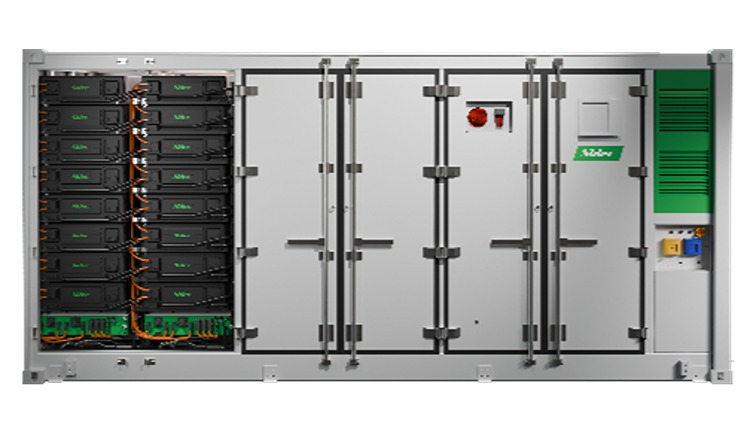
Nidec to Showcase Energy Storage Technologies at RE+ 2026

Image: Nidec
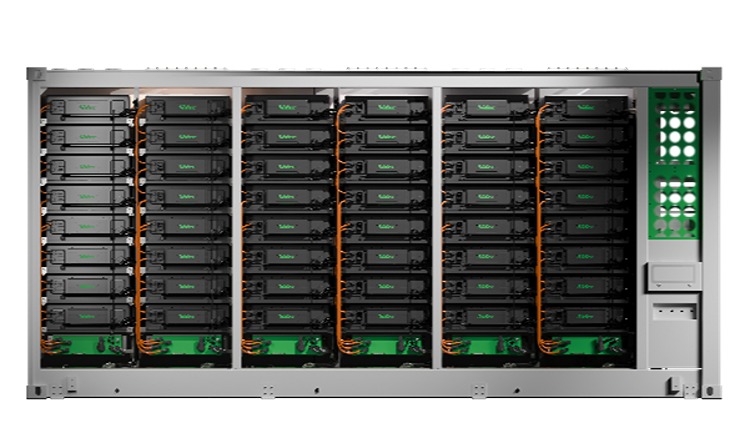
Image: Nidec

LAS VEGAS, NV, Nov 13, 2026 – Nidec Conversion will showcase two energy storage technologies at RE+ 2026,: UniQube, a liquid-cooled power conversion platform for storage applications, and ACBOX V4, a battery energy storage system (BESS) with grid-forming capabilities.

UniQube Power Conversion Platform

UniQube is a modular power conversion system (PCS) designed for energy storage applications with storage durations of two to eight hours. It can operate as standalone equipment or in combination with Nidec’s DCBOX.

Designed for outdoor installation, UniQube uses liquid cooling for operation in high-temperature climates. Nidec claims up to 20% higher power density compared with a market benchmark. The platform supports 1,500 V applications and designed to accommodate a transition toward 2,000 V systems. It also supports solar and hydrogen-related energy infrastructure applications.

ACBOX V4 Energy Storage System

Image: Nidec

ACBOX V4 uses a distributed power conversion architecture incorporating silicon carbide (SiC) semiconductor technology. The AC-block system supports granular energy management and is designed to improve system efficiency and availability.

“Energy infrastructure is entering a new phase, where reliability, flexibility and the ability to integrate increasingly complex technologies are becoming essential,” said Michael Briggs, chairman, Nidec Motion & Energy Business Unit, CEO, appliance automotive division. “At Nidec, we are bringing together our engineering expertise, advanced technologies and global scale to help customers address these challenges. Our focus is on strengthening the technologies and capabilities that will support the world’s growing energy needs.”

“Customers need solutions that not only meet today’s technical requirements but also adapt as their projects and the grid evolve,” said Dominique Llonch, president, Nidec Motion & Energy Business Unit. “ACBOX V4, DCBOX and UniQube reflect our commitment to practical innovation, combining advanced technologies with engineering expertise to help customers simplify integration, improve performance and support long-term operations. Together, these solutions demonstrate how Nidec is responding to evolving energy infrastructure needs, from renewable integration and grid stability to the growing power demands of data centers.”

Nidec will display UniQube, ACBOX V4 and DCBOX (booth C5454) in Central Hall at the Las Vegas Convention Center, Nov 17-19, 2026.

Source: Nidec

About Nidec

Nidec is a Japanese manufacturer of electric motors, electronic components and industrial equipment. Founded in 1973, the company is headquartered in Kyoto, Japan. It designs and manufactures precision motors, automotive systems, industrial drives, generators and control equipment. Its products include motors for household appliances, computers, electric vehicles and industrial machinery. Nidec also produces compressors, electronic controls, power transmission equipment and manufacturing machinery. The company serves automotive manufacturers, electronics producers, appliance makers, industrial operators and energy companies. Its customers also operate in aerospace, transportation, data centers and infrastructure development. Nidec supplies equipment for factory automation, renewable energy systems and commercial buildings. Its engineering activities include motor design, electrical systems development and mechanical component manufacturing. The company maintains manufacturing, research and sales facilities across Asia, Europe and the Americas. Its operations include more than 300 group companies in over 40 countries. Nidec reports about 100,000 employees worldwide.

About Nidec Conversion

Nidec Conversion is an Italian industrial engineering company and part of Japan’s Nidec Corp. Established under its current name in 2024; the business traces its origins to 1899. It is headquartered in Cinisello Balsamo, Italy. The company designs and manufactures electric motors, generators, industrial drives, power converters and automation systems. Its products include battery energy storage systems, electrical controls and power management equipment. Nidec Conversion serves the manufacturing, power generation, renewable energy, metals, mining and marine industries. It also supplies equipment for oil and gas operations and electric vehicle charging infrastructure. Its engineering services cover electrical system design, installation, commissioning, maintenance, repairs and equipment upgrades. The company operates through industrial businesses, including Nidec ASI, Avtron Industrial Automation and Motortecnica. It maintains manufacturing and engineering operations in Europe and North America. Nidec Conversion reports more than 2,200 employees worldwide.

Gleeds Expands OpenSpace Across Construction Projects

Image: Gleeds
Image: Gleeds

LONDON, UK, Nov 13, 2026 – OpenSpace has announced that Gleeds will continue expanding Visualise, its client-facing site intelligence service built on OpenSpace’s Visual Intelligence Platform. Since its introduction in 2022, Visualise has grown from a 16-person pilot to more than 1,900 platform users across approximately 340 projects in 10 countries.

According to OpenSpace, Visualise contributed to approximately £2 million in client savings during 2025. The expansion forms part of Gleeds’ Service Innovation program, which focuses on digitizing service delivery and improving project performance.

Visualise provides project teams with access to site information for monitoring progress, managing costs and assessing risks. Using OpenSpace’s Field Notes function, teams have recorded more than 50,000 site observations, issues and actions against live project records.

Sheldon Atkinson, head of Visualise at Gleeds said: “Combining OpenSpace’s Visual Intelligence Platform with Gleeds’ trusted consultancy expertise, Visualise creates a scalable site intelligence service that gives clients and project teams a clear, time-stamped view of site progress, supporting better decisions, stronger evidence, and improved control of cost, program, and risk.”

“Gleeds selected OpenSpace for its leadership in Visual Intelligence, ease of adoption, proven performance across complex projects, and ability to scale globally across diverse client portfolios. Together, we’re helping to transform site observations into structured, actionable project intelligence”.

OpenSpace also reported efficiency improvements of up to 75% in progress reporting, change management, claims assessment and defects resolution. Gleeds users have logged nearly 10,000 hours of remote site viewing, reducing the need for physical site visits.

Tamas Borodi, managing director UK, Ireland, Nordics, and Eastern Europe at OpenSpace, said: “Gleeds exemplifies what it means to put technology at the heart of how you serve clients. From a 16-person pilot to more than 1,900 users across ten countries in four years, the growth speaks for itself – but what’s even more impressive is the discipline with which Gleeds has focused that growth on creating real, documented value for clients. The £2m in identified savings demonstrates the value of giving project teams access to a complete, reliable, and shared record of site reality, enabling better decisions, stronger risk management, and greater confidence throughout the project lifecycle.”

Source: Gleeds

About Gleeds

Gleeds is a British consultancy providing project management and advisory services for construction and property development. Founded in 1875, the company is headquartered in London, United Kingdom. Its services include cost management, quantity surveying, project planning, procurement and construction supervision. Gleeds also provides risk management, contract administration, sustainability consulting and property asset management. The company advises clients on project planning, design, construction, operations and maintenance. Its customers include property developers, government agencies, infrastructure operators, investors and private businesses. Gleeds serves the commercial property, health care, education, transportation, energy, manufacturing and data center sectors. Its consultants assess construction costs, manage budgets and coordinate projects with contractors and designers. The company also advises clients on building performance, environmental requirements and property investments. Gleeds operates internationally across Europe, Asia, Africa, the Americas and Australia. Gleeds reports more than 3,000 employees worldwide and more than 3,000 clients globally.

About OpenSpace

OpenSpace, founded in 2017 and headquartered in San Francisco, CA, is a construction technology company specializing in reality capture and AI-driven analytics. Its platform enables construction teams to document jobsites through automated 360° imagery, providing a visual record that aids in progress tracking, quality assurance, and coordination. Serving general contractors, specialty trades, and real estate owners, OpenSpace’s solutions are utilized across over 100 countries, with more than 275,000 users and over 43 billion square feet captured. The company’s product suite includes OpenSpace Capture, OpenSpace Air, OpenSpace BIM+, and Progress Tracking, all powered by its Spatial AI engine.

Vectorworks Sustainability Dashboard Receives DaVinci Awards

Vectorworks Sustainability Dashboard (Image: Vectorworks)

COLUMBIA, MD, Nov 13, 2026 – Sustainability Dashboard of Vectorworks, introduced with Vectorworks 2026, has received a three-star certification from the latest round of judging for The DaVinci Awards. The dashboard aggregates data from design models to provide information on environmental performance during the design process.

The dashboard tracks four metrics: embodied carbon, Urban Greening Factor (UGF), biomass density and Biodiversity Net Gain (BNG). Designers can use these measurements to assess environmental performance in architecture, urban planning and building information modeling (BIM) projects. The DaVinci Awards judges entries quarterly, with successful nominations receiving one-, two- or three-star awards.

“We’re delighted to award Vectorworks a DaVinci Award, in recognition of their work in providing real-time environmental performance in architecture, urban planning, or building information modeling (BIM) projects,” said CEO and founder of The DaVinci Awards, James Williams. “Three-star awards are earned by nominees that embody innovation and deliver unparalleled impact – either by addressing an unmet need or significantly improving an existing area to the point of setting a new standard for others to aspire to. Many congratulations to Vectorworks on securing this award.”

“Vectorworks has delivered an exceptional innovation in sustainable design, transforming environmental analysis from a separate, retrospective exercise into an active part of the creative process,” added The DaVinci Awards COO, Annabelle Whittall. “Vectorworks’ ambitious approach to making environmental performance an everyday design consideration rather than a late-stage compliance exercise was particularly impressive to the judges.”

“The Sustainability Dashboard launched to provide instant, real-time insight into a project’s environmental performance, giving architects the confidence to push boundaries and deliver projects that make a measurable difference for people and the planet,” said Vectorworks VP of product marketing, Rubina Siddiqui. “It’s powerful to see that impact be celebrated by The DaVinci Awards recognition, as we are committed to shaping the next generation of design technology that leads toward a more sustainable built environment with smarter, more resilient designs.”

Source: Vectorworks

About Vectorworks

Vectorworks is a software company based in Columbia, MD. The company was founded in 1985 and develops design and BIM tools. Its software supports CAD, 3D modeling, rendering, documentation and project coordination. Products include Vectorworks Architect, Landmark, Spotlight, Fundamentals and ConnectCAD. The software serves architects, landscape architects, entertainment designers, engineers, contractors, educators and students. Users apply it to building design, site planning, urban design, stage production, lighting design and event planning. Vectorworks operates as part of the Nemetschek Group and sells through partners and resellers. Its products serve the architecture, engineering, construction and entertainment industries. Vectorworks reports more than 685,000 users in 85 countries. The company employs about 450 people globally.

Rhino 9 Brings AI-Assisted Modeling and Faster Development to AEC

Source: AEC Magazine.


McNeel is embracing artificial intelligence to accelerate software development and expand modeling capabilities while preserving Rhino’s established business model. At Rhino World 2026, held near Barcelona, the company demonstrated its evolving AI strategy alongside the release of Rhino 9.

According to AEC Magazine, AI has significantly increased development productivity at McNeel. Developers using Claude reported nearly tripling their output, with merged pull requests rising from 3.3 to 9.5 per working day. AI also assists with debugging, automated testing, code analysis, and performance improvements, although developers continue reviewing changes.

A major development is RhinoAI, an open-source plug-in connecting AI agents to Rhino through the Model Context Protocol (MCP). Users can interact with agents such as Claude and Codex to generate geometry, create Grasshopper definitions, automate modeling tasks, and develop custom plug-ins.

Demonstrations included converting sketches into parametric models, reconstructing objects from images, and simplifying imported CAD geometry. However, complex architectural modeling produced inconsistent results, highlighting the need for human guidance.

Rhino 9 introduces more than 100 enhancements, including improved freeform modeling, advanced drafting tools, and Grasshopper 2. New capabilities support live section drawings, metadata management, multithreaded calculations, and faster handling of large models.

Rhino.Inside.Revit continues connecting Rhino with BIM workflows, while Rhino.Compute extends cloud-based processing to Linux servers. AI experiments also demonstrated automatic furniture scheduling and model metadata generation.

Despite these advances, McNeel maintains perpetual licensing, unchanged upgrade pricing, and support for earlier Rhino versions.

The developments signal McNeel’s shift toward AI-assisted design and development without abandoning user control or its established software philosophy.

Swindon Powertrain, MoTeC Expand Engineering Partnership

Image: Swindon Powertrain

Swindon Powertrain and MoTeC have announced a sales and engineering support partnership at PMW Expo 2026. Under the agreement, Swindon Powertrain will sell MoTeC products through its website and provide technical support for automotive and motorsport projects.

The partnership covers customers developing restomods, niche and electrified vehicles, prototypes, production vehicles and competition cars. Swindon Powertrain will provide engineering support for these vehicle programs.

“Today’s announcement builds on the trust we and MoTeC have developed through many years of close collaboration,” says Swindon Powertrain’s CEO, Raphaël Caillé. “This partnership takes that relationship to the next level for customers, enabling Swindon Powertrain to support a broader range of MoTeC users with the detailed engineering expertise to extract the maximum from their systems.”

MoTeC Products and Engineering Support

MoTeC’s product portfolio includes engine management systems, data acquisition equipment, digital displays and logging systems, and modular electronics for monitoring and controlling vehicle systems.

The range includes programmable engine control units (ECUs), display loggers and integrated data systems used in motorsport and specialist vehicle programs.

Swindon Powertrain’s engineering team has completed training covering the expanded MoTeC product range. MoTeC’s regional dealer network includes approximately 90 authorised dealers that provide technical support and training.

The partnership also covers engineering support for one-off vehicle projects and motorsport applications, including rallying, LMP2, Time Attack and other national racing categories.

Source: Swindon Powertrain

About Swindon Powertrain

Swindon Powertrain is a British engineering company that develops propulsion systems for automotive and motorsport applications. Founded in 1971, the company is headquartered in Swindon, United Kingdom. It designs, manufactures, assembles and tests internal combustion engines and electric vehicle powertrains. Its customers include vehicle manufacturers, racing teams, automotive suppliers and vehicle conversion companies. Swindon Powertrain supplies engines, electric motors, battery systems, transmissions and mechanical components. Its engineering services include design, simulation, component development, machining and vehicle integration. The company also manufactures wiring harnesses, electrical assemblies, crankshafts and cylinder heads. Its testing facilities support engine calibration, electric powertrain evaluation and component durability testing. Swindon Powertrain has supplied engines and engineering services for touring car racing programs. It also develops electric propulsion systems for specialized vehicles and classic car conversions. The company operates engineering facilities in the United Kingdom and France.

About MoTec

MoTeC is an Australian company that develops electronic systems for motorsports, automotive and industrial applications. Founded in 1987, the company is headquartered in Victoria, Australia. It designs and manufactures engine management systems, vehicle control units and data acquisition equipment. Its products include digital displays, data loggers, telemetry systems and power distribution controllers. MoTeC also develops software for vehicle data analysis, system configuration and electronic control. Its customers include racing teams, vehicle manufacturers and engineering companies. The company supplies electronic systems for electric vehicles, commercial equipment and marine applications. Its products support engine control, vehicle monitoring, data recording and electrical power management. MoTeC operates a R&D facility in Australia and maintains operations in Europe.

Four Platforms That Automate Mechanical Component Selection

Source: Leo AI.
Source: Leo AI.


Selecting mechanical components involves evaluating dimensions, material properties, load conditions, manufacturing standards, and supplier availability. Manual calculations and catalog searches can consume valuable engineering time, particularly when teams must coordinate information across CAD, product data management (PDM), and product lifecycle management (PLM) systems.

Leo AI examines four platforms designed to automate component sizing and selection: Leo AI, KISSsoft, Ansys Mechanical, and Siemens NX. Each addresses different engineering requirements, from intelligent part searches to structural validation and manufacturing integration.

Leo AI uses natural language queries to search more than 120 million vendor components alongside internal engineering databases. Its AI-powered calculations and PDM integration help engineers identify suitable parts, compare specifications, and reduce bill of materials (BOM) preparation time. The company reports that users save more than 8.3 hours per engineer weekly.

KISSsoft specializes in standards-based calculations for gears, shafts, bearings, and related machine elements. Supporting ISO, DIN, and AGMA standards, it helps engineers validate component dimensions and optimize gearbox designs.

Ansys Mechanical uses finite element analysis (FEA) to evaluate structural performance under mechanical and thermal loads. Python scripting, Ansys Parametric Design Language (APDL), and customization tools support automated simulations, parameter studies, and design optimization.

Siemens NX combines CAD, computer-aided engineering (CAE), and computer-aided manufacturing (CAM) capabilities. Its generative design tools and Part Families functionality support component variations and integrated design-to-manufacturing workflows.

The article recommends evaluating platforms according to engineering accuracy, component libraries, standards compliance, CAD compatibility, and the transparency of automated recommendations.

Parametric modeling, configurable component libraries, and integrated calculation tools are particularly valuable for reducing repetitive work.

Ultimately, successful automation depends on matching software capabilities to engineering requirements. Rather than replacing professional judgment, these platforms help engineers make faster, better-informed component selection decisions while maintaining design quality and technical compliance.

AI Improves Cosmic Particle Scans to Detect Hidden Objects Inside Structures

Multiple Coulomb scattering of a muon trajectory, with the scattering angle. This figure demonstrates a potential application: inspecting the interiors of trucks to detect concealed or prohibited materials. (Source: IEEE Access, 2026. DOI: 10.1109/access.2025.3648859).


Researchers at the University of Tartu in Estonia, collaborating with technology company GScan, have developed AI-based methods to improve the accuracy of muon tomography, a scanning technique that uses naturally occurring cosmic particles to examine the interiors of large structures without damaging them, tells Tech Xplore.

Muon tomography relies on muons, particles produced when cosmic rays interact with Earth’s atmosphere. Approximately 10,000 muons strike each square meter of Earth’s surface every minute. These particles penetrate thick materials, including concrete, steel, and rock, making them useful for inspecting bridges, buildings, and industrial equipment.

Detectors track muons as they pass through objects. While some travel in straight lines, others scatter when encountering dense materials. Analyzing these trajectories helps researchers identify hidden objects and determine their locations. However, slow particle arrival rates and noisy measurements often produce unclear images.

Led by lecturer Kallol Roy, the research team developed machine learning models that analyze both straight and scattered muon trajectories. Combining these measurements provides more information about where objects are present or absent.

In computer simulations, the approach located hidden objects more accurately than conventional muon imaging methods. A hybrid technique also improved the separation of closely spaced objects, reducing incorrectly merged detections from approximately 15% to 2%.

The researchers are investigating material identification using muon measurements. They have analyzed 14 materials and tested statistical and machine learning techniques to distinguish their properties.

Potential applications include monitoring structural integrity, detecting concealed hazardous materials, and inspecting industrial facilities without destructive testing or artificial X-ray radiation.

However, the technology requires further validation under real-world conditions. Researchers plan to improve model reliability and expand training datasets to accommodate more materials and complex environments.

The research demonstrates AI’s potential to improve nondestructive inspection by extracting more useful information from cosmic particle measurements.

Sivers Signs Distribution Agreement With WT Microelectronics

Image: Sivers Semiconductors

KISTA, Sweden, Nov 13, 2026 – Sivers Semiconductors has announced a global distribution agreement with WT Microelectronics covering indium phosphide (InP) lasers and wireless beamformer products. The agreement will expand Sivers’ distribution reach in markets including AI data center connectivity, satellite communications and defense.

WT Microelectronics, which has 15% market share, will add Sivers’ continuous-wave (CW) lasers and wireless beamformer technologies to its product portfolio. Sivers will become WT Microelectronics’ first laser line card.

“WT is a global leader in electronics and semiconductors distribution. Partnering with WT Microelectronics and becoming their first laser line card gives Sivers access to an established global distribution network, strong demand creation capabilities and the ability to support production ramp fulfilments at scale,” said Vickram Vathulya, CEO of Sivers Semiconductors. “The WT partnership commitment is an indication of the strength of the innovation and scale Sivers is bringing to the ecosystems in AI infrastructure, SATCOM and defense.”

The agreement gives Sivers access to WT Microelectronics’ distribution network and customer relationships to support product availability and fulfillment of production-scale orders.

“We are pleased to add Sivers’ CW lasers and wireless beamformer technologies to our portfolio. These solutions address important and expanding markets, including AI data center connectivity, satellite communications, and next-generation wireless,” said Joseph Cheng, SVP of Marketing at WT Microelectronics. “Our global distribution network and established customer relationships position us to bring these technologies to customers seeking advanced connectivity solutions. We look forward to working with Sivers to capitalize on these market opportunities.”

Source: Sivers Semiconductors

About Sivers Semiconductors

Sivers Semiconductors, based in Kista, Sweden, develops and markets integrated chips and modules for satellite communications, 5G and 6G wireless networks, and optical communications. Operating through its Photonics and Wireless divisions, the company serves industries including telecommunications, defense, aerospace, industrial sensing and data centers. Its laser and RF beamforming technologies support high-speed connectivity and improved energy efficiency in AI data centers, satellite networks and telecom systems.

About WT Microelectronics

WT Microelectronics is a Taiwanese company that distributes semiconductors and electronic components worldwide. Founded in 1993, the company is headquartered in New Taipei City, Taiwan. It also maintains a headquarters in Montreal, Canada, following its acquisition of Future Electronics. The company supplies integrated circuits, memory devices, analog components and other electronic products. Its customers include equipment manufacturers, electronics producers, product designers and industrial technology companies. WT Microelectronics serves the automotive, telecommunications, computing, industrial, consumer electronics and data center sectors. Its services include component sourcing, inventory management, supply chain management and technical support. The company also assists customers with component selection and electronic product design. WT Microelectronics represents more than 400 component suppliers and operates approximately 160 locations across more than 40 countries. The company reports more than 20,000 customers worldwide. The employee strength is around 7,500 globally.

Human-Centered Design Puts Practical Needs Ahead of AI Features

Savannah Kunovsky is a managing director at Ideo and works in its Emerging Tech Lab (source: SuperAI; iStock; Andreas Rentz/Getty Images).


Artificial intelligence is rapidly entering consumer products, but adding AI does not automatically improve functionality or user experience. In an IEEE Spectrum interview, Savannah Kunovsky, managing director at design consultancy IDEO, argues that product developers must prioritize genuine user needs rather than technological novelty.

Companies often introduce AI features because of competitive pressure, investor expectations, or market trends. However, Kunovsky emphasizes that successful product design begins by understanding users, their objectives, and the environments in which products operate.

Poorly implemented AI can complicate previously straightforward interactions. Examples include unreliable voice assistants, touchscreen vehicle controls, and Humane’s AI Pin, which attempted to replace familiar smartphone interfaces with slower, less dependable interactions.

Kunovsky describes a proposed AI-controlled cooktop that eliminated physical knobs. During testing, users struggled to reduce heat quickly when a pan began smoking. The experience demonstrated why immediate, safety-critical actions often require physical controls rather than voice commands.

Effective AI integration also requires selecting appropriate technologies. Large language models are not always necessary; computer vision, sensor fusion, and on-device models may better address specific requirements.

AI can deliver meaningful improvements in accessibility. Examples include hearing aids that isolate speech in noisy environments, applications that describe surroundings for visually impaired users, and earbuds providing real-time translation.

Generative AI introduces additional design challenges because its responses can vary. Kunovsky recommends establishing clear evaluation criteria, behavioral boundaries, and transparent interfaces that communicate uncertainty.

Human oversight remains essential. Users should be able to override automated decisions, undo actions, edit suggestions, or disable features without navigating complicated settings.

IDEO’s Ethiqly educational writing tool illustrates this approach by requiring teachers to approve AI-generated feedback before students receive it.

Ultimately, Kunovsky advocates designing AI products that extend human capabilities while preserving familiar interactions, reliability, and user control. Successful innovation depends on solving problems rather than simply introducing automation.

Graitec Updates Ideate Software With AI Assistant and Licensing

PARIS, France, Nov 13, 2026 – Graitec Group has released the Nov’2026 update to Ideate Software tools for Autodesk Revit, introducing the Graitec AI Assistant for Revit, Graitec Updater and a licensing system that replaces the Ideate Software Bundle with the Ideate Suite. Existing subscribers can migrate at no cost and should complete the transition by March 31, 2027, to avoid interrupted access.

François Appéré, solution line vice president, Autodesk Ecosystem at Graitec said: “This release brings the Graitec AI Assistant to Revit and modernizes the licensing technology behind Ideate Software.”

Licensing Changes and Product Access

The Ideate Suite retains the five tools previously included in the Ideate Software Bundle:

Under the previous Bundle model, each tool was licensed separately, allowing different users to work with different tools simultaneously. With the new Cloud Floating suite license, one user at a time can access all five tools. When that user finishes, the license becomes available to another user.

New purchases are available through the Ideate Suite, Enterprise Suite, Active Host, Automation and individual product offerings.

AI Assistant and Software Updates

The Graitec AI Assistant for Revit works only with the new licensing system. Existing subscribers can access it using their new license codes, while new customers can request an evaluation license or purchase a subscription. The release also incorporates the Graitec Licensing component to support new licensing and product offerings. Ideate Software uses the Graitec Updater to manage product updates.

Migration Requirements and Deadline

Graitec is distributing new license codes to existing subscribers. Customers should install the latest software release to complete the transition.

Migration requirements vary by license type:

  • Cloud Floating Suite licenses: Customers should deploy the latest release using their new license codes and manage licenses through the Graitec Advantage Portal.
  • Named User licenses: Organizations should configure their named users in the Graitec Advantage Portal for license management.

Customers using Revit 2022 or earlier versions should contact Graitec at ideatesupport@graitec.com to review options.

Source Graitec

About Graitec

Graitec is a French software company serving the architecture, engineering, construction and manufacturing industries. Founded in 1986, the company is headquartered in Paris, France. Graitec develops software for structural engineering, building design, construction documentation and manufacturing. Its products support CAD, BIM, structural analysis and project coordination. The company also distributes Autodesk software and provides consulting, training and technical support. Its customers include architects, engineers, construction contractors, fabricators, manufacturers and design firms. Graitec’s software portfolio includes Advance Design, PowerPack, Ideate Software and Strucsoft applications. These products support structural calculations, model management, technical drawings and construction workflows. The company operates across Europe and North America, providing software and services to engineering organizations. Graitec reports approximately 800 employees and more than 270,000 users worldwide.

About Ideate Software

Ideate Software is a U.S. software company that develops applications for Autodesk Revit. Founded in 2009, the company is based in San Francisco, CA. Its products serve architects, engineers, construction firms and facilities management professionals. Ideate Software develops tools for building information modeling, project documentation and data management. Its products include Ideate BIMLink, Ideate Explorer, Ideate Sticky, Ideate StyleManager and IdeateApps. Ideate BIMLink connects Revit model data with Microsoft Excel for editing and updating. Ideate Explorer helps users examine model elements, properties and warnings. Ideate Sticky incorporates external document information into Revit projects. Ideate StyleManager identifies and manages styles across models and project files. IdeateApps supports drawing production and routine model management tasks. The company also offers Ideate Automation for model maintenance and data exports.

0FansLike
0FollowersFollow
0SubscribersSubscribe
Google search engine

Recent Articles

Trending Now