NVIDIA Unveils Personal Super Computer, Predicts Robot-filled Future at CES

brain surgery assisted with robots
It is brain surgery. In the world imagined by NVIDIA, AI is everywhere and helping everyone. Image: NVIDIA
brain surgery assisted with robots
It is brain surgery. In the world imagined by NVIDIA, AI is everywhere and helping everyone. Image: NVIDIA

NVIDIA CEO Jensen Huang delivered the first keynote at CES 2025 and set the stage for the future of AI. With continuing advances in GPU hardware, the chips that most AI runs on these days, NVIDIA reaffirmed its position as the hardware leader in the tech industry.

humanoid robots and Jensen Huang

Huang first announcement was the GeForce RTX 5090, the “most powerful graphics card NVIDIA has ever developed,” perhaps paying homage to NVIDIA’s beginnings as a maker of graphics cards for gamers. Built on the Ada Lovelace 2 architecture, the RTX 5090 introduces significant advancements in performance and efficiency and may indeed raise the bar for gaming and content creation.

Jensen Huang and RTX with GPUs
Is that alligator skin, Jensen? Huang highlights the mechanical design of the RTX. “This is just a big fan,” he says, showing the circuit board with the GPU chips inside.

Is that alligator skin, Jensen? Huang highlights the mechanical design of the RTX. “This is just a big fan,” he says, showing the circuit board with the GPU chips inside.
“The GeForce RTX 5090 is not just an upgrade; it’s a revolution for gamers and creators alike,” Huang declared. “It blurs the line between the virtual and the real, making experiences more immersive than ever.”

Graphics Imagined Mostly, Some Computed

Rendering by AI by NVIDIA
Rendering by AI. Of 33 million pixels generated in an image, only two million are computed, the rest “inferred” by AI, making real-time rendering of complex 3D scenes possible.

Rendering by AI. Of 33 million pixels generated in an image, only two million are computed, the rest “inferred” by AI, making real-time rendering of complex 3D scenes possible.

Huang emphasized the rapid advancement of artificial intelligence, stating that AI is progressing at an “incredible pace. He outlined the evolution of AI from perception AI—understanding images, words and sounds—to generative AI, which creates text, images, video and sound.

Huang introduced the concept of “physical AI,” describing it as AI that can perceive, reason, plan and act but is deeply rooted in the physical world. NVIDIA’s GPUs and platforms are central to enabling breakthroughs across industries, including gaming, robots and autonomous vehicles, said Huang (more on that later).

Huang underscored the exponential rate of data creation.

“In the next couple of years, humanity will produce more data than it has produced since the beginning,” he said.NVIDIA Blackwell in productionHuang announced that the company’s latest generation AI processor series, Blackwell, is now in full production. and claimed that every major cloud service provider has systems up and running with Blackwell and showcased systems from 15 computer manufacturers at the event. Huang emphasized that Blackwell is the engine of AI, bringing significant advancements to PC gamers, developers, and creatives.

Huang poses as a gladiator at CES2025

A Token Investment

Huang told of how his new GPUs, which manage better performance and use less energy, will allow data centers to make more money. Not only would it cut cooling costs, a major expense for data centers, but they will enable data centers to generate more AI tokens—a critical metric for monetizing AI services.

NVIDIA’s latest Blackwell-based GPUs, such as the RTX 5090 and the Grace Blackwell NVLink 72 systems, deliver significantly better energy efficiency so data centers can achieve the same computational output with far less electricity.

Or datacenter could run at full tilt and generate more AI tokens— the key unit of output in the AI-driven economy. Tokens, the blocks of AI-generated text or other outputs, can be produced faster and at lower costs.

For example, suppose a data center previously generated 1 billion tokens daily at a specific energy cost. An improved efficiency might now allow them to generate 1.5 billion tokens using the same energy, directly increasing revenue potential.

Agentic AI

An AI agent to assist with every job, says Jensen Huang.
An agent to assist with every job. “The IT department of the future will be like the HR of AI agents,” said Huang.

An agent to assist with every job. “The IT department of the future will be like the HR of AI agents,” said Huang.
“The age of AI agentics is here,” said Huang, signaling a transformative shift in artificial intelligence. He described agentic AI as a “multitrillion-dollar opportunity” that will revolutionize work across industries. Huang emphasized that AI agents are becoming the new digital workforce, capable of reasoning, planning, and acting autonomously.

NVIDIA Cosmos: A platform designed to advance physical AI by providing new models and video data processing pipelines for robots, autonomous vehicles, and vision AI.
AI Foundation Models for RTX PCs: These models feature NVIDIA NIM microservices and AI Blueprints for crafting digital humans, podcasts, images, and videos, enabling the development of specialized AI agents to automate tasks.
Companies will develop the agents into assistants for many of their roles, predicts Huang. Perhaps the best example is developers, for whom AI-code generation is already being widely used.

There are 30 million developers who could use an AI agent, says Huang.

Foundation for the World

Digital twin of a warehouse
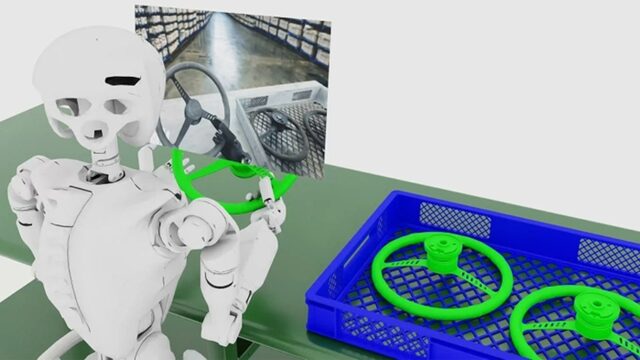
Huang thinks the next big AI (after LLMs, which work only with text) is physical AI, which works with physics. In the keynote, Huang introduced NVIDIA’s Cosmos, the world’s first World Foundation Model, which uses physical AI.

This foundational knowledge allows Cosmos to create simulations that reflect real-world behavior, making it highly suitable for industries like robotics, autonomous vehicles, and industrial AI.

Cosmos will then be able to model the physical world. It has learned all its physics not from sitting in class or reading books but from “20 million hours of video” of objects in motion, interactions between objects, and physical environments. This ought to allow it to predict interactions and motion for industries such as robotics and autonomous vehicles where real-world data is limited or costly to capture, factory automations, warehouse operations and their optimization.

Huang announced that Cosmos will be freely available, open-licensed and available on GitHub.

The Cosmos World Foundation Model is a sophisticated AI system that ingests and understands multimodal data, including text, images, and video, to generate realistic simulations and predictions about the physical world. Unlike LLMs that process text-based tokens, the World Foundation Model generates “action tokens,” enabling it to predict and simulate real-world behavior based on actual Newtonian physics.

rough shapes of buildings in sought west town created by AI
With COSMOS physical AI, we will be able to generate real worlds from sketches and models and depict their variations fully rendered using Omniverse (below).

rendered image of buildings in Southwest townHuang discussed autonomous vehicles (AVs) as one of the most significant applications of physical AI and NVIDIA’s advanced computing platforms. He outlined the current state of AV technology, NVIDIA’s contributions, and how physical AI plays a critical role in testing, training, and advancing the capabilities of autonomous systems (more on that later).

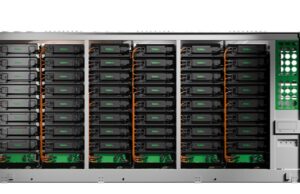
DIGITS – Your Own Personal SupercomputerDIGITS supercomputer in very small size

Huang introduced DIGITS, a personal supercomputer that will be available later this year (May). The diminutive computer (see image above) is the productization of the project called “Deep Learning GPU Intelligence Training System” (DIGITS), which NVIDIA shortened to DGX and introduced as a graphics platform of the same name in 2016.

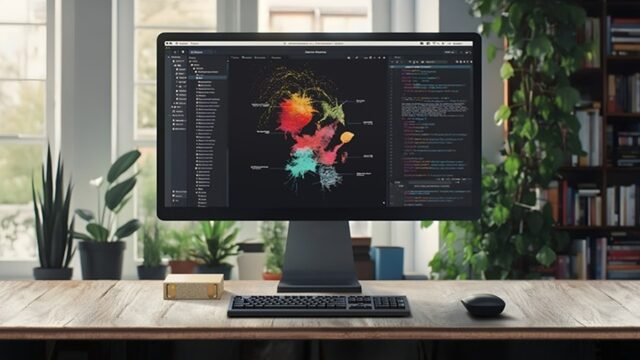
DIGITS is meant to be used for the development of AI applications. Users can access the whole of the NVIDIA AI software library for experimentation and prototyping, including software development kits, orchestration tools, frameworks and models available in the NVIDIA NGC catalog and on the NVIDIA Developer portal. Developers can fine-tune models with the NVIDIA NeMo framework, accelerate data science with NVIDIA RAPIDS libraries and run common frameworks such as PyTorch, Python and Jupyter notebooks, according to NVIDIA.

That NVIDIA is making a desktop supercomputer that can run Windows applications (with WSL 2, a Windows subsystem for Linux machines) DIGITS should be a wake-up call, if not a fire alarm, for every PC manufacturer. Here is the 2nd most valuable computer hardware company no longer content to make chips and boards for PC manufacturers but is stepping out to make its own PCs. It’s as if makers of jet engines decided to make airplanes. No specifics, like benchmark comparisons, were given at CES but since DIGITS will be operating at a scale and speed of DGX systems, thanks to the advanced architecture of the GV110 chip and its integration with NVIDIA’s AI software stack, we expect it to blow the doors off any traditional Intel-based PC running AI-assisted software… and what software will not be within the year?

An AI-Based Windows?

Huang outlined a vision for a future version of Windows that would be deeply integrated with AI capabilities. He referenced the revolutionary impact of Windows 95, which introduced multimedia APIs that transformed the software development landscape. He likened this transformative potential to what he envisions for the future of AI on Windows PCs.

Huang introduced the concept of “generative APIs,” which would allow developers to integrate AI directly into applications on Windows PCs. These APIs would enable:

Generative AI for Language: Advanced natural language processing for creating text and responding to queries.
Generative AI for Graphics: Tools for producing 3D models, animations, and video content.
Generative AI for Sound: Capabilities for audio synthesis and manipulation.
These APIs would extend the functionality of traditional computing by bringing AI-assisted tools directly into everyday applications.

Currently, NVIDIA is using Windows Subsystem for Linux (WSL) 2, which provides a dual-operating-system environment optimized for AI development.

Autonomous Vehicles

Mercedes autonomous vehicle going across the Golden Gate BridgeNVIDIA’s automotive vertical business is currently at $4 billion and is expected to grow to approximately $5 billion in fiscal year 2026, according to NVIDIA.

Huang highlighted that autonomous vehicle, after years of development, are now becoming mainstream, citing the success of companies like Waymo, Tesla, and Aurora (AV trucks). He characterized the AV industry as likely to become the first multi-trillion-dollar robotics market, driven by the massive demand for self-driving cars and trucks.

Each year, 100 million cars are built, said Huang. A billion cars are on the road globally, collectively driving a trillion miles annually. Autonomous capabilities will revolutionize how these vehicles operate.

NVIDIA is working with major automakers like Mercedes, BYD, Toyota and startups like Zoox and Waymo to develop next-generation autonomous systems.

3 Body Problem movie poster
Instead of a 3 Body Problem, we have a 3 Computer Solution, said Jensen Huang at CES, invoking the sci-fi series. Image: Netflix.

Autonomous vehicles require a “three-computer solution” tailored for different stages of development and deployment:

  1. Training AI Models (DGX Systems) for training AV models using vast datasets and simulations.
  2. Simulation and Synthetic Data Generation (Omniverse & Cosmos) to create environments and situations to enable extensive tests before real-world deployment.
  3. In-Car AI Systems (Drive AGX Thor), VIDIA’s latest AI supercomputer for cars, processes massive amounts of sensory data, from cameras to LiDAR and radar, to make real-time driving decisions.

Thor offers 20 times the processing power of its predecessor, making it suitable not only for AVs but also for robotics and other high-performance applications.

Huang emphasized the importance of testing AV systems with synthetic data and simulations powered by physical AI. These technologies allow NVIDIA to simulate real-world driving conditions at an unprecedented scale and fidelity. NVIDIA’s Cosmos platform generates lifelike driving scenarios based on real-world data, including weather, lighting, and road conditions. This allows AV models to train on edge cases that are rare or dangerous to capture in real life. Using NVIDIA Omniverse, AV systems can simulate billions of miles of driving by replaying and altering existing driving logs. For example, recorded real-world footage of a drive can add rain and snow, change the time of day, increase traffic, and more. This would allow the AV industry to turn thousands of real-world drives into billions of simulated miles, amplifying the training data exponentially.

Huang stressed that the ability to simulate edge cases—such as unpredictable pedestrian behavior or hazardous weather—is critical for reducing risk with autonomous vehicles.

Huang concluded his keynote with a forward-looking statement about the transformative role of AI and computing in society. “We are entering an era where AI will become as ubiquitous as electricity,” he said. “From healthcare to entertainment, from scientific research to autonomous systems, NVIDIA’s technologies will drive the next wave of innovation.”
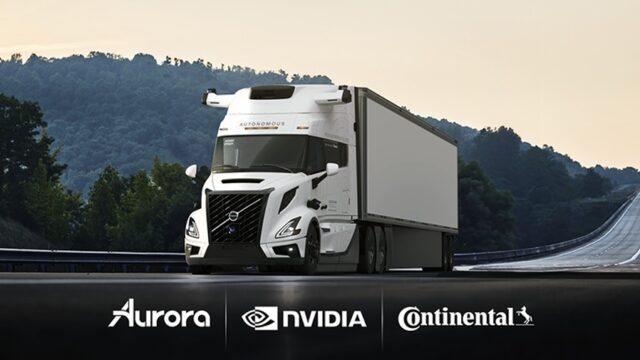
NVIDIA Partners with Toyota, Aurora, Continental for AI-Driven Fleets

NVIDIA announced that Toyota, Aurora and Continental have joined the list of global mobility leaders developing and building their consumer and commercial vehicle fleets on NVIDIA accelerated computing and AI.

Toyota, the world’s largest automaker, will build its next-generation vehicles on NVIDIA DRIVE AGX Orin, running the safety-certified NVIDIA DriveOS operating system. These vehicles will offer functionally safe, advanced driving assistance capabilities.

The majority of present day auto manufacturers, truck-makers, robotaxi, and autonomous delivery vehicle companies, tier-one suppliers and mobility startups are developing on NVIDIA DRIVE AGX platform and technologies. With cutting-edge platforms spanning training in the cloud to simulation to compute in the car, NVIDIA’s automotive vertical business is expected to grow to approximately $5 billion in fiscal year 2026.

“The autonomous vehicle revolution has arrived, and automotive will be one of the largest AI and robotics industries,” said Jensen Huang, founder and CEO of NVIDIA. “NVIDIA is bringing two decades of automotive computing, safety expertise and its CUDA AV platform to transform the multitrillion dollar auto industry.”

Aurora, Continental and NVIDIA also announced a long-term strategic partnership to deploy driverless trucks at scale, powered by NVIDIA DRIVE. NVIDIA’s accelerated compute running DriveOS will be integrated into the Aurora Driver, an SAE level 4 autonomous-driving system that Continental plans to mass-manufacture in 2027.

Other mobility companies adopting NVIDIA DRIVE AGX for their next-generation advanced driver-assistance systems and autonomous vehicle roadmaps include BYD, JLR, Li Auto, Lucid, Mercedes-Benz, NIO, Nuro, Rivian, Volvo Cars, Waabi, Wayve, Xiaomi, ZEEKR, Zoox and many more.

NVIDIA offers three core computing systems and the AI software essential for end-to-end autonomous vehicle development. NVIDIA DRIVE AGX is the in-vehicle computer. NVIDIA DGX processes the data from the fleet and trains AI models, and NVIDIA Omniverse and NVIDIA Cosmos running on NVIDIA OVX systems test and validate self-driving systems in simulation.

Source: NVIDIA

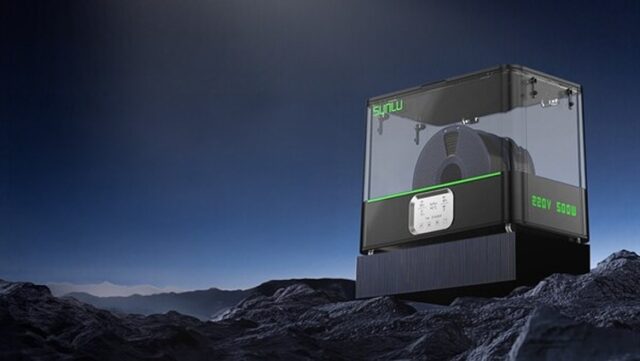
FilaDryer E2 3D Printer Dries, Anneals Filament

Image: FilaDryer
Image: FilaDryer

ZHONGSHAN, China, Jan 13, 2025 – SUNLU has unveiled its latest development – the FilaDryer E2, an optimum solution for efficiently drying and annealing engineering filaments. Addressing professionals and enthusiasts, the E2 is designed to handle high-performance materials, setting a new benchmark in filament management and post-processing.

Key Features

  • One-Touch Efficient Drying – The FilaDryer E2 is the first in the industry to achieve up to 110°C drying temperature. It is ideal for handling moisture-sensitive materials like PA and PC by drying at 90°C in just 2–3 hours, significantly improving efficiency. With a user-friendly one-touch drying function, the E2 automatically provides optimal drying settings for the most common filament types. The FilaDryer E2 features a dual-chamber insulation ensuring efficient, consistent and energy-efficient drying by trapping heat and blocking external moisture.
  • Powerful Annealing – The FilaDryer E2 is the first filament dryer capable of annealing 3D-printed parts. Annealing eliminates residual stress through consistent thermal treatment, thus, enhancing mechanical properties. This feature allows users to achieve superior strength, stability, and durability in the prints, particularly with engineering-grade materials like PA and PC.
  • Dry Bigger – The FilaDryer E2 accommodates up to one 3kg/2kg spool or two 1kg spools (maximum spool size: φ250mm×153mm). This makes it the ideal choice for users working with larger spools, providing the convenience of handling bulk materials without frequent spool changes.
  • Enhanced Safety – The FilaDryer E2 prioritizes user safety with a dual-layer insulation structure that maintains exterior temperatures below 60°C, even at its maximum drying temperature of 110°C. A high-temperature-resistant fan, a PTC heater, and an automatic power-off system safeguard the device during prolonged use.

The FilaDryer E2 represents SUNLU’s commitment to driving innovation in the 3D printing industry. Specially designed for the engineering filament market, it is available for preorder. The E2 delivers efficient, reliable engineering filament printing, unlocking endless possibilities for creators and professionals.

Source: SUNLU

NVIDIA Launches Cosmos for Physical AI Development

Cosmos. Image: NVIDIA

LAS VEGAS, NV, Jan 13, 2025 – NVIDIA announced NVIDIA Cosmos, a platform comprising generative world foundation models, advanced tokenizers, guardrails and an accelerated video processing pipeline built to advance the development of physical AI systems such as autonomous vehicles (AVs) and robots.

Physical AI models are costly to develop, and require vast amounts of real-world data and testing. Cosmos world foundation models, or WFMs, offer developers an easy way to generate massive amounts of photoreal, physics-based synthetic data to train and evaluate their existing models. Developers can also build custom models by fine-tuning Cosmos WFMs.

Cosmos models will be available under an open model license to accelerate the work of the robotics and AV community. Developers can preview the first models on the NVIDIA API catalog, or download the family of models and fine-tuning framework from the NVIDIA NGC catalog or Hugging Face.

Leading robotics and automotive companies, including 1X, Agile Robots, Agility, Figure AI, Foretellix, Fourier, Galbot, Hillbot, IntBot, Neura Robotics, Skild AI, Virtual Incision, Waabi and XPENG, along with ridesharing giant Uber, are among the first to adopt Cosmos.

“The ChatGPT moment for robotics is coming. Like large language models, world foundation models are fundamental to advancing robot and AV development, yet not all developers have the expertise and resources to train their own,” said Jensen Huang, founder and CEO of NVIDIA. “We created Cosmos to democratize physical AI and put general robotics in reach of every developer.”

Open World Foundation Models to Accelerate the Next Wave of AI

NVIDIA Cosmos’ suite of open models means developers can customize the WFMs with datasets, such as video recordings of AV trips or robots navigating a warehouse, according to the needs of their target application.

Cosmos WFMs are purpose-built for physical AI research and development, and can generate physics-based videos from a combination of inputs, like text, image and video, as well as robot sensor or motion data. The models are built for physically based interactions, object permanence, and high-quality generation of simulated industrial environments – like warehouses or factories – and of driving environments, including various road conditions.

In his opening keynote at CES, NVIDIA founder and CEO Jensen Huang showcased ways physical AI developers can use Cosmos models, including for:

    • Video search and understanding, enabling developers to easily find specific training scenarios, like snowy road conditions or warehouse congestion, from video data.
    • Physics-based photoreal synthetic data generation, using Cosmos models to generate photoreal videos from controlled 3D scenarios developed in the NVIDIA Omniverse platform.
    • Physical AI model development and evaluation, whether building a custom model on the foundation models, improving the models using Cosmos for reinforcement learning or testing how they perform given a specific simulated scenario.
    • Foresight and “multiverse” simulation, using Cosmos and Omniverse to generate every possible future outcome an AI model could take to help it select the best and most accurate path.

Advanced World Model Development Tools

Building physical AI models requires petabytes of video data and tens of thousands of compute hours to process, curate and label that data. To help save enormous costs in data curation, training and model customization, Cosmos features:

      • An NVIDIA AI and CUDA-accelerated data processing pipeline, powered by NVIDIA NeMo Curator, that enables developers to process, curate and label 20 million hours of videos in 14 days using the NVIDIA Blackwell platform, instead of over three years using a CPU-only pipeline.
      • NVIDIA Cosmos Tokenizer, a state-of-the-art visual tokenizer for converting images and videos into tokens. It delivers 8x more total compression and 12x faster processing than today’s leading tokenizers.
      • The NVIDIA NeMo framework for highly efficient model training, customization and optimization.

World’s Largest Physical AI Industries Adopt Cosmos

1X, an AI and humanoid robot company, launched the 1X World Model Challenge dataset using Cosmos Tokenizer. XPENG will use Cosmos to accelerate the development of its humanoid robot. And Hillbot and Skild AI are using Cosmos to fast-track the development of their general-purpose robots.

“Data scarcity and variability are key challenges to successful learning in robot environments,” said Pras Velagapudi, chief technology officer at Agility. “Cosmos’ text-, image- and video-to-world capabilities allow us to generate and augment photorealistic scenarios for a variety of tasks that we can use to train models without needing as much expensive, real-world data capture.”

Transportation leaders are also using Cosmos to build physical AI for AVs:

      • Waabi, a company pioneering generative AI for the physical world starting with autonomous vehicles, is evaluating Cosmos in the context of data curation for AV software development and simulation.
      • Wayve, which is developing AI foundation models for autonomous driving, is evaluating Cosmos as a tool to search for edge and corner case driving scenarios used for safety and validation.
      • AV toolchain provider Foretellix will use Cosmos, alongside NVIDIA Omniverse Sensor RTX APIs, to evaluate and generate high-fidelity testing scenarios and training data at scale.
      • Global ridesharing giant Uber is partnering with NVIDIA to accelerate autonomous mobility. Rich driving datasets from Uber, combined with the features of the Cosmos platform and NVIDIA DGX Cloud, can help AV partners build stronger AI models even more efficiently.

“Generative AI will power the future of mobility, requiring both rich data and very powerful compute,” said Dara Khosrowshahi, CEO of Uber. “By working with NVIDIA, we are confident that we can help supercharge the timeline for safe and scalable autonomous driving solutions for the industry.”

Developing Open, Safe and Responsible AI

NVIDIA Cosmos was developed in line with NVIDIA’s trustworthy AI principles, which prioritize privacy, safety, security, transparency and reducing unwanted bias.

Trustworthy AI is essential for fostering innovation within the developer community and maintaining user trust. NVIDIA is committed to safe and trustworthy AI, in line with the White House’s voluntary AI commitments and other global AI safety initiatives.

The open Cosmos platform includes guardrails designed to mitigate harmful text and images, and features a tool to enhance text prompts for accuracy. Videos generated with Cosmos autoregressive and diffusion models on the NVIDIA API catalog include invisible watermarks to identify AI-generated content, helping reduce the chances of misinformation and misattribution.

NVIDIA encourages developers to adopt trustworthy AI practices and further enhance guardrail and watermarking solutions for their applications.

Cosmos WFMs are now available under NVIDIA’s open model license on Hugging Face and the NVIDIA NGC catalog. Cosmos models will soon be available as fully optimized NVIDIA NIM microservices.

Developers can access NVIDIA NeMo Curator for accelerated video processing and customize their own world models with NVIDIA NeMo. NVIDIA DGX Cloud offers a fast and easy way to deploy these models, with enterprise support available through the NVIDIA AI Enterprise software platform.

Source: NVIDIA


NVIDIA Unveils AI Supercomputer Project DIGITS

Image: NVIDIA
Image: NVIDIA

LAS VEGAS, NV, Jan 13, 2025 – NVIDIA unveiled NVIDIA Project DIGITS, a personal AI supercomputer that provides AI researchers, data scientists and students worldwide with access to the power of the NVIDIA Grace Blackwell platform.

Project DIGITS features the new NVIDIA GB10 Grace Blackwell Superchip, offering a petaflop of AI computing performance for prototyping, fine-tuning and running large AI models.

With Project DIGITS, users can develop and run inference on models using their own desktop system, then seamlessly deploy the models on accelerated cloud or data center infrastructure.

“AI will be mainstream in every application for every industry. With Project DIGITS, the Grace Blackwell Superchip comes to millions of developers,” said Jensen Huang, founder and CEO of NVIDIA. “Placing an AI supercomputer on the desks of every data scientist, AI researcher and student empowers them to engage and shape the age of AI.”

GB10 Superchip Provides a Petaflop of Power-Efficient AI Performance

The GB10 Superchip is a system-on-a-chip (SoC) based on the NVIDIA Grace Blackwell architecture and delivers up to 1 petaflop of AI performance at FP4 precision.

GB10 features an NVIDIA Blackwell GPU with latest-generation CUDA cores and fifth-generation Tensor Cores, connected via NVLink-C2C chip-to-chip interconnect to a high-performance NVIDIA Grace CPU, that includes 20 power-efficient cores built with the Arm architecture. MediaTek, known for its Arm-based SoC designs, collaborated on the design of GB10, contributing to its power efficiency, performance and connectivity.

The GB10 Superchip enables Project DIGITS to deliver powerful performance using only a standard electrical outlet. Each Project DIGITS features 128GB of unified, coherent memory and up to 4TB of NVMe storage. With the supercomputer, developers can run up to 200-billion-parameter large language models to supercharge AI innovation. In addition, using NVIDIA ConnectX networking, two Project DIGITS AI supercomputers can be linked to run up to 405-billion-parameter models.

Grace Blackwell AI Supercomputing Within Reach

With the Grace Blackwell architecture, enterprises and researchers can prototype, fine-tune and test models on local Project DIGITS systems running Linux-based NVIDIA DGX OS, and then deploy them seamlessly on NVIDIA DGX Cloud, accelerated cloud instances or data center infrastructure.

This allows developers to prototype AI on Project DIGITS and then scale on cloud or data center infrastructure, using the same Grace Blackwell architecture and the NVIDIA AI Enterprise software platform.

Project DIGITS users can access an extensive library of NVIDIA AI software for experimentation and prototyping, including software development kits, orchestration tools, frameworks and models available in the NVIDIA NGC catalog and on the NVIDIA Developer portal. Developers can fine-tune models with the NVIDIA NeMo framework, accelerate data science with NVIDIA RAPIDS libraries and run common frameworks such as PyTorch, Python and Jupyter notebooks.

To build agentic AI applications, users can also harness NVIDIA Blueprints and NVIDIA NIM microservices, that are available for research, development and testing via the NVIDIA Developer Program. When AI applications are ready to move from experimentation to production environments, the NVIDIA AI Enterprise license provides enterprise-grade security, support and product releases of NVIDIA AI software.

Project DIGITS will be available from May, 2025 from NVIDIA and its partners, starting at $3,000.

Source: NVIDIA

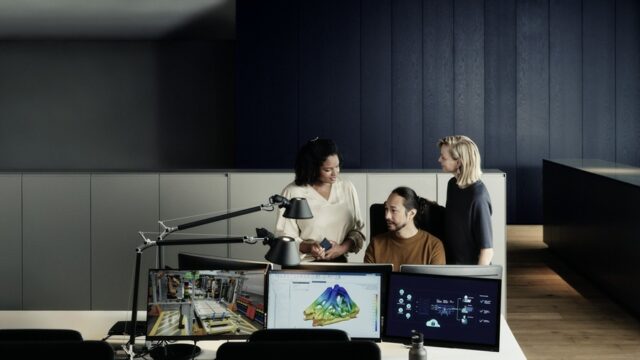
Siemens Launches Program to Help Startups with New Tech

Image: Siemens
Image: Siemens

MUNICH, Germany, Jan 13, 2025 – Siemens launched “Siemens for Startups”, a new program to empower early-stage engineering and manufacturing startups. Announced at CES 2025, the program will enable new companies to accelerate innovation, offer venture services to speed up development and scale faster, reducing costs for Siemens software and hardware access. “Startups are essential to making our customers more competitive, sustainable and resilient. By collaborating with startups, Siemens helps bring breakthrough ideas to industries faster, empowering customers to address global challenges more effectively with cutting-edge technologies, tools and solutions,” said Peter Koerte, member of the Managing Board of Siemens AG, chief technology officer and chief strategy officer.

The Siemens for Startups program has three pillars:

  • Connect – Startup companies to connect with the Siemens Xcelerator marketplace, providing access to a global go-to-market channel and the Siemens Xcelerator ecosystem.
  • Collaborate – Siemens will collaborate with startups through venture clienting. This will help startups with growth and early revenue.
  • Empower – “Siemens for Startups” program will provide startups with packaged access to essential software tools from Siemens Xcelerator.

Partnership with AWS

As part of its ongoing strategic collaboration with AWS, Siemens will link the “Siemens for Startups” program with AWS’s Startup program to accelerate innovation, streamline development processes and enable startups to scale faster. The collaboration underscores both companies’ commitment to fostering entrepreneurship and driving digital transformation in the industrial sector.

“Collaborating with Siemens allows us to extend the capabilities of our AWS Startup program to a new generation of innovators in the engineering and manufacturing space,” said Jon Jones, vice president and global head Startups at AWS. “By providing startups with advanced software, generative AI and cloud services, AWS and Siemens are enabling them to bring their ideas to life more quickly and boost entire industries with cutting-edge solutions.”

Integrating Siemens’ comprehensive suite of industrial software – including design, simulation and manufacturing solutions from the Siemens Xcelerator portfolio – into AWS’s scalable cloud infrastructure and startup program will enable startups to access the tools and resources they need to seize market opportunities. For technical and go-to-market support, qualifying startups will receive AWS credits, business development resources and access to the AWS Activate program.

Showcasing Startups

At CES 2025, Siemens highlighted the following startup companies that are collaborating with Siemens’ teams and technology to scale operations.

  • Arkisys is building one of the first business platforms in space for new technology hosting, satellite integration, assembly and resupply.
  • Dirac, a Siemens Technology Partner, has introduced BuildOS, the first automated work instruction platform, using physics-based simulations and manufacturing best practices to automatically generate animated, interactive, 3D assembly-ready work instructions directly from CAD models. Dirac brings technological advancements to the Automotive and Aerospace & Defense industries.
  • EthonAI is developing the EthonAI Manufacturing Analytics System (MAS), a software suite designed to achieve operational excellence at scale. Customers using EthonAI have achieved waste reductions of over 50 percent.
  • Haddy is revolutionizing furniture manufacturing with advanced 3D printing and robotics, producing sustainable products at a low cost and on a commercial scale. Haddy is building a global network of local micro-factories equipped with hybrid Flexbot systems from CEAD and recycling units that shorten the supply chain and help the environment by reducing waste.
  • Instrumental technology automates failure discovery and root cause analysis in electronics manufacturing — accelerating new product development.
  • Tended uses geospatial data and wearable technology to transform the safety of high-risk work environments.

Source: Siemens

Lenovo at CES 2025: AI Driven Innovation

Image: Lenovo
Image: Lenovo

LAS VEGAS, NV, Jan 13, 2025 – Lenovo unveiled a lineup of AI-powered solutions at CES 2025, showcasing innovation across its commercial, gaming, and consumer segments. At the heart of Lenovo’s innovation is its Smarter AI for All vision that integrates cutting-edge AI capabilities into its Copilot+ PCs and solutions. Leading this effort is Lenovo AI Now, a powerful on-device personalized AI assistant built on Meta’s Llama 3 model that offers natural language processing for tasks like document summarization, knowledge base retrieval, and workflow assistance. Additionally, Legion Space, Lenovo’s unified gaming platform, connects AI to provide features like personalized gameplay analytics, content creation tools, and seamless device synchronization.

Redefining Business Productivity with AI-Powered ThinkPad and ThinkBook Solutions

Lenovo introduced its latest business-focused Copilot+ PC devices, tailored for modern workplaces and professionals:

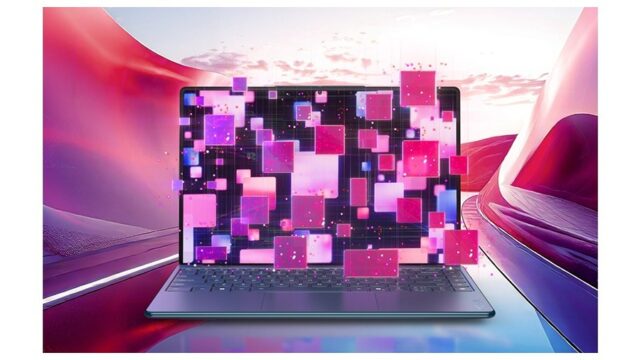
  • ThinkPad X9 Aura Editions: The ThinkPad X9 14” and 15” Aura Edition laptops offer top performance with Intel Core Ultra processors, Lenovo AI Now for automation, and premium OLED displays, ideal for hybrid professionals.
  • ThinkBook Plus Gen 6 Rollable: AI-enabled laptop with rollable display that expands vertically from 14” to 16.7”. It redefines productivity with split-screen functionality, virtual display options, and powerful Intel Core Ultra processors.
ThinkPad X9 14 Aura Edition. Image: Lenovo

Lenovo also introduced new ThinkCentre desktop solutions:

  • ThinkCentre M90a Pro Gen 6: AI enabled QHD display desktop with AI-powered noise suppression and directional audio for virtual meetings.
  • ThinkCentre neo 50q QC: The world’s first Snapdragon X Series powered commercial desktop, offering AI-driven workflows in a tiny 1-liter form factor.
  • ThinkCentre neo Ultra Gen 2: The upgraded powerhouse has Intel Core Ultra processors and Thunderbolt 4 ports.

Additional Commercial Announcements

Lenovo further expanded its ecosystem with advanced monitors, accessories, and software designed to enhance productivity and connectivity:

  • ThinkVision P Series Monitors: Monitors featuring high dynamic color accuracy, AI-powered energy efficiency, and modern designs with 95% post-consumer recycled plastics.
  • Self-Charging Bluetooth Keyboard: A battery-free keyboard with ambient light power, customizable tilt legs, media controls, and real-time power tracking.
  • ThinkPad X9 Accessories: Designed for professionals on the go, including:
    • Lenovo X9 Charging GaN Dock, a compact hub offering versatile connectivity with HDMI 2.1, USB-C, and SD card support.
    • Multi-Device Wireless Mouse (X9 Edition), connecting three devices with customizable AI Now trigger button.
    • Lenovo TWS Earbuds (X9 Edition) with audio, auto-switching, and noise cancellation.
    • Origami X9 Sleeves, protective covers that double as workstation stands, made from recycled materials.
  • QHD and 4K Pro Webcams: Microsoft Teams-certified webcams with AI-enhanced features like participant tracking, lighting adjustments, and real-time image optimization.

This expanded portfolio showcases Lenovo’s leadership in delivering AI-powered, sustainable, and highly adaptable solutions that address the evolving needs of today’s businesses.

Expanding the Lenovo Legion Gaming Portfolio: Game without Limits

Lenovo Legion unveiled a comprehensive lineup of next-generation gaming devices, accessories, and software designed to deliver cutting-edge performance, innovation, and adaptability for all levels of gamers:

  • Legion Go S (8”, 1) and Legion Go S (8”, 1) – Powered by SteamOS: A gaming device powered by AMD processors and available in Windows or SteamOS versions.
Legion Go S (8”, 1). Image: Lenovo
    • Legion Go (8.8”, 2) Prototype: A gaming device featuring OLED PureSight display, AMD Ryzen processors, and enhanced ergonomics.
    • Legion Pro Series Laptops: The redesigned Legion Pro 7i, Pro 5i, and Pro 5 feature Intel Core Ultra or AMD Ryzen processors, NVIDIA GeForce RTX GPUs, and Coldfront Hyper cooling systems for competitive performance, dynamic visuals, and smooth framerates.
    • Legion 7i and Legion 5 Series: Portable gaming laptops with PureSight displays, sleek designs, and superior cooling, ideal for gamers handling STEM and academic tasks.
Legion Pro 7i (16”, 10). Image: Lenovo

Lenovo also introduced advanced gaming desktops, monitors, LOQ systems, and the latest Legion Tab:

  • Legion Tower Series: The Legion Tower 7i, Tower 5i, and Tower 5 offer upgradable components, Intel Core Ultra or AMD Ryzen processors, and NVIDIA GeForce RTX GPUs
  • Legion Pro 34WD-10 Gaming Monitor: A curved 800R PureSight OLED gaming monitor featuring AI-driven burn-in protection and high-performance visuals with a 240Hz refresh rate and one-cable USB Type-C solution.
  • Legion R34w-30 Monitor: A versatile ultrawide 34” display with a 1500R curve, 180Hz refresh rate, and vibrant color accuracy,
  • Lenovo LOQ portfolio: Updated Lenovo LOQ devices are available with either Intel or AMD options with NVIDIA GeForce RTX GPUs,
  • Lenovo Legion Tab (8.8”, 3): A portable gaming device with an 8.8” 2.5K 165Hz PureSight touch display, Snapdragon 8 Gen 3 processor supporting ray tracing and 165 FPS, 12GB RAM, and 256GB storage. Features Legion Coldfront Vapor Chamber for efficient cooling, a 6550mAh battery for extended sessions.

Legion Space software was fully redesigned, providing gamers with enhanced ecosystem control and AI-powered tools:

  • Game Coach: Tracks user inputs and delivers personalized recommendations to improve reaction time, accuracy, and spatial awareness.
  • Game Clip Master: Uses generative AI to edit hours of gameplay into shareable, social-ready highlights.
  • Game Companion: A customizable AI avatar that reacts to gameplay, offering encouragement and tips in real time.

Lenovo Legion Accessories round out the ecosystem, delivering performance and convenience:

  • Legion Go S Screen Protector: Durable 9H glass that protects the handheld device without compromising touch sensitivity.
  • Legion Sling Bag: Water-resistant and adjustable, designed to carry Legion Go devices and accessories on the go.
  • Legion Glasses 2: Updated lightweight wearable virtual screen glasses with brighter visuals, wider color gamut, and up to 120Hz refresh rate for private, immersive gaming experiences.
  • Legion H410 Wireless Gaming Headset: High-fidelity sound, dual connectivity (2.4GHz and Bluetooth 5.2), and a flip-to-mute microphone for seamless, high-performance audio.

With this expanded lineup of devices, monitors, accessories, and software innovations, Lenovo Legion continues to redefine what’s possible in gaming, empowering players of all levels to game their way—whether they’re at home, in the classroom, or on the move.

Lenovo unveiled AI-driven Yoga, IdeaPad, and IdeaCentre devices designed to transform creativity, productivity, and entertainment experiences:

    • Yoga Slim 9i (14”, 10): The world’s first laptop with camera-under-display (CUD) technology, delivering a stunning 98% screen-to-body ratio and a 4K PureSight Pro OLED display. This Copilot+ PC powered by Intel Core Ultra processors saves power by up to 17 hours of battery life.
  • Yoga Slim 9i (14”, 10). Image: Lenovo
    • Yoga Book 9i (14”, 10): A dual-screen OLED laptop is a creative studio with AI tools for note-taking and book synopses, featuring Air Gestures for multitasking.
    • Yoga 9i 2-in-1 Aura Edition (14”, 10): The convertible Copilot+ PC has Intel Core Ultra processors, Lenovo Aura Edition features, OLED visuals, and a flexible 360-degree design for creators.
    • Yoga Tab Plus: Lenovo’s first on-device AI tablet, featuring Snapdragon 8 Gen 3 processor, and AI tools like AI Note and AI Transcript.

Lenovo also introduced more new Yoga and IdeaPad laptops for versatile users:

  • Yoga Slim 7i Aura Edition: AI-powered canvas with a 2.8K OLED display, Lenovo Aura Edition features, including Smart Modes for personalized productivity.
  • Yoga 7i 2-in-1 Series: Convertible laptops featuring OLED PureSight displays and versatile form factors
  • IdeaPad Pro 5i (16”, 10): A laptop featuring Intel Core Ultra processors, NVIDIA GeForce RTX graphics, and an OLED display with up to 135W TDP

IdeaCentre Desktops deliver compact performance and AI-driven features for creative and home users:

  • IdeaCentre Mini x (1L, 10): The world’s first consumer desktop powered by Snapdragon X Series processors.
  • IdeaCentre Tower (17L, 10): A customizable desktop with Intel Core Ultra processors and NVIDIA GeForce RTX graphics.

Lenovo expanded its tablet lineup to empower students, creatives, and families:

  • Idea Tab Pro: A tablet with Circle to Search and Google Gemini, 3K display, and boosted performance by MediaTek Dimensity 8300.
  • Lenovo Tab: A 10.1” tablet with customizable cases

A Vision for the Future: AI-Driven Innovation and Concept Devices

Lenovo showcased visionary AI concepts that highlight the future of smart, adaptive technology:

  • AI Display: AI improves user interaction through screen rotation, elevation, tilt, posture alerts, and voice control.
  • AI Travel Set: AI enabled wearables track activity, offer productivity insights, and provide real-time language translation for travelers.
  • Lenovo Action Assistant: An AI assistant utilizing Action Model to automate tasks through language processing.
  • AdaptX Mouse: A multi-purpose mouse that becomes a tool, hub, or power bank, offering practicality and portability.
  • AI Headphones: High-tech headphones for transparent, effective communication.

Lenovo is committed to blend AI tech and user-centric design to create solutions that redefine productivity, collaboration, and adaptability.

Source: Lenovo

Hexagon Evaluates ADAS and Autonomous Systems with VTDx

Image: Hexagon
Image: Hexagon

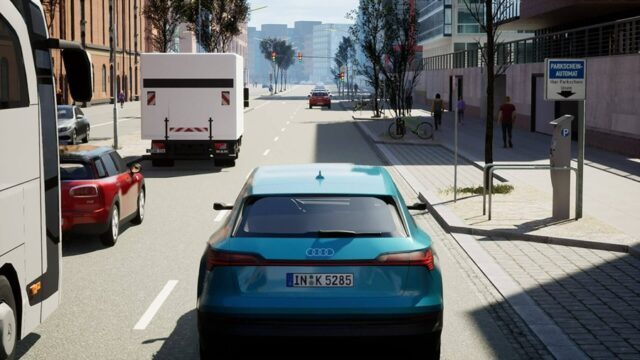
Hexagon’s Manufacturing Intelligence division introduces a new cloud-native solution to test, train, and validate Advanced Driver-Assistance Systems (ADAS) and autonomous vehicle systems. Utilizing hyperscale computing and automation, Virtual Test Drive X (VTDx) enables the automotive industry to validate the quality and function of software against thousands of real-world scenarios automatically, accelerating the time to market for safe mobility innovations.

Software plays an increasing role in vehicle design, enabling innovations that deliver convenience and safety for customers, but today’s software-defined vehicles (SDVs) are putting more pressure on the automotive teams delivering ADAS features. As vehicles integrate more sensors, adopt advanced chips and operating systems and apply increasingly complex AI and software algorithms, software development and testing create bottlenecks that delay vehicle launches and feature deployment. Safety and compliance is paramount, but the business impact is also tangible – underperforming ADAS features frustrate customers and vehicle recalls significantly impact brand loyalty and profits.

Ensuring the quality and safety of ADAS software developments is cost and time intensive, but critical because the cost of fixing defects when a vehicle is ready for production is fifteen times greater. VTDx addresses these challenges with a comprehensive consumption-based service that makes it easier to scale up virtual prototyping and mitigate the delays, high-cost, and safety risks associated with physical testing. SaaS is built from the bottom up to utilize the cloud computing power and automation of Hexagon’s Nexus digital reality platform, enabling software teams can build rigorous testing into their continuous test and integration workflows for ADAS and autonomous vehicle systems.

From an intuitive Web interface, ADAS engineers can easily create and configure their system under test (SUT) such as ADAS algorithms. They can validate their SUT with highly accurate physics-based simulations from Hexagon’s environment simulation engine that leverages its 15 years of domain expertise. When developers run a test, VTDx executes the OpenDRIVE and OpenSCENARIO standard compliant software-in-the-loop (SIL) test programs. By orchestrating tens or thousands of simulations of – as many scenarios as needed – automatically and simultaneously, companies can significantly reduce delays in configuration and computing time for their standardized SIL test programs.

VTDx addresses the dramatic change in ADAS as electrical/electronic (E/E) architectures are centralized and regulations become more stringent. It enables new SDV testing strategies that align with modern software development practices and embeds vital physical safety testing practices that are unique to the ADAS component of the vehicle codebase. Its high-productivity, highly scalable code test and integration approach provides:

  • Continuous integration and continuous testing (CI/CT): Enables continuous development, integration, and testing, allowing for faster software iterations and releases.
  • Seamless workflow integration: Integrates with existing ADAS development toolchains, embedding into existing customer workflows with modern, well-defined APIs and open environment simulation standards.
  • Ease of use: Intuitive configurations of sensors and test scenarios with user-friendly operation.
  • Scalability: Supports parallel scenario execution and real-time collaboration among global teams, making it scalable for various ADAS development needs.
  • Cloud availability: Available as a public or private SaaS, VTDx can be deployed by small and large organizations with consumption-based pricing and 24/7 availability.
  • Accessibility: Users can share a project with global team members, making scenario setups and results available in real-time through an intuitive web-based user experience.

VTDx has received positive feedback from Hexagon’s automotive customers, including OEMs and Tier 1 suppliers. User-friendly interface, high productivity, and ability to automate thousands of code-test simulations, including the consumption-based pricing, are also benefits.

It was developed in collaboration with the Microsoft Azure team, realizes photorealistic visualization via the Unreal Engine, and provides full support for the ASAM-maintained OpenSCENARIO and OpenDRIVE standards.

“We embarked on a journey to build our cloud-based ADAS simulation software from the ground up with CI/CT processes in mind, addressing the software development challenges our automotive customers face today. Whether aiming to increase test coverage, shorten test cycles, or automate workflows, our VTDx solution offers significant benefits.” said Mahesh Kailasam, general manager at Hexagon’s manufacturing intelligence division.

VTDx enables automakers to test and validate their ADAS and autonomous vehicle systems in a SIL environment, ensuring safety and performance. It is available as a public SaaS with consumption-based pricing on Nexus, with private cloud deployments available on request.

Source: Hexagon

Trimble-Qualcomm Tech Empowers Automated Vehicles

WESTMINSTER, CO, Jan 10, 2025 – Trimble has announced that it has extended its technology collaboration with Qualcomm Technologies, Inc. to deliver precise positioning solutions for automated vehicles ranging from automobiles to heavy trucking. Trimble’s precise positioning engine, Trimble ProPoint Go, will be integrated with the Snapdragon Auto 5G Modem-RF Gen 2, a key platform of the Snapdragon Digital Chassis solution, to provide positioning accuracy within 10 cm. Vehicles with the joint solution are expected to be on the roads by 2028.

This new integration is capable of supporting Level 2+ and potentially higher levels of automated driving (AD) applications with high-accuracy positioning for advanced driver assistance systems (ADAS), and cellular vehicle-to-everything (C-V2X) for automakers and Tier-1 suppliers. With the Snapdragon Auto 5G Modem-RF Gen 2, customers can extend into Level 3 autonomous driving applications, and C-V2X solutions, with the same chipset.

“Continued success between Qualcomm Technologies and Trimble is a testament to our joint innovation and delivery of solutions that help make higher levels of ADAS and C-V2X a reality for the automotive and telecom industries,” said Olivier Casabianca, vice president, positioning services at Trimble. “Together we are ensuring the highest standards of accuracy and are empowering our end customers to operate with confidence. While fully automated vehicles and trucking are still in the development stages, we are making great strides in providing technology to meet the requirements of greater levels of autonomy.”

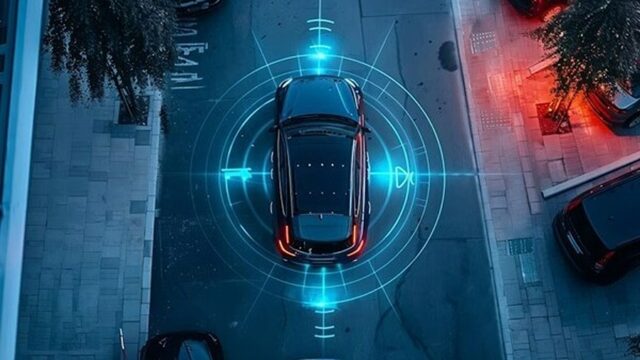
The ProPoint Go positioning engine is designed to provide position and orientation data from the fusion of GNSS signals, including globally accessible high-accuracy Trimble correction services and measurement data from a variety of sensors. ProPoint Go provides precise and reliable centimeter-level position, velocity and time information based on multi-frequency GNSS signals and ASIL-C certified Trimble RTX correction data. This positioning ecosystem helps companies advance their automated driving capabilities with safety at the forefront.

The Snapdragon Auto 5G Modem-RF Gen 2 automotive connectivity platform features integrated C-V2X direct communications, non-terrestrial networks (NTN), high-precision multi-frequency global navigation satellite system (HP-GNSS) and RF front-end (RFFE) functionalities to support major operators across key spectrum bands globally. “We are committed to delivering driver assistance technologies with a focus on achieving automated driving and creating a system that accurately responds to its surroundings,” said Jeff Arnold, vice president, product management at Qualcomm Technologies, Inc. “Our continued collaboration with Trimble allows us to add more reliable and accurate positioning to our technology stack that enhances our commitment to maintaining the highest levels of safety and system reliability.”

Pimax Launches Crystal Super Headset at CES

Image: Pimax
Image: Pimax

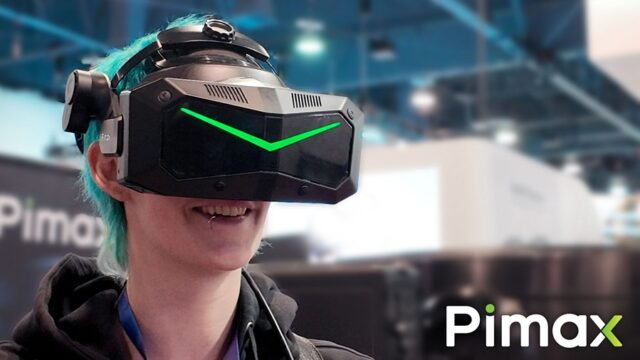
LAS VEGAS, NV, Jan 10, 2025 – Pimax has launched its Crystal Super headset at CES 2025, giving global media the opportunity to experience the 29 million-pixel VR device for the first time.

The World Meets the Crystal Super

The Crystal Super is Pimax’s latest flagship headset, featuring a resolution of 3840×3840 per eye, meaning it’s the first VR headset reaching retina levels of clarity. Glass aspheric lenses provide 57 PPD at over 120° horizontal field of view, with a brightness of 280 nits.

Pimax brought the Crystal Super DVT2 model (Design Validation Test #2), with all features working except eye-tracking, and final optimizations still to be made. International media outlets such as Linus Tech Tips, CNN, TechRadar, PC Gamer, PC Mag, Heise and Gaming Nexus have been among the first to test these innovations, making remarks on the new clarity, brightness and wide field of view of the new headset.

The Crystal Super comes with different optical engines, meaning the whole panels and lenses can be swapped out within seconds. The 57 PPD QLED (demoed at CES) is shipping soon, with the 50 PPD QLED and micro-OLED shipping also in Q1 2025.

Image: Pimax

Partners & Other Headsets

Joining the Crystal Super’s debut was the streamlined Pimax Crystal Light; a more accessible high-end PCVR headset, that is extremely popular among flight & race simmers. It was demoed in such a use scenario by partners such as Next Level Racing, MOZA Racing, Podium1, and Apevie — as well as in other use cases by Moxi (sports training) as well as CAD FORGE and NEED Immersive Reality (professional design).

Completing the lineup of Pimax at CES 2025 is the 60G Airlink, enabling ultra-low-latency wireless PCVR with the original Pimax Crystal. The 60G Airlink runs at a 90 Hz refresh rate, so that users can enjoy complete freedom without compromising on performance or visual fidelity.

“It’s always exciting to be at CES to meet users and see them use our headsets, and this year especially being the first time we publicly demoed the Crystal Super,” said Robin Weng, founder of Pimax. “The positive reactions from attendees affirm our dedication to pushing VR technology to new heights.”

Source: Pimax

0FansLike
0FollowersFollow
0SubscribersSubscribe
Google search engine

Recent Articles

Trending Now