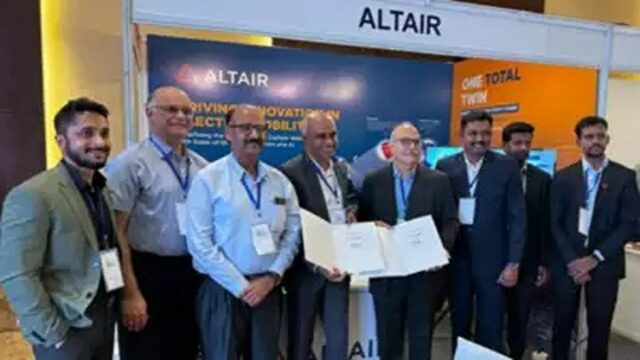
TROY, MI, Jan 10, 2025 – Altair has signed a MoU with The Centre of Excellence in Advanced Automotive Research (CAAR) to foster innovation and collaboration in the automotive industry. The collaboration will focus on developing solutions that advance e-mobility, autonomous systems, and sustainable vehicles while reducing product development timelines and ensuring India progresses at the forefront of automotive technology.
“Our collaboration with CAAR and IIT Madras is poised to drive innovation in the automotive sector,” said Vishwanath Rao, country manager, Altair India. “This MoU underscores Altair’s commitment to delivering technologies that enable automotive sustainability, efficiency, and progress.”
“Our partnership with Altair marks a significant step in our mission to speed up the process of taking innovative concepts from academic research towards industry-ready technologies,” said Thiru Srinivasan, CEO, CAAR. “This partnership will also help further develop Altair’s software tools for use in the rapid development of high-value automotive products.”
CAAR was established under the guidance and support of the Indian Institute of Technology (IIT), Madras. CAAR provides world-class technologies and facilities to the automotive industry, advises on policy, and develops human capital. With a focus on translational research, CAAR bridges the gap between academic innovation and industrial implementation.
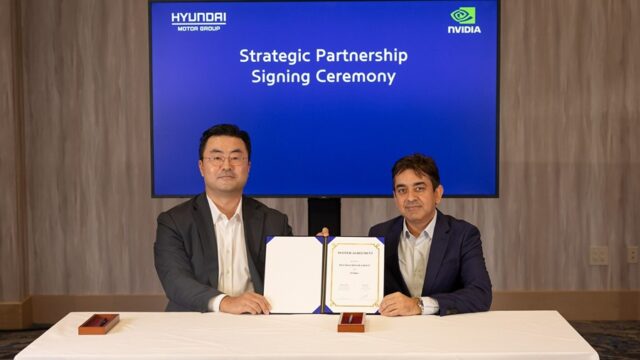
(from left) Heung-Soo Kim, executive vice president and head of global strategy office at Hyundai Motor Group and Rishi Dhall, vice president of automotive at NVIDIA
(from left) Heung-Soo Kim, executive vice president and head of global strategy office at Hyundai Motor Group and Rishi Dhall, vice president of automotive at NVIDIA
LAS VEGAS, NV, and SEOUL, South Korea, Jan 10, 2025 – Hyundai Motor Group has announced a strategic partnership with NVIDIA to accelerate the development of advanced AI technologies that will drive the future of mobility.
In the AI era, Hyundai Motor Group is driving innovation through strategic AI integration, positioning itself at the forefront of smart mobility solutions. The Group operates a variety of AI initiatives and through this partnership aims to further enhance the application of intelligence to its core mobility products, such as software-defined vehicles and robotics, and across its business operations.
“Hyundai Motor Group is exploring innovative approaches with AI technologies in various fields such as robotics, autonomous driving, and smart factory,” said Heung-Soo Kim, executive vice president and head of global strategy office at Hyundai Motor Group. “This partnership is set to accelerate our progress, positioning the Group as a frontrunner in driving AI-empowered mobility innovation.”
As part of the agreement, Hyundai Motor Group will harness NVIDIA accelerated computing and AI Enterprise software to help manage the massive amounts of data required to safely develop and train its AI models for various applications.
The Group will also utilize the NVIDIA Omniverse platform to develop physical AI and digital twin applications to simulate its factories, helping improve manufacturing efficiencies and quality, and streamline costs. In addition, the Group will use the NVIDIA Isaac robot development platform to develop and safely deploy AI robots.
Both the companies will also work closely to create virtual simulation environments for safe and reliable autonomous driving technology and robotics systems.
“Accelerated computing, generative AI, and Omniverse are unlocking a new era of mobility,” said Rishi Dhall, vice president of automotive at NVIDIA. “This partnership will drive the creation of safer, more intelligent vehicles, supercharge manufacturing with greater efficiency and quality, and deploy cutting-edge robotics to help build a smarter, more connected digital workplace.” The initiatives pave the way for groundbreaking innovations in the partnership’s future plans, with more announcements expected soon.
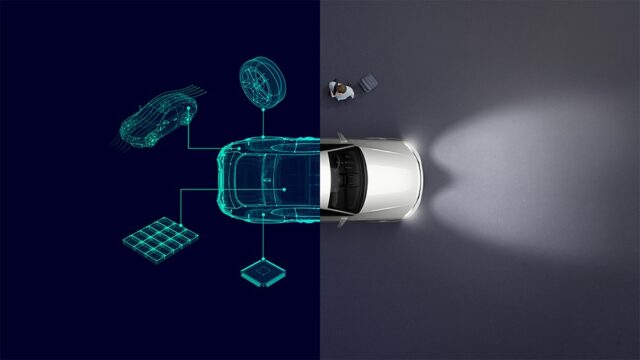
TEANECK, NJ, Jan 10, 2025 – Cognizant has announced new collaboration with Siemens Digital Industries Software to integrate Siemens’ PAVE360 into its software-defined vehicle (SDV) solution accelerator. This enhanced accelerator, featuring Siemens’ Simcenter Prescan for sensor modeling and scenario-based testing, aims to meet rising customer demands by accelerating the SDV development cycle. It is designed to enable continuous and simulated verification and validation, streamline the development process and reduce the time required to deliver features while managing the increasing software complexity from diverse platforms and components.
As the automotive landscape evolves, clients face increasing amount of pressures to innovate amidst growing customization and hyper-personalization demands. The shift toward continuous verification and validation throughout the vehicle development lifecycle necessitates partnerships that can provide robust, agile solutions.
“We are already in an era where software is the differentiating factor in the automotive industry,” said Sidhant Rastogi, president, of Zinnov. “From OEMs and tier 1 suppliers to new-age carmakers, tech service providers and platform providers, an ecosystem-driven approach is becoming central to building the capabilities required for SDVs. By enabling a shift-left approach that addresses safety and security requirements, the Cognizant-Siemens collaboration intends to accelerate product development cycles, a critical advantage for automakers in today’s competitive landscape.”
The automotive industry faces high demand to accelerate product development and testing with limited resources, manage competitive pressures and handle the complexity of over 100 million lines of code. The Cognizant solution accelerator aims to address these challenges by enabling continuous and simulated verification and validation across vehicle development.
“Cognizant’s expertise in scalable, hardware-agnostic software development aligns perfectly with our goals to innovate and meet the increasing demands for customization and hyper-personalization in the automotive industry,” said David Fritz, vice president, hybrid and virtual Systems, of Siemens. “This collaboration with Cognizant allows us to respond to customers’ growing demands effectively, leveraging our combined expertise to accelerate product development and testing processes.”
“We are thrilled to collaborate with Siemens to drive the future of mobility through our advanced solution accelerators,” said Aditya Pathak, vice president and Americas head of auto, transportation and logistics, of Cognizant. “Our expertise in developing scalable, hardware-agnostic software solutions for SDVs will help us toward our goal of delivering exceptional vehicle experiences, features and capabilities to meet the evolving needs of the automotive industry and our clients.”
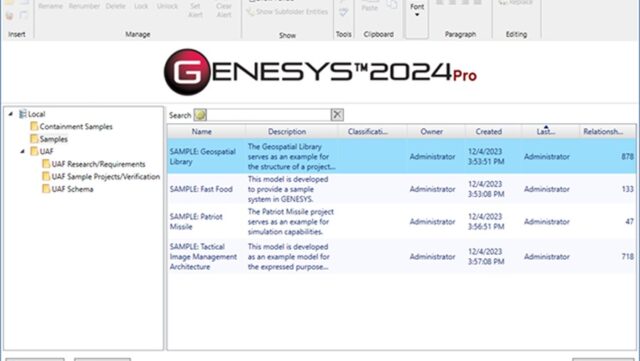
BLACKSBURG, VA, Jan 10, 2025 – Zuken Vitech has released GENESYS 2024, the latest iteration of its premier model-based systems engineering (MBSE) platform. This release introduces advancements to enhance systems engineering practices, streamline workflows, and provide users with cutting-edge tools.
Key Features and Advancements in GENESYS 2024
GENESYS 2024 introduces robust support for the Unified Architecture Framework (UAF), enabling organizations to model, analyze, and manage complex systems within a standardized framework. This capability guarantees smooth alignment with industry standard, enabling seamless collaboration among multidisciplinary teams.
The new release includes refined tools for project organization and classification, allowing users to structure and manage their projects in a well-phased manner. The enhancements simplify navigation, improve traceability, and provide greater control over large-scale system models.
With a focus on extensibility, GENESYS 2024 debuts a versatile add-in framework that enables seamless integration of third-party extensions. The new capability empowers organizations to customize their GENESYS experience, adapt to specific workflows, and leverage external tools for maximum efficiency.
GENESYS 2024 delivers a host of usability and performance upgrades, including faster processing speeds, intuitive user interfaces, and streamlined workflows. The enhancements boost productivity and ensure a smooth, responsive user experience.
“GENESYS 2024 represents a significant step forward in the evolution of model-based systems engineering,” said Enrique Krajmalnik, president and CEO of Zuken Vitech. “With the introduction of support for UAF, enhanced organizational tools, and the flexibility of a new add-in framework, we are empowering our users to tackle complex engineering challenges with unprecedented ease and precision.”
Zuken Vitech remains committed to advancing the field of systems engineering through continuous innovation and collaboration with its global user community and partners. GENESYS 2024 is available for purchase and upgrade.
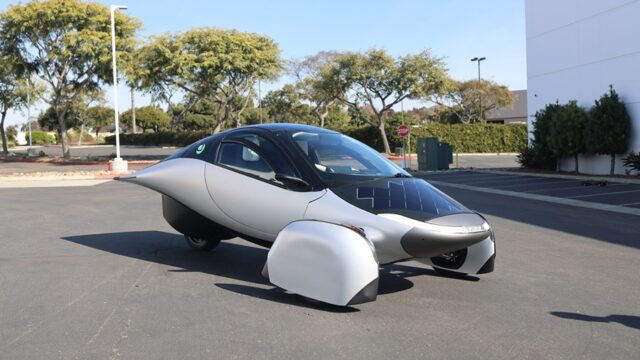
LAS VEGAS, NV, Jan 9, 2025 – Aptera Motors has introduced its production-ready solar electric vehicle (sEV) at CES 2025, marking a significant advancement in transportation. Transitioning from prototyping to validation vehicles, Aptera’s sEV offers energy efficiency, freedom from conventional charging, and a zero- emission driving experience.
Aptera has introduced the first solar-powered EV designed to eliminate the need for plugging in for major daily driving needs. Aptera’s sEV combines cutting-edge engineering with capabilities:
Up to 400 miles of range from a single charge in under an hour.
Up to 40 miles of free driving per day powered entirely by sunlight.
Over 10,000 miles per year of solar-powered driving in sunny climates, significantly reducing reliance on grid charging.
CES 2025 marks the first public showcase of Aptera’s complete solar array, consisting of four panels strategically placed on the hood, dash, roof and hatch of the vehicle, alongside its production body structure, built from carbon fiber sheet molding compound (CF-SMC). The material significantly reduces complexity, requiring fewer than one-tenth the parts of traditional vehicles, resulting in a lightweight yet robust design.
Image: Aptera
“Today marks a pivotal moment not only for Aptera but for the future of sustainable transportation,” said Chris Anthony, co-CEO of Aptera Motors. “This vehicle embodies years of innovation and relentless pursuit of energy-efficient mobility. CES is the perfect stage to share our vision and invite the world to join us in creating a cleaner, solar-powered future.”
Redefining Transportation
Unlike larger, heavier vehicles that are dependent on fossil fuels or grid power, Aptera’s sEV generates its own energy. It’s a lightweight, independent solution tailored to today’s world and tomorrow’s challenges.
Driving Demand and Innovation
With nearly 50,000 reservations and over $1.7 billion potential revenue, Aptera has raised $135 million through equity crowdfunding. At present, Aptera is speeding towards series production, envisioning sun-powered journeys.
LAS VEGAS, NV, Jan 9, 2025 – US-based startup G3 Power is poised to transform the energy industry with the debut of its Tri-Gen energy production system at CES 2025. This groundbreaking innovation delivers uninterrupted, electrical energy 24/7 from renewable sources —regardless of weather, location, or time of day.
G3 Power, an impactful startup that has already raised several million dollars, unveils its technology at CES 2025 and marks a significant milestone in energy production, promising a potential change in the energy landscape.
The Tri-Gen system is a patented technology that combines multiple physical principles and advanced engineering to generate power from continuous renewable sources. It boasts scalability, capable of producing between 1 kWh and several MWh per unit, whether deployed onshore or offshore as part of a full-scale power plant. Despite its high output, each unit requires only a few square meters of space. The modular design will enable the creation of energy production facilities ranging from 1.08 kWh (25 kWh/day) to over 100 MWh.
Concretely, G3 Power team has developed a technology based on a triple flow, the first flow using gravitational force to produce energy, the second flow using Archimedes’ thrust to complete the cycle and generate electric energy as well, the third flow being there to compensate pressure and fluid levels using less energy than produced, based on differential pressure.
Tri-Gen’s key features include:
100% efficiency irrespective of cloud cover, latitude, season, or temperature (operates seamlessly between – 30°C and + 65°C),
No heat or radiation emissions during operation, ensuring safety and sustainability,
Continuous functionality day and night, even during calm weather conditions,
Resilience to extreme weather conditions, including storms and hurricanes,
Versatility for deployment onshore and offshore (underwater), making it adaptable to a variety of environments.
G3 Power will need just 5m2 of floor space and 6 KWh of batteries to offer complete autonomy under the same conditions, all year round, all seasons, all latitudes. That’s why G3 Power signifies a major advancement in combating global warming and reducing CO2 emissions, ensuring steady energy prices for both consumers and businesses The Tri-Gen energy system offers a pathway to cleaner, more reliable power for a wide range of applications.
Starting Jan 7, 2025, G3 Home can be pre-ordered, with available capacities ranging from 25 kWh to 150 kWh per day.
LAS VEGAS, NV, Jan 9, 2025 – Provizio has expanded its automotive portfolio with their software-defined antenna reference board using radar technology from Texas Instruments (TI), a global pioneer in semiconductor technology. Provizio aims to make mobility safer and more intelligent through affordable, advanced perception imaging radar that works consistently in difficult weather conditions.
Provizio’s innovative software defined antenna solution uses the AWR2944 radar sensor from Texas Instruments. This solution sets a new benchmark for advanced imaging radar perception and safety systems in the – ever-evolving automotive landscape.
At the heart of this imaging radar system is the integration of Provizio’s MIMSO software defined antenna reference design with the single-chip 77GHz 4D imaging radar chip from Texas Instruments. This innovative design transforms a single radar SoC into 48 virtual receiver channels, achieving sub 0.5° angular resolution and enabling precise detection and tracking of objects, including pedestrians, cars, and trucks. Powered by Provizio’s proprietary MIMSO and SPTDMA technologies, the design delivers 20x higher resolution from a single chip, addressing critical challenges of cost and performance in high-performance radar systems.
The design is on display at CES 2025 with a live vehicle demonstration at Provizio’s Westgate Hotel suite location, along with the reference design shown in TI’s booth in the Las Vegas Convention Center in North Hall, N116.
Image: Provizio
Transforming Automotive Safety and Perception
The inclusion of this reference design is vital for advancing safety in mobility by making it generally available for automotive & industrial OEMs and Tier 1s. By delivering precise, real-time detection and tracking of objects such as pedestrians and vehicles, it enhances a vehicle’s ability to respond to potential hazards. This innovation is a key step towards significantly reducing the risk of accidents, building added trust in autonomous technology, and supporting the development of safer, more reliable transportation systems.
Speaking on the announcement, Barry Lunn, CEO & co-founder of Provizio said: “We have known for some time that 4D Imaging radar is key to unlocking safer driving and next generation ADAS, however cost has been a key challenge that has held back rollout across all vehicles. This work between Provizio and TI balances the perception and system cost challenges of high-performance imaging radar.”
Lunn added: “To achieve 0.5deg angular resolution using just a single TI radar chip is a testament to the proprietary antenna innovation of the Provizio development team and also the embedded power of the TI radar SoC.” Dedicated to enabling scalable advanced driver assistance systems (ADAS) and autonomous driving solutions, Provizio develops the future of radar.
TOKYO, Japan, Jan 9, 2025 – Honda Motor Co., Ltd. and Renesas Electronics Corp. has announced that they have signed an agreement to develop a high-performance system-on-chip (SoC) for software-defined vehicles (SDVs). The new SoC is designed to deliver leading-edge¹ AI performance of 2,0002 TOPS combined with a world-class power efficiency of 20 TOPS/W, and is slated for use in future models of the “Honda 0 (Zero) Series,” Honda’s new electric vehicle (EV) series, specifically those that will be launched in the late 2020s. The agreement was announced during a Honda press conference held at CES 2025 in Las Vegas, NV on Jan 7, 2025.
Honda is developing original SDVs to provide a mobility experience optimized for each individual customer in the Honda 0 Series. The Honda 0 Series will adopt a centralized E/E architecture that combines multiple electronic control units (ECUs) responsible for controlling vehicle functions into a single ECU. The core ECU, which serves as the heart of the SDV, manages essential vehicle functions such as advanced driver assistance systems (ADAS) and automated driving (AD), powertrain control, and comfort features, all on a single ECU. To achieve this, the ECU requires a SoC that provides higher processing performance than traditional systems, while minimizing any increase in power consumption.
Renesas is committed to providing automotive semiconductor solutions that enable automobile OEMs to develop SDVs. Renesas’ R-Car solutions offer higher AI performance with the ability to customize by leveraging multi-die chiplet technology3 and integrating AI accelerators4 into its SoC.
To realize the Honda vision for SDVs, Honda and Renesas reached an agreement to develop a high-performance SoC compute solution designed for core ECUs. Using TSMC’s leading-edge 3-nm automotive process technology, the SoC can achieve a significant reduction in power consumption. Additionally, it realizes a system that utilizes multi-die chiplet technology to combine Renesas’ generic fifth-generation (Gen 5) R-Car X5 SoC series with an AI accelerator optimized for AI software developed independently by Honda. With this combination, the system aims to achieve one of the industry’s top class AI performances with power efficiency. The SoC chiplet solution will provide the AI performance required for advanced functions such as AD, while keeping power consumption low. Chiplet technology allows flexibility to create customized solutions and offers future upgrades for functional and performance improvements.
Honda and Renesas have collaborated closely for many years. This agreement will accelerate the integration of advanced semiconductor and software innovations into the Honda 0 Series, enhancing the mobility experience for customers.
References:
1. Renesas estimate as of January 2025
2. Tera operations per second (TOPS) is a metric of AI processing performance and measures the number of operations that can be performed per second. Based on a sparse AI model
3. Technology to build a system by combining multiple chips with different functions 4 Hardware designed for high-speed and high-efficiency AI (artificial intelligence) computational processing
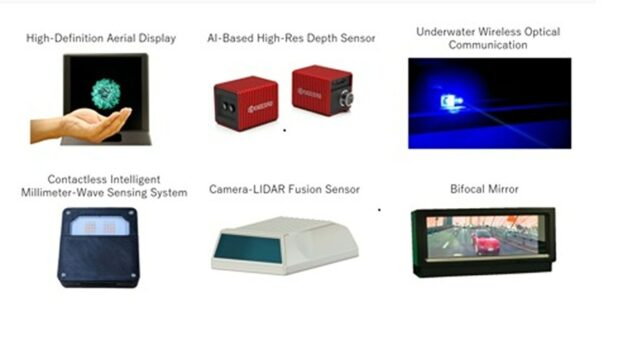
KYOTO, Japan, Jan 9, 2025 – Kyocera Corp. has announced the technologies Kyocera Group companies will exhibit at CES 2025, in Las Vegas, NV, Jan 7-10, 2025. Kyocera’s latest innovations in aerial display technology, AI-based depth sensor, underwater wireless optical communication, millimeter-wave sensor, camera-LIDAR fusion sensor, bifocal mirror, and more solutions to further safe, autonomous driving will be showcased at booth #4816 in the Vehicle Tech & Advanced Mobility Zone, West Hall.
High-Definition Aerial Display Transforms Car Interiors
Kyocera’s aerial display, a blend of miniaturization, high resolution, and next-generation image quality, can project highly realistic, floating images. Curved mirrors maximize light efficiency, producing a high-resolution display with low power consumption. The interactive display utilizes various sensors for non-contact operation, unlike any current display. Kyocera’s booth will showcase a futuristic automotive navigation demonstration utilizing this cutting-edge aerial display technology.
AI-Based High-Res Depth Sensor for Close Imaging
10x More Accurate with Tiny, Transparent Objects, Towards Automation Functionality
Kyocera’s AI-Based Depth Sensor camera, offering world-record resolution in measuring extremely small1 and shiny/semi-transparent objects2, is a versatile tool for a wide range of needs. It enables accurate measurement of objects that are difficult to measure with conventional methods, achieving 10 times greater accuracy than traditional monocular measurement. The sensor is a breakthrough for a variety of industries including manufacturing, helping robots sort tiny parts; medical, offering accurate human body measurements and recognition of shiny metallic surgical instruments; and logistics, enabling peripheral monitoring of transport robots at logistics and retail sites. This versatility makes it an asset in addressing labor shortages and improving productivity.
Kyocera’s Underwater Wireless Optical Communication technology using GaN lasers stands out for its ability to enhance data communication by expanding optical bandwidth . In a groundbreaking demonstration, Kyocera achieved the world’s fastest communication speed underwater, reaching up to 2 Gbps. Kyocera aims to achieve 10 Gbps or more in the future using blue lasers. The unique beam shape propagation characteristics of this technology and the fast response of semi-polar GaN lasers enable targeted transmission to specific receivers, and high-speed communication is also possible underwater, while being resistant to external light such as sunlight. This next-generation communication technology provides speed, reliability, and security for highly sensitive data transmission.
Contactless Intelligent Millimeter-Wave Sensing System for Autonomous Driving and Vital Sensing Applications
Kyocera developed a Millimeter-Wave Sensor that can accurately detect minute vibrations without contact. This technology helps improve healthcare by measuring heart rate and other changes in vital conditions such as in a car or the bathroom, while respecting the user’s privacy. In addition, Kyocera developed a millimeter-wave simultaneous localization and mapping (SLAM) technology that can replace mechanical-based LIDAR using 4D imaging radar. As demand for driver assistance increases, this technology will enable more accurate and safer driving through sensing, even in bad weather conditions, at an ultra-low cost.
Camera-LIDAR Fusion Sensor – World’s Highest Resolution, High Durability
LIDAR is an indispensable technology for mobility, including autonomous driving. Kyocera’s Camera-LIDAR fusion sensor, the world’s first3 LIDAR in which a camera and optical axis are integrated into a single unit, enabling real-time superimposition of camera image data and LIDAR distance data for advanced object recognition. Its uniquely designed MEMS mirror delivers the world’s highest resolution and high durability. This enables the system to be used for obstacle detection in-vehicle driver assistance, ships, and heavy machinery, showcasing its versatility and adaptability.
Bifocal Mirror Improves Visual Awareness for Drivers
Electronic automotive rearview mirrors are growing in popularity, but drivers with age-related farsightedness (presbyopia) often struggle to focus on them due to differences in distance and field of view. Like a heads-up display, Kyocera’s bifocal mirror displays an enlarged image in the distance, making it easier for drivers to adjust their focus and instantly see the image. AR technology also supports safe driving by instantly displaying information recognized by the rearview camera in the mirror.
Reference:
1. Stereo camera capable of measuring very small objects with a resolution of 100 µm, surveyed by Kyocera in Oct, 2024.
2. As a stereo camera capable of measuring glossy (highly reflective) objects and translucent products; surveyed by Kyocera in Oct, 2024.
3. In the development of a sensor in which the optical axes of the camera and LIDAR are aligned and integrated into a single unit; Oct, 2024, based on Kyocera research.
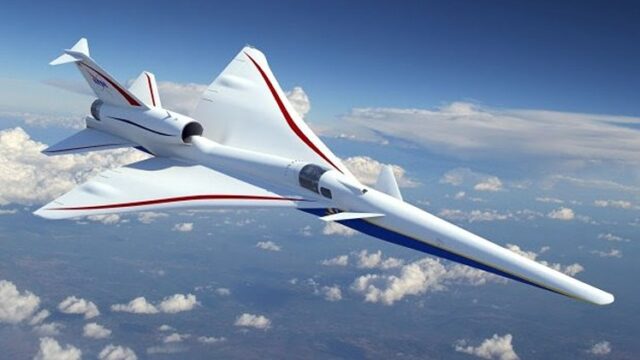
The X-59, a unique experimental aircraft from Lockheed Martin Skunk Works, is part of the Quesst (Quiet Supersonic Technology) mission of U.S. National Aeronautics and Space Administration (NASA) to quiet loud sonic booms.
Photo Credits: Lockheed Martin / NASA
The X-59, a unique experimental aircraft from Lockheed Martin Skunk Works, is part of the Quesst (Quiet Supersonic Technology) mission of U.S. National Aeronautics and Space Administration (NASA) to quiet loud sonic booms. Photo Credits: Lockheed Martin / NASA
NEWPORT NEWS, VA, Jan 9, 2025 – Collier Aerospace Corp. has announced that its design and analysis software was chosen by Swift Engineering, Inc., for structural sizing, analysis and test validation of the low-boom X-59 aircraft’s nose cone. This experimental aircraft from Lockheed Martin Skunk Works is part of the Quesst (Quiet Supersonic Technology) mission of U.S. National Aeronautics and Space Administration (NASA) to quiet loud sonic booms. Swift Engineering was contracted to build and perform structural analysis and certification testing for the X-59’s distinctive, 35 ft.-long nose cone, designed to control aerodynamic pressure waves (shock waves), that form at the sharp nose tip during supersonic flight, resulting in quieter sonic booms.
Collier Aerospace’s software enabled Swift Engineering to remove mass that reduced the nose cone’s weight by over 25 percent while maintaining dimensional stability; evaluate the design for a wide range of load cases; and provide detailed stress reporting to support part release and fabrication. The company also used the software to perform detailed analyses, supporting structural testing substantiation of the structural design.
Collier Aerospace’s design and analysis software was chosen by Swift Engineering, Inc., for structural sizing, analysis and test validation of the X-59 aircraft’s nose cone. Photo Credits: Lockheed Martin / NASA
“The Collier Aerospace software played a critical role throughout this high-visibility project to design, engineer and build the X-59 nose structure,” said Bill Giannetti, technical consultant to Swift Engineering. “At the outset, when the team from Skunk Works explained how important lightweighting was, I had so much confidence in the software that I was convinced we would remove 100 pounds from the nose cone. However, we surpassed that goal by achieving a significant weight savings of over 25 percent on the nose cone structure.”
Giannetti added, “We were able to iterate the structural sizing software with our finite element analysis solver, which enabled weight reduction through structural optimization and rapid load path convergence. Once the system was set up, we could literally watch the mass come out of the nose structure, while meeting all the traditional aerospace failure criteria simultaneously. It’s a fantastic software tool.”
Meeting Rigorous Requirements
To lower the weight of the approximately 400-lb. preliminary design, that specified graphite/epoxy composite and a honeycomb-core sandwich structure, Swift Engineering’s team removed unnecessary plies, simultaneously optimizing the structure for stress and stability. The Collier Aerospace software enabled the team to evaluate design alternatives by considering trade-offs in ply-layup schedules and core panel and edge band thicknesses, and then assess the change to the section stiffness and deflection.
Swift Engineering used the full capabilities of the Collier Aerospace software for this unique aircraft nose structure, extending beyond preliminary sizing and optimization to include conducting detailed laminate strength analysis using design allowables derived from testing. The software enabled the company to deliver the nose cone ahead of schedule and under budget.
HyperX software automates stress analysis and design. It performs rapid structural sizing to all load cases, lightweighting and margin writing. The software helps ensure the producibility of a composite part by creating a design that is optimized for manufacturability. It reduces schedule time by speeding up the engineering cycle and shortening the U.S. Federal Aviation Administration (FAA) and European Union Aviation Safety Agency (EASA) certification processes.
From Boom to “Thump”
The goal of the X-59 aircraft, which is expected to make its first flight in 2025, is to help establish an acceptable noise standard for commercial supersonic flights over land, potentially resulting in U.S. and international regulators lifting a five-decade-long ban that was imposed due to loud sonic booms. Attributing to its unique geometry, particularly the elongated nose cone, the X-59 is expected to generate a barely audible thump rather than a boom, reducing noise impacts.
“We’re grateful that our software helped Swift Engineering achieve success with the X-59 nose cone and met the high expectations of Lockheed Martin Skunk Works,” commented James Ainsworth, vice president, Engineering Services, Collier Aerospace. “The high level of credibility that our solution has earned, and its powerful sizing and analytical capabilities, were key factors in Swift’s decision to choose our software. We’re looking forward to the X-59’s first flight.”