At the COMSOL Conference held in Boston recently, the turns to brain cancer. Not what you were expecting: a talk about cancer at a conference for simulation software users? Get used to it. It’s day 3. I have learned it is called COMSOL Multiphysics for a reason. The physics spans multiple disciplines, including medicine. Day 1, I learned how a medicine in a pre-filled syringe can jam and now this … hyperthermic treatment (HT) of brain tumors.
However, on the main stage is Dr. Dario Rodrigues, a medical researcher from the University of Maryland in Baltimore.
How Does Hyperthermia Work?
Hyperthermia is derived from the Greek terms υπέρ/ypér, meaning “above, “more,” or “over,” and θερμός/thermós meaning “hot.” Hyperthermia therapy (HT) is most often used to describe the therapeutic technique of induced temperature increase through thermal energy delivery. – National Library of Medicine
Hyperthermia creates a hotspot in the brain that is 44 to 44° C for varying periods. Microwaves, RF, lasers can supply the energy…it doesn’t matter. The important thing is that the beams focus the energy on a small volume, so it only affects where it is aimed and not damage healthy tissues nearby.
The physics of energy penetration means that hyperthermic treatments are most common close to the surface, like skin cancer. Several clinics have opened to do this. However, the University of Maryland, where Dr. Rodrigues works, is able to work in deep-seated tumors, such as cervical, prostate, bladder and rectal cancer.
Hyperthermia can be used in conjunction with other treatments: surgery, immunotherapy, chemotherapy and radiation. In fact, one study found that if hyperthermia is used with radiation therapy, patients can have up to 5x better outcomes, which doctors define as being 2 years cancer-free.
Combined with surgery, hyperthermia will have an even better outcome – so long as the surgery is done immediately. Don’t wait a month, he says.
The surgeon “scoops out the tumor,” then the patient has to wait 30 days for hyperthermia treatment. Surgery will get most of the cancer cells but leave nearby cells unharmed. Thirty days late those cells have moved on — as much as centimeters away, explains the doctor.
Microwaves, which stimulate the water molecule, causing the lone oxygen atom to flip back and forth, generating heat, are perhaps the best energy source to use. HT microwaves are either 915 Mhz or 433 Mhz, the lower wavelength for going deeper under the surface.
The deadliest for form of brain cancer, glioblastoma, was removed successfully with hyperthermia 31% of the time, compared to a mere 15% of the time with surgery, according to a study, says the doctor.
COMSOL to the Rescue
The SAR radiation model is created with COMSOL Multiphysics and models the skin, fat, skull, spinal fluid and brain tissue.“ The interaction of fluid, solids, and electromagnetics make this truly multiphysics. Therefore, Dr. Rodrigues finds COMSOL indispensable to his research.
Dr. Rodrigues uses COMSOL to model the brain undergoing HT to predict the efficacy of HT devices under development. By varying the number of amplifiers, antennas and placement on a device worn around the head can be simulated. The cancer-killing hotspot shows up in red. He also likes that COMSOL’s visualization will let him customize the color mapping.
“Won’t it also help with how hyperthermia could increase the permeability of the blood-brain barrier?” asks an audience member.
Dr. Rodrigues: Someone on the staff is looking into that.
“COMSOL is wonderful for these studies,” says the doctor.
Milan style
Every year around this time, the best infrastructure projects that use Bentley Systems software (as determined by independent judges) are feted at the only black-tie awards ceremony in the industry at a conference named The Year in Infrastructure.
This year’s event is being held in Vancouver, a mere two-hour flight from SFO for yours truly.
Once again, the projects are breathtaking in their scale. I regret only that I can’t see all the finalists give their presentations. The presentations all happen in one day in parallel tracks, and the choice of which one to go to at any one time can be an excruciating decision.
Here are highlights from what I managed to attend.
Milan Style
Milan is Italy’s fashion center, and you might expect its buildings to be designed with style. ENI headquarters, a curvaceous building with a fantastic sky bridge, does not disappoint. The sky bridge connects two towers, and the preassembled steelwork was so massive that physics-based animation was used to make sure cranes would not tip over as they were hoisted in place.
Webuild used Bentley’s SYNCHRO software. In addition to making sure cranes didn’t tip over, SYNCHRO created a virtual construction environment, performing clash detection and scenario analysis to visualize every step of the construction process.
Before anything was made in the field, it was made on the screen,” says Allesandro. Being able to see how everything would go together on their iPhones helped reduce rework by 90% and shrink the construction timeline from 85 by an astounding 81 days! Less time on the job also means less injuries. Webuild manage to throw a perfect game: zero injuries.
Hutama’s Phase 2A of Jakarta’s MetroPT Hutama Karya used Bentley’s software to model Jakarta’s MRT Phase 2A, which involves building two underground stations. Hutama’s challenges included a dense urban population and geotechnical conditions. Using Bentley’s geotechnical software Leapfrog and PLAXIS for soil analysis improved soil data collection and analysis, saved the equivalent of $2.5 million. Hutama used SYNCHRO for 4D planning, ProjectWise and iTwin for digital twin collaboration and LumenRT. So much of the project was modeled digitally, making onsite inspections unnecessary 90% of the time.
To be continued…
Despite all attempts to popularize it, CAE remains in the domain of specialists. CAD companies, in an effort to expand their business, have acquired CAE companies and tried to simplify analysis so even designers can use it, but beyond the most straightforward stress analysis, CAE is attempted only by a small portion of design engineers and a smaller portion of designers.
Let’s face it: simulation is hard. It’s hard enough when the simulation involves only one discipline but when a simulation spans multiple disciplines, it becomes near impossible. An engineer can get bogged down in unfamiliar theory. With time pressures, they could make wrong assumptions, miss important details, get results that are way off — and never know it.
What is a product engineer, an expert in one discipline but a babe lost in the woods in every other, to do when faced with a challenging analysis that involves multiple disciplines?
They can call in the cavalry.
Cue Veryst
Holding a class at the recently concluded COMOL 2024 Conference in Boston titled “Solving Challenging Multiphysics Problems” is Veryst. This consulting firm has built a business in guiding simulation users out of the fine mesh (literally) they often find themselves when trying to use COMSOL Multiphysics and other simulation programs.
One such challenge presented: a prefilled syringe that clogs.
This would baffle a mechanical engineer finding nothing in the geometry of the syringe to cause such behavior. But Joseph Barakat, PhD, a chemical engineer at Veryst, notices that the needle clogged only when the plunger was pressed quickly. The cause: particles in the fluid that can’t get out of their own way, and get stuck. That happens with a non-Newtonian fluid, he says.
I flashback to Bird’s custard powder, always in the cupboard of our London house when I was young, and the mysterious way it resisted the spoon at times. It was not explained by a mechanical engineering education, in which fluids were always fluid — not somehow turning solid.
Barakat is on the verge of stealing the show. A PhD in chemical engineering from Stanford, sealed with a dissertation on “Microhydrodynamics of Vesicles in Channel Flows,” Barakat is nevertheless exceedingly polite and personable. Rheology is his specialty, and he is able to explain the intricacies of it in a way the typical (non-chemical) engineer can understand.
“It’s the same phenomenon you encounter with corn starch,” he says of the clogged syringe problem.
After the class, I sought out Veryst to thank them for solving a childhood mystery. There’s Barakat humbly pointing out that such knowledge is standard to his discipline. He has respect for all engineering disciplines, though he can’t resist sharing a joke about 3 of them with different perspective on fluids.
An aerospace engineer is bragging about designing Mach 10 aircraft.
A mechanical engineer thinks Mach 1 is plenty
A chemical engineer says “What’s Mach?”
It turns out these chemical engineers have been having a lot of fun with non-Newtonian fluids. Their favorite demo: filling a bowl with a water/corn starch mix and slapping at it towards the unsuspecting and amusing themselves at their overreaction. Haha, the mix clogs and won’t splash. Haha. That oobleck*. So much fun.
We Meet the Team
I had the pleasure of meeting Matthew Hancock, a partner at Veryst, and every bit a gentleman. Veryst (pronounced VER ist) is a made-up name, he says. We were called something else but that domain was taken.
I’m having a blast learning how analysis can be used to solve problems in multiple fields — in no small part due to a Veryst’s presentation. I came to the conference to learn about COMSOL’s ability to handle multiphysics. I left impressed by Veryst, which has among its staff a profound knowledge of various disciplines and the skills to use COMSOL Multiphysics.
These guys are super impressive. The typical engineer considers themselves smarter than the average Joe with a bachelors in engineering, but Veryst, based in Needham, MA, is packed with PhDs, many of them earned at Eastern elite schools, such as MIT and Harvard.
Six of the posters stem from Veryst’s cadre of engineering expertis. Is the COMSOL conference at risk of becoming a Veryst conference? A branding problem for COMSOL, perhaps, but the quality of posters would not suffer.
AltaSim
Also with a booth and posters was Veryst’s main competitor, AltaSim. AltaSim has fewer posters but a commanding position at the exhibit entryway with a booth stocked with brochures and manned by a director of business development and a VP of sales. Clearly, these guys are good at marketing.
They are no slouches in COMSOL, either. Established in 2002, AltaSim, headquarters outside Columbus, Ohio, claims expertise in COMSOL, completing over 850 projects spanning many of COMSOL’s physics. They will take on the actual simulation, train users in how to do it themselves, or, if the company does a particular analysis over and over again, make the customer an app for it.
_________
*From a Dr. Zeuss book titled Bartholomew and the Oobleck, where a strange green substance falls from the sky. Oobleck is a non-Newtonian fluid, meaning it behaves like both a liquid and a solid depending on the pressure applied to it. It’s made by mixing cornstarch and water, typically in a ratio of about two parts cornstarch to 1 part water. When you apply force to oobleck—like squeezing it or hitting it quickly—it acts like a solid, resisting the pressure. However, if you touch it gently or let it sit, it flows like a liquid. It is a school science experiment every chemical engineer remembers.
Sinequa searches across a company's data, files and applications with a natural language interface
Sinequa searches across a company’s data, files and applications with a natural language interface
A clean-sheet design is often presented as a good thing. But is it really? It is more often that an engineering team tasked to make the next product has to start from an existing design. Let’s say the next product is an electric vehicle. Does it not make sense to start with the suspension, seats, body in white, chassis, etc., from an existing vehicle? Why reinvent the wheel?
I am reminded of an aerospace company CTO who told me about the horror of engineers designing a whole product from scratch — only to discover in midstream that another division was building the exact same product.
Reinventing the wheel is real. It happens all the time. Why? Because an enterprise’s departments and divisions each store their data in silos, in warehouses or server farms (the modern-day equivalent) in different programs, file formats and databases.
Of course, this problem could be avoided if we put all our data in a central location (the cloud) and use one app to read it all. But can we all do that? Many engineers, especially those who work for military agencies, defense contractors and super-secretive consumer product companies (think Apple), are not allowed to take any data or prototypes outside their walls. And how much of an undertaking would it be to feed all that data into one app?
Enterprise Search
For the problem of data silos, one software company, Sinequa, offers a solution. Leave the data where it is and connect to it using a search engine with a natural language interface. That’s right, like ChatGPT, only different. ChatGPT may have read the world’s data, but Sinequa has read your company’s data.
Sinequa offers another use case, that of Airbus Helicopters. Airbus, the parent company, had already been using Sinequa for enterprise search. The helicopter division installed Sinequa One Cloud to help reduce the load on its 23 support centers, which collectively get 30,000 requests annually. Neither Sinequa nor Airbus say how long it took to index all the data, but when it was done, customers could get part and maintenance information on a part simply with natural language commands.
This was much faster and, for the user, easier than alternative solutions, such as entering everything into an enormous database, which would have left its use for only those with training on it. SQL queries, anyone? — instead of using natural language queries.
Companies have often tried to consolidate their data and have it read by PDM and ERP systems, but it can take months for a big company to feed all the documents into them, downtime, and days and weeks before everyone gets up to speed.
The Sinequa method has all the data stay in place and searches through it. There is no program to learn, no massive conversion effort.
Siemens Also a Customer
In the world of manufacturing, no company is bigger and has a more diverse product line than Siemens. The German conglomerate has over 200,000 employees. Customer support of so many products, current and outdated, can rely on finding the correct information from over 20 million scattered and far-flung technical documents. To help a beleaguered tech support staff, Siemens has integrated Sinequa’s Gen-AI into its Siemens Industry Online Support (SIOS) portal. Search time for the correct information has decreased 10 to 30% for the tech support staff, by Sinequa estimates. Their system is now able to handle over 200 million customer inquiries annually for customers, partners and employees, and Siemens has benefited from not having to build an additional 12 call centers, saving the company an estimated $1.9 million.
Customers who use SIOS are able to get their information more often and quicker, resulting in less instances a staff member has to get involved.
Enter GenAI
GenAI, short for generative artificial intelligence, is a generic term for AI that is able to create new content, whether it be words or pictures, based on what it has learned from old content. Two types of genAI, “AI for design and engineering” and “AI for Product Lifecycle,” have been climbing up the Gartner Hype Cycle as companies, analysts and media start to realize there is more to genAI a public infatuation than a natural language interface, can and should be applied to help sort a company’s data.
Sinequa is mentioned by Gartner on the GenAI for Product Lifecycle along with, strangely enough, the Big 4 CAD vendors (Autodesk, Dassault Systèmes, PTC and Siemens). There is no pure enterprise search firm on “AI for Product Lifecycle” list.
Xavier Pornain, SVP of Sales, Sinequa
Sinequa (from the Latin “sine qua non,” which means “without which not” or “something essential”) was doing AI before AI was fashionable, says Xavier Pornain of Sinequa, currently wearing an SVP of Sales hat but has been with the company since it got its name. We call on Xavier to give us a demo of Sinequa’s capability.
Immediately in the demo, the ease with which Sinequa fields natural language questions is apparent. May it forever banish SQL queries and arcane PLM commands to oblivion! Xavier merely has to ask in English what he wants and Sinequa answers. It makes me long for CAD programs to work the same way. Instead of having to learn the language of the CAD program, for example, DIMLINEAR in AutoCAD, why can’t I ask my CAD program to “dimension this?”
A 360-degree view, as Sinequa calls it. A search through a company’s data can reveal information associated with a CAD model. Image from Sinequa video.
Sinequa cannot search by CAD shape but can extract metadata, such as GD&T information, part numbers, bills of material, etc. Sinequa can read more 350 file formats, but most important to engineers, it can read all of the major PLM files and most, if not all, the major CAD formats to extract the metadata.
For a super-secretive company, Sinequa’s application can run on the company’s server or a private cloud.
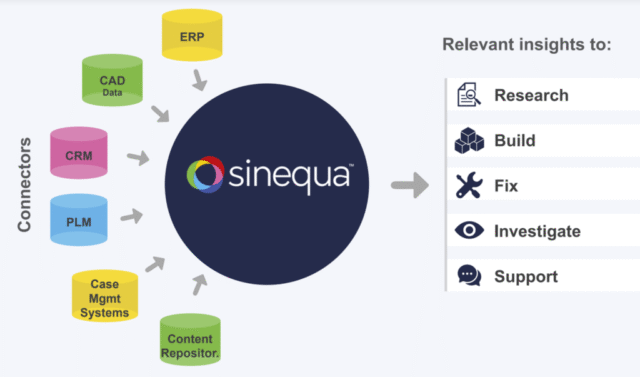
It’s ragtime. Sinequa’s retrieval-augmented generation (RAG) ties it all together: semantic search, company data, public LLMs and natural language queries and answers. Image: Sinequa
How Does it Work?
Sinequa reads everything your company has created. The company has built over 200 connectors and deciphered 350 formats by their count. Because of that, I can function as a digital assistant. Sinequa’s points out the advantages of its GenAI Assistant compared to a human assistant (to which I’ve added one of my own): it is never tired, never sassy and never calls in sick. Also, GenAI has read everything your company has produced and remembers all of it.
We presume Sinequa’s GenAI will show proper discretion. We would not want it to show off how much it knows to the rank and file, serving up HR info, exposing executive bonuses, much less divulging state secrets. Sinequa assures us this is not going to happen, that they treat security as paramount, and that their system recognizes permission set by enterprise apps and honors them.
Sinequa’s is designed to read and process vast amounts of data quickly. How long will it take to set up, though? The company makes no mention of setup time, but no doubt it would depend on the size and complexity of the dataset. Millions of documents and records should be fine, says Sinequa. But ill-formed data that requires cleanup or files and databases for which Sinequa is not accustomed – though the odds of the latter are small since Sinequa has built over 200 connectors and deciphered 350 formats — may cause delays.
Companies with more than one PLM in operation will rejoice at being able to ask questions about all the company’s data, PLM, PDFs, Word and Excel files, technical documentation, etc., for example, show me the latest information about a part.
Sinequa “leverages” the publicly available or private LLM of your choice, whether it be ChatGPT, Gemini, Perplexity… whatever. It does not have a LLM of its own. If you prefer ChatGPT, Sinequa will create a custom Assistant that uses ChatGPT as its engine.
The combination of Sinequa’s search technology and an LLM like ChatGPT ought to enable it to be more nuanced in its search and have more contextually relevant responses.
Here’s how Sinequa handles input and output with an LLM:
A user inputs a question in a natural language. Sinequa runs this question through its neural search to better understand the user’s intent in the context of that user and augments the query. Presumably, Sinequa has learned something about this user in the setup and continues to learn. For example, knowing the user is a design engineer, a question about a washer would yield information on a fastener, whereas ChatGPT might consider washing machines on their own. The augmented query then extracts relevant information from all the applicable company data sources (not data out into the wild).
To the LLM output, Sinequa adds citations so you know where the answers are coming from, allowing users to check sources for accuracy and relevancy.
Conclusion
LLMs, by their nature, can condense vast amounts of information into concise, easy-to-understand summaries. For example, in a research or clinical trial setting, an LLM can summarize complex scientific data in plain English. Sinequa’s GenAI will provide the guardrails, keeping it trained towards company data and thereby reducing, if not eliminating, hallucinations, as unguided LLMs, fed a diet of publicly available information, are known to have.
If ChatGPT is a wild horse, foraging in dangerous places, dropping crap everywhere and prone to hallucination, think of Sinequa putting a harness on the horse, throwing a saddle over, giving it oats — and the riders don’t have to clean up after it.
This blend of Sinequa’s search technology with LLMs like ChatGPT creates a powerful tool for enterprises, transforming how users access, understand, and act on their vast data repositories.
About Sinequa
Sinequa has been doing semantic search forever – in Internet years, that is. Initially, it was just a research group operating in a small Paris office. The researchers may have had the earliest intention of making computers understand our language rather than us having to learn theirs. Alexandre Bilger acquired the company in 2002, which had, early on, established itself with cutting-edge enterprise search with semantic search, the type of search that, among other things, completes your search phrase a la Google.
The company received its first round of financing, getting $5.19 million at the beginning of 2007. Realizing that more gold lay in North America, the company set up a New York City office in 2014. A Paris-based private equity firm didn’t mind eyes towards America and kicked in $23 million in 2019.
Sinequa was on a roll — only to be drowned out by the din over ChatGPT. The hype over LLMs, with their inherent unreliability and propensity for wrong answers, may have left most executives disillusioned with LLMs in general. CIOs knew LLMs were based on the world’s data, much of it of dubious value. How much of Reddit forums, Wikipedia, Facebook, X or Twitter can you trust? It is now up to enterprise search companies, such as Sinequa, to convince them there is treasure to be found.
Sinequa adapting to harness LLMs (including ChatGPT) is a smart move, and adding guide rails, focusing on company data even smarter. Now to convince companies that there is a treasure in those data silos and warehouses if only you know where to dig.
The overall winner of the 2024 BIM Awards is the Kruunuvuori Bridge in Helsinki, Finland. Image: Trimble.
The overall winner of the 2024 BIM Awards is the Kruunuvuori Bridge in Helsinki, Finland. Image: Trimble.
Trimble announced the winners of its 2024 Tekla Global Building Information Modeling (BIM) Awards, recognizing outstanding projects that utilized Tekla solutions. The biennial competition evaluates projects based on various criteria, including the use of BIM, collaboration, innovative application of Tekla software, constructability, environmental benefits, and overall “cool factor.”
The overall winner of the 2024 BIM Awards is the Kruunuvuori Bridge in Helsinki, an end-to-end BIM project that also took home the prize in the Infrastructure Project category.
Overall Winner & Infrastructure Project: Kruunuvuori Bridge, Finland
The 1,200-meter-long, cable-stayed Kruunuvuori Bridge will be the longest car-free (train, pedestrians and cyclists only) bridge in the world upon completion. The project was a collaboration between multiple organizations. It utilized a range of BIM software, including Trimbles’s Tekla Structures, Novapoint, and Connect, as well as non-Trimble software such as Autodesk Civil 3D, Navisworks and Grasshopper. The project also involved wind tunnel testing to ensure sound structural design with a 3D-printed model. It was the blending of so much BIM software that impressed the jury. The use of BIM, in all its variations, allowed all stakeholders to see progress throughout the construction process.
Public Project: Seattle Aquarium Ocean Pavilion, U.S.A.
Turner Construction overcame serious challenges in building the curvaceous 50,000-square-foot aquarium expansion. The shell-like tank has no straight edges. There were 229 panels designed with Rhino and Grasshopper. A bidirectional link to Tekla Structures was needed to ensure consistent geometry, make installation sequence drawings, and perform constructability analysis. Construction was aided by Trimble Connect and FieldLink, which allowed construction crews access to the latest 3D models.
Industrial Project: Brewery Roman, Belgium
Belgium’s oldest family-run brewer, Brewery Roman, makers of Gentse Strop and Ename beers, needed to expand and double its production capacity. The project involved preserving part of the façade and reconstruction of the rest, as well as an overhaul of the beer production area with its 100-year-old copper kettles. A LiDAR scan of the building was merged with the BIM model so the steel structure added would fit inside the existing building. The installation of massive precast sections was modeled and animated with a Tekla plug-in that was able to model crane movement and loading – preventing tipping.
Sports & Recreation Project: Al Hudayriyat Island Velodrome, U.A.E.
Image: Trimble
Build it, and indeed, the world’s top cyclists will come. That was the thought that launched the Hudayriyat Island Velodrome in Abu Dhabi, U.A.E., a 3,500-spectator indoor cycle arena. Both Revit and Tekla were used on the project, and the two played nicely with
The project involved Tekla software for connection design, detailing, fabrication and erection of steel and concrete as well as coordinated facade, R.C.C. and M.E.P. Perhaps most remarkable was Tekla’s ability to manage the complex presetting of the 2,000 metric ton roof steel and ensure proper camber after construction.
Commercial Project: Lyyra, Finland
The mission: build a multistory building that occupies a whole city block on top of an existing metro station. The train service is not to be interrupted and let’s run a road through it on a diagonal. This is what was required in Helsinki, Finland.
The Lyrra project stood out not just for its daring but also for its data-driven approach and collaboration between stakeholders. The project was also recognized for its commitment to sustainability, including using “green I-beams,” created at half the carbon cost of standard steel beams, and recycling 95% of demolition waste on-site.
Small Projects: Te Veld Modular Homes, The Netherlands
The Te Veld project, focused on designing modular, sustainable homes, won in the Small Projects category. The homes, made of prefabricated timber, demonstrated innovative use of BIM for rapid production and delivery optimization.
Tomasz Stęplowski from Wroclaw University of Science and Technology won in the Student Projects category for his thesis on a reinforced concrete hall design, utilizing Tekla Structures to explore graphic statics principles.
API Development Project: Component Code Generator, U.S.A.
Keyack Technology Solutions won in the API Development Projects category for their tool that automates coding processes in Tekla Structures, reducing the time required to program system configurators.
Public Choice Winner: Preservation Plaza Canopy, U.S.A.
While an international jury picks all the above winners, Trimble reserves one award that the public picks. This year’s people choice was the Preservation Plaza Canopy project by Structures Online from a field of 155 entries.
Lucid Motors will be using Everspin Technologies’ PERSYST MRAM for its Gravity luxury all-electric SUV, which is expected to be delivered to eager customers in early 2025.
The Gravity will have an undisclosed number of 256Kb MRAMs. In automotive applications, persistent memory like MRAM is typically deployed in key places rather than in large quantities like ordinary RAM. An EV might use a few MRAM chips for critical functions—one or two per key system, such as the powertrain control module, battery management system, or main control units.
“The selection of our PERSYST product family is a testament to the reliability and performance our MRAM products provide in demanding environments,” said Everspin CEO Sanjeev Aggarwal, as MRAM’s role in automotive data resilience grows.
MRAM stands for magnetoresistive random access memory, a type of non-volatile memory that uses magnetic states to store data rather than an electric charge. Non-volatile memory retains information even when the power is turned off.
The magnetoresistive RAM concept first came about in the 1970s by researchers at IBM and Motorola, and later Freescale, but it was in the 1990s that the technology turned into a product. Freescale Semiconductor is credited with creating the first commercially viable MRAM in 2006. Everspin, a spinoff from Freescale, advanced the whole concept with its “Spin-Transfer Torque MRAM (STT-MRAM), which emerged in the 2000s with an advantage in automotive applications, according to Everspin sources.
Lucid may have picked Everspin’s MRAMs after its experience with using them in the design of the Lucid Air, which uses the MR25H256AMDF 256Kb chip integrated into its master powertrain system.
Grand frunk central. Lucid Gravity’s frunk has a seating option. Image: Lucid Motors.
MRAM chips claim several advantages over other types of non-volatile memory, such as Flash or FeRAM, particularly in applications requiring enduring memory retention, fast speeds, and reliable data integrity. Flash memory degrades with repeated MRAM and has virtually unlimited write cycles. This should appeal to vehicle manufacturers who do not want to service warranty claims and vehicle owners after the warranty period.
Everspin’s MR25H256A has little resemblance to the RAM you would find in your temperature-controlled, stationary PC. They meet hardship requirements imposed by all-weather, shock and vibration resistance of vehicles. For example, automotive MRAMs have to operate reliably in temperatures ranging from -40°C to +125°C.
Unlike Flash, DRAM, FeRAM, MRAM claims to retain data with greater reliability and, lower power requirement and lower power consumption and is more resilient to temperature fluctuations (electrical engineers with more knowledge of volatile memory than I am welcome to correct me)
Everspin is not alone with an MRAM chip. IBM was an early developer of MRAM technology and has conducted significant research into improving MRAM speed and density. Samsung has been actively developing MRAM for use in its consumer electronics and offers MRAM-based embedded memory for integrated circuits. The biggest semiconductor manufacturer in the world, Taiwan’s TSMC, manufactures embedded MRAM (eMRAM) for customers in automotive, IoT, and other applications.
Everspin Technologies (from Everspin sources)
Founded in 2008, Everspin Technologies is headquartered in Chandler, Arizona, and is a leader in magnetoresistive random access memory (MRAM) technology. The company designs and manufactures high-performance MRAM solutions, including persistent MRAM and Spin-Transfer Torque MRAM (STT-MRAM), which are used in data-intensive applications across various industries such as automotive, industrial IoT, and data centers. Everspin’s products are known for their endurance, fast read/write speeds, and data integrity, making them ideal for environments requiring reliable, non-volatile memory. Everspin’s MRAM solutions, such as the PERSYST MRAM family, offer virtually infinite write cycles, low latency, and resilience under extreme temperatures, positioning them as critical components in sectors needing robust data retention. With a customer base spanning diverse mission-critical industries, Everspin reported annual revenue of approximately $54 million in 2023, reflecting strong demand for durable memory solutions that ensure data
The first line is written on Apple Notes in my sloppy handwriting. The second line was written with the new SmartScribe function turned on. The third line is my reaction.
The first line is written on Apple Notes in my sloppy handwriting. The second line was written with the new SmartScribe function turned on. The third line is my reaction.
SmartScribe is new for Apple’s free and underrated Notes. There is nothing to download; it comes standard with iOS and iPadOS. And with iPadOS 18, it makes all the difference by cleaning up your handwriting. Maybe now I’ll be able to read my own hastily scribbled notes.
I had to use the beta version of iPadOS 18. It’s worth any risk you might associate with beta version.
I’ve been using an iPad Mini and the iPad Pro to take notes with an Apple pencil for years, but I’m not always able to go back and read them. While the ability to jot down a thought or quote in an interview immediately was indispensable, but from being in a hurry, the writing was sloppy. I was spending to much time trying to decipher my notes days or weeks later. I’m normally sloppy with pen on paper, but on an iPad, my writing got even worse. The plastic tip of the Pencil on the glass of the iPad is like a skate on ice. I was all over the place. A Paperlike screen helped somewhat, but it wasn’t paper-like enough.
SmartScribe seemed to be just what the doctor ordered. I rushed to update my tablets to iPadOS 18. SmartScribe is not on by default. You have to turn it on. When done, you write as you normally do, but upon finishing a word, letters and words are recognized, separated and straightened.
SmartScribe does have its limits. Having it turned on doesn’t mean you can go crazy. SmartScribe doesn’t perform miracles or read minds. You still have to write somewhat neatly in the first place. You still have to be somewhat disciplined.
Leave it Apple to invent computer-aided writing. Apple’s CEO, Tim Cook, promised AI (for Apple, that stands for Apple Intelligence) for all of the company’s devices. Is This the start?
December 13, 2023. TechSoft 3D launches HOOPS Illuminate, built on the RedSDK module. Image TechSoft 3D.
We knew ye when you sold just a graphics engine. Ron Fritz, CEO of TechSoft 3D, has expanded through a series of acquisitions and has gone beyond supplying modules to CAD, CAM, and CAE vendors. The company’s acquired apps, such as Spinfire, can be used by end users.
TechSoft 3D, the company best known for the HOOPS 3D graphics engine, has been content to stay out of the limelight for most of its existence. Despite HOOPS being licensed to several major CAD, CAM and CAE companies, most CAD users have probably never heard of TechSoft 3D. It just runs silently under the hood, and unlike CAD companies bragging about using Parasolid (a geometry kernel), they rarely sing the praises of HOOPS 3D. But in 2020, TechSoft 3D began a series of acquisitions that would shake off the anonymity and begin to make a name for itself.
In 2020, the year that brought us COVID, it marked the start of TechSoft 3D’s expansion. Battery Venture, a private equity firm that has acquired over 450 companies, took notice of TechSoft and invested in it. We don’t know how much, but it was enough for TechSoft to go on a buying spree. Included in the buying spree was Actify, maker of what was once the most popular universal CAD viewer, Spinfire. This acquisition alone got TechSoft 3D a lot of attention.
The Spinfire CAD viewer by Actify. Image: Actify.
Not all the attention was favorable. Critics argued that the shift towards end-user solutions would put Tech Soft 3D in competition with its customers. Also, there was some concern that TechSoft 3D, gathering data from its modules inside a company to be acquired, had an unfair advantage in negotiating the price of an acquirer in an acquisition, as reported by Forbes.
Battery Ventures, the company that invested in TechSoft 3D, has its hands in hundreds of companies. It acquired Newforma, Cimatron, GibbsCAM and SigmaTEK in 2018 and 2019, respectively. It also made a sizeable investment in CNC Software, the company that made Mastercam.
Up until 2020 and the subsequent buying spree, TechSoft 3D had only one acquisition: Tetra4D in December of 2013. Here is an annotated timeline of the acquisitions in 2020 and later.
February 20, 2020. Battery Ventures invests in TechSoft 3D.
October 15, 2020. TechSoft 3D acquires Ceetron, a Norwegian software company specializing in 3D visualization of CAE (FEA and CFD) datasets. Why would an Oregon company, flush with dollars, choose to spend them in Scandinavia? The area is a hotbed of industry. Here is COMSOL, a leading CAE vendor in Sweden, as are automotive and aerospace companies, notably Saab, Volvo, Scania (whose cars are all over Europe, not in the US) and Koenigsegg – the head-turning supercar.
November 11, 2020. TechSoft 3D acquired Visual Kinematics, makers of DevTools, an SDK for CAE.
September 7, 2022. TechSoft 3D acquires Redway3D, the maker of REDsdk, a rendering module complementary to TechSoft 3D’s HOOPS 3D module.TechSoft 3D was to rebrand REDsdk, 13 months later, introducing it as HOOPS Luminate.
December 13, 2023. TechSoft 3D launches HOOPS Illuminate, built on the RedSDK module. Image TechSoft 3D.
May 1, 2024. TechSoft 3D acquired Actify, a clear signal that TechSoft 3D was no longer going to be the unbranded, unseen motor under the hood. Founded in 1996 in San Francisco. From 2000 to 2010, Actify’s Spinfire was the industry’s foremost CAD viewer. It was a time when CAD companies kept their file formats secret, and a universal viewer could unlock them. Actify users, most of them in the automotive industry and using enterprise CAD programs, had to deal with files from suppliers that used mainstream MCAD programs. A $495 viewer-to-viewer made a lot more sense than a $4,000 mainstream MCAD program. But, as CAD vendors began issuing their viewers for free and sharing file formats, the market for a universal viewer shrank. Actify tried to be more than a CAD viewer by adding data-viewing tools to Spinfire, but Spinfire’s popularity never recovered.
June 4, 2024. TechSoft 3D announces the acquisition of Theorem Solutions, founded in the 1990s in the UK. Theorem specializes in modules for CAD data interoperability, visualization, and digital twin solutions. Initially focused on translating CAD data across platforms, Theorem customers are primarily in industries like automotive and aerospace. In the 2010s, they expanded into digital twins and extended reality (XR), providing immersive visualization tools for better collaboration and design reviews.
About Ron Fritz
Ron Fritz is the CEO and co-founder of TechSoft 3D, a leading provider of software development tools that enable companies to build applications for CAD, CAM, CAE, and other engineering software. Under his leadership, TechSoft 3D has grown into a globally recognized company, empowering engineers and developers primarily with tools to create high-performance 3D graphics applications, but increasingly with much more. Fritz has played a pivotal role in expanding TechSoft 3D’s product portfolio, including popular technologies like HOOPS Visualize, a widely used graphics engine, and engineering software solutions integrated into applications across industries.
Throughout all the acquisitions, Ron Fritz has stayed on top of what is becoming, at least in the middle kingdom of CAD, CAM and CAE modules, an empire. Fritz is no ordinary software CEO. He was the life of the party at COFES for most of its existence, always its most entertaining speaker, and quite popular in the design and engineering software community. It may have helped that he hosted an invitation-only microbrewfest, bringing to Phoenix (COFES’ usual venue) what his present hometown is best known for. Fritz initially set up shop in San Francisco, but now only holds events there
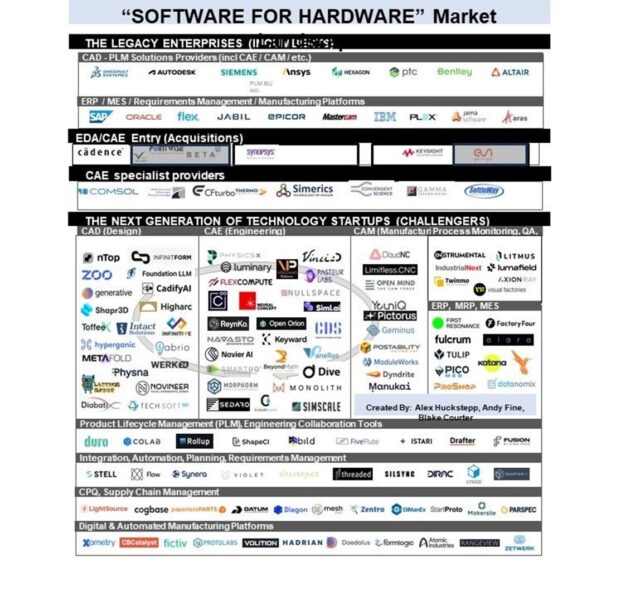
Andy Fine’s world — and welcome to it. Is there any company of consequence in the design and simulation world missing?
Andy Fine has been in the design and engineering software world for quite some time. He has learned a lot. Now, he wants to impart that knowledge to startups. He’s no VC shark, looking for a chunk of equity and taking up a board seat forever. Startups can retain Andy for as long as they wish. On retainer, Andy will take the time to study the startup and their business plan and, among other things, suggest a go-to-market strategy. Perhaps most importantly, he can help startups secure funding, which he has done twice.
Andy Fine’s world — and welcome to it. Is there any company of consequence in the design and simulation world missing?
The wide world of “Software for Hardware” is Andy’s backyard. He has worked for several of the companies above, dealt with many more and appears to be familiar with them all. Born in the UK and now outside Denver, Andy is the founder of Fine Physics. He has an extensive background in FEA and CFD, using it early on while earning a Master’s in Aeronautical Engineering from Cranfield University in the UK and a bachelor’s in aerospace engineering from the University of the West of England.
After a stint as a hardcore user, Andy quickly got into sales. His resume reads like a Who’s Who of simulation, including Ansys and Altair – and we’re only on the A’s.
Andy now seeks to apply what he has learned to help young companies, some with founders who may need to learn how to spell FEA or CFD, on how they can do more with simulation software and get to a better-finished product with fewer prototypes and testing.
With the surge of AI, there could be no better time to use simulation without knowing its intricacies. For those who insist on learning how, Andy is confident he can demystify the usually very daunting software.
I asked about the AI role in the simulation. To the two items on my AI-for-simulation wishlist (A, converging quickly to a solution and B, smart refinement of a mesh), Andy added another:
AI should be able to suggest shapes based on the stated design intent. The shapes would have been predetermined to be valid. Then, the simulation can analyze those shapes in all the necessary details and within the time available. A few good shapes are better than thousands of shapes, such as those generated by generative design programs.
What does Andy think about CAD companies trying to pass off every design tool as AI?
He laughs. “A lot of stuff is being placed under the AI umbrella.”
Also, Altair and SimScale are making smarter meshes, finer where they should be and coarse elsewhere.
Andy is working with a company that uses AI to generate 2D drawings from 3D models. Its ability to infer tolerances may put it ahead of established CAD companies that are also attempting to automate dimensioning.
His other company on retainer is Key Ward in Berlin, which he helped secure €1 million. Key Ward specializes in extracting valuable insights from massive datasets, including those generated by simulation programs. By using low-code instead of SQL queries or programming, they hope to develop systems that enable more engineers to use simulation intelligently, rather than the perception that CAD companies are just dumbing down the interface and giving it to untrained designers.
You can find out more about Andy Fine and connect with him on LinkedIn.
The construction industry, long characterized as slow to adopt technology, is being offered five tempting reasons to step it up. AMC Bridge, a CAD and BIM technology company, has isolated five uses of AI with the potential to change the way architects, contractors and builders design and manage construction projects.
LiDAR Scan-to-BIM Floor Planner
LiDAR (Light Detection and Ranging) technology has found a niche in the construction world, but usually in the form of expensive scanning systems with rotating scanners on tripods that generate massive point clouds. But what if you could use your iPhone, which actually has a LiDAR sensor? AMC Bridges’s Scan-to-BIM Floor Planner uses the iPhone to scan a physical space, leading to a usable, if not the most accurate, 3D model and floor plans. No expensive scanner. No point clouds. This app automates the creation of detailed 3D floor plans, drastically reducing the time needed to convert scanned data into usable BIM models.
Floor Plan Generator for Autodesk Revit
In real estate development, interior design, and facility management, creating optimized floor plans that meet specific design goals and space constraints can be a time-consuming challenge. The Floor Plan Generator for Autodesk Revit addresses this issue by using AI to quickly generate and visualize multiple design permutations in 3D. This tool enables architects to efficiently explore and optimize design alternatives, whether for new buildings or existing spaces. Factoring in elements such as natural light and space utilization helps create functional, well-designed floor plans tailored to specific needs. Automating the process also reduces costs by improving material estimation accuracy and boosting overall project efficiency. Additionally, the tool supports offline work, making it even more versatile across the design process.
The Architectural Chatbot for Revit
This app offers a cost-effective solution to streamline the design process for architects and engineers, who often spend significant time refining models, leading to delays and increased construction costs. By harnessing the power of AI, specifically the ChatGPT API, this tool assists in generating and modifying residential building floor plans during the initial design phase based on specific project requirements. It eliminates time-consuming manual procedures, enabling architects to quickly create and adjust design concepts. This not only speeds up the design process but also helps reduce delays and costs associated with construction projects.
Construction Quality and Progress Checker
This technology demonstrator is designed to address the inefficiencies, costs, and errors associated with manual site inspections in construction, architecture, real estate, and facility management. By utilizing machine learning, this tool identifies deviations from the design early in the construction process, ensuring projects stay on track and avoiding costly rework or delays. It helps resolve measurement inaccuracies and significantly reduces the time and effort required for manual inspection tasks, streamlining overall project progress and quality management.
Construction Coordination Issue Tracker
By leveraging digital twin technology, this app addresses the common challenge of communication breakdowns and delays in the construction process, where multiple stakeholders must collaborate effectively. By streamlining the workflow between design and construction teams, this issue tracker reduces the lag in information handoffs, minimizing misunderstandings and errors. It integrates with Autodesk Revit, allowing team collaboration and making issue management not an issue. Resolution of issues should be faster, leading to time and cost savings.
AMC Bridge Makes CAD Magic with AI
With these “demonstrators,” AMC Bridge has demonstrated its knowledge of AEC and identified multiple AI implementations that are bound to help architects, contractors, and builders use BIM better, faster, and more efficiently. Using an iPhone with the LiDAR Scan-to-BIM Floor Planner is much faster than measuring, making a hand sketch, input that information into CAD or BIM programs. The Floor Plan Generator for Autodesk Revit uses AMC Bridge’s easy-to-use sketching app to draw outside walls, doors and windows. Then generative design kicks in, offering multiple floor plans to choose from. There may be no faster way to get a whole bunch of layouts from Revit. With the Architectural Chatbot for Revit installed, you type in natural language commands like “Make me a floor plan of a house with a total area of 1500 square feet with three bedrooms, a living room, and two baths,” and Revit will do it. You want changes? Just ask. Like this: “Make an exterior door in the living room.”
Autodesk said this could not be done. Yet, AMC has done it. Since the beginning, CAD has insisted on using its own language, not ours. AMC Bridge, toiling away in war-torn Ukraine, has shown the CAD giant how it can be done.





 PT Hutama Karya used Bentley’s software to model Jakarta’s MRT Phase 2A, which involves building two underground stations. Hutama’s challenges included a dense urban population and geotechnical conditions. Using Bentley’s geotechnical software Leapfrog and PLAXIS for soil analysis improved soil data collection and analysis, saved the equivalent of $2.5 million. Hutama used SYNCHRO for 4D planning, ProjectWise and iTwin for digital twin collaboration and LumenRT. So much of the project was modeled digitally, making onsite inspections unnecessary 90% of the time.
To be continued…












 Born in the UK and now outside Denver, Andy is the founder of Fine Physics. He has an extensive background in FEA and CFD, using it early on while earning a Master’s in Aeronautical Engineering from Cranfield University in the UK and a bachelor’s in aerospace engineering from the University of the West of England.