STMicroelectronics Introduces STM32G5 MCUs for Power and Motor Control
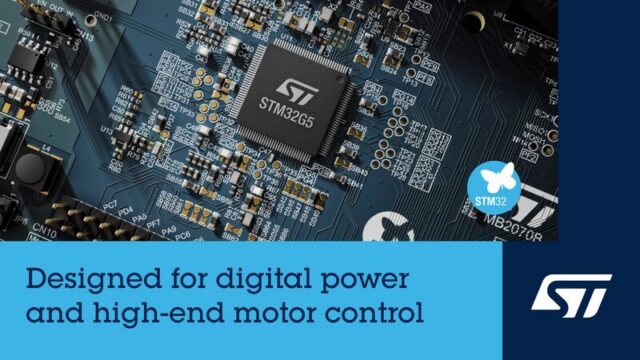
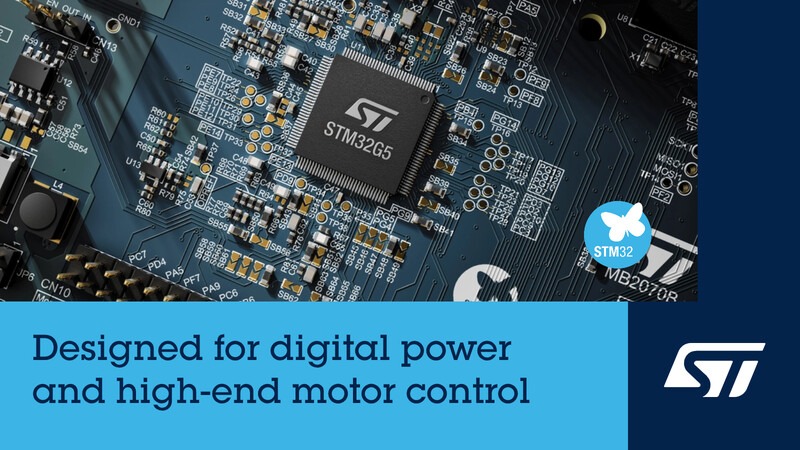
GENEVA, Switzerland, Nov 5, 2026 – STMicroelectronics (ST) has introduced the STM32G5 of mixed-signal microcontrollers (MCUs), featuring an Arm Cortex-M33 processor running at 280 MHz. The MCUs deliver twice the computing performance of the STM32G4 series and combine processing, analog control and hardware security features for digital power systems, motor control, robotics and industrial applications.
The STM32G5 series includes upgraded peripherals for controlling power supplies and electric motors. Applications include AI data centers, photovoltaic installations, wind turbines, industrial drives and commercial drones. ST also plans to expand the single-core portfolio with higher-performance dual-core devices offering additional peripherals in 2027.
Patrick Aidoune, general manager, general purpose and automotive microcontrollers division, STMicroelectronics, said: “This new generation of microcontrollers addresses the challenge to meet the growing energy needs of AI datacenters efficiently, realize more sophisticated humanoid robots, and power more complex motor-control systems. With the STM32G5 series, ST makes the compute performance needed for physical AI accessible and embeddable to deliver improvements that enhance sustainability, safety, and security.”
Digital Power and Motor Control
ST describes the STM32G5 as its first MCU with a 12-channel high-resolution timer. The series also includes motor-control timers, a position encoder and a programmable logic array (PLAy). These peripherals support precise control of power supplies and electric motors.
The timer supports control algorithms that adjust power supply operation as server workloads change. The MCUs also support higher switching frequencies in power supplies using silicon carbide (SiC) and gallium nitride (GaN) semiconductors.
“Digital power is at the heart of our mission to deliver innovative, clean, and energy-efficient solutions for a better tomorrow, and it requires control platforms that can keep pace with increasingly complex systems. The STM32G5 brings the level of performance and flexibility needed for next-generation digital-power applications. The combination of processing power, integrated peripherals, and built-in security makes it a strong option for our designs, helping deliver lower energy losses, a smaller footprint, and higher reliability in demanding AI and EV applications,” said Andy Hsiao, senior commodity buyer, PSBG materials division, Delta Electronics.
“In humanoid robotics, dexterity depends on combining strength, precision, sensing and real-time control in an extremely compact space,” said Paul Tian, Ruiyan Intelligent CEO. “The STM32G5 delivers more than twice the performance of the previous generation, more peripheral support and stronger built-in security needed to control more motors, respond faster when speed and precision matter, and integrate more sensors into the robotic hand. Together with ST, we’re bringing dexterous robotic hands closer to real-world use, from factory automation to medical laboratories, with the goal of making everyday life easier.”
Hardware Security and Processing Features
The PLAy peripheral allows developers to implement custom functions in on-chip hardware, reducing the need for external logic components.
Security features combine Arm TrustZone with ST’s STM32Trust technologies, including an immutable Root of Trust (STiRoT) for secure boot and firmware updates. The devices also provide a cryptographic engine supporting algorithms covered by ST’s post-quantum cryptography (PQC) libraries, software protection, secure storage for cryptographic keys, tamper detection, side-channel attack resistance and life cycle security management.
Additional hardware specifications include:
- Cortex-M33 processor delivering 420 DMIPS and 1,136 CoreMark at 280 MHz.
- Instruction and data caches and a routine booster for processing acceleration.
- A 12-bit analog-to-digital converter (ADC), operational amplifier, 12-bit digital-to-analog converter (DAC) and ultra-fast comparators.
- Motor-control timers and a position encoder (POSENC).
- Low-profile quad flat package (LQFP) options in two variants, including a thermally enhanced exposed-pad version required for data center power applications.
Development Tools and Software
ST supports the STM32G5 series with hardware development boards, software libraries, documentation and training resources for digital power and motor-control applications.
The devices are supported by STM32CubeMX2, which provides live code previews, graphical configuration tools, clock and pinout configuration features, and online documentation. The new STM32Cube hardware abstraction layer (HAL2) provides access to STM32G5 hardware features with an optimized memory footprint.
Development resources include:
- NUCLEO-G564RE: STM32 Nucleo board with an STM32G5-512K device in an LQFP64 package.
- B-G564E-MC1S: Motor Control Discovery Kit.
- B-G564E-DPOW1: Digital Power Discovery Kit.
- X-CUBE-DPOWER: Digital power software libraries.
- X-CUBE-MCSDK: Motor-control software development kit.
The STM32G5 series is now in production, with performance and product lines offering 64 KB to 512 KB of on-chip flash memory.
Source: STMicroelectronics
About STMicroelectronics
STMicroelectronics (ST) is a semiconductor company founded in 1987. It designs and manufactures microcontrollers, sensors, power devices and other analog and mixed-signal components. The company operates as an integrated device manufacturer with in-house production that supports large-volume supply for global markets. Its customers include automotive, industrial, consumer electronics and communications equipment manufacturers. ST also works with technology partners to develop components used in mobility systems, energy and power management equipment and connected devices. The company reports ongoing efforts to reduce emissions across its operations and increase the share of renewable electricity in its manufacturing sites, with a goal to reach full renewable sourcing by 2027. ST is headquartered in Geneva, Switzerland. It serves more than 200,000 customers worldwide and employs about 50,000 people. Its technologies support applications that require efficient power conversion, sensing, processing and connectivity. The company expands its portfolio to support automotive, industrial, consumer and connected system applications through integrated design and manufacturing.